Soya Shingo, Sakurai Takeshi
Faculty of Medicine/International Institute for Integrative Sleep Medicine (WPI-IIIS), University of Tsukuba, Tsukuba, Japan.
Front Neurosci. 2020 Jul 10;14:691. doi: 10.3389/fnins.2020.00691. eCollection 2020.
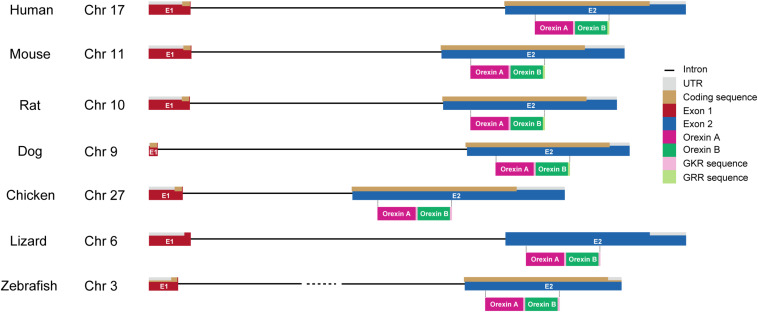
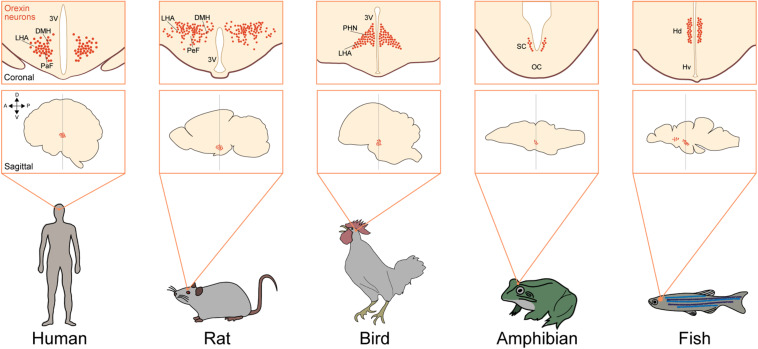
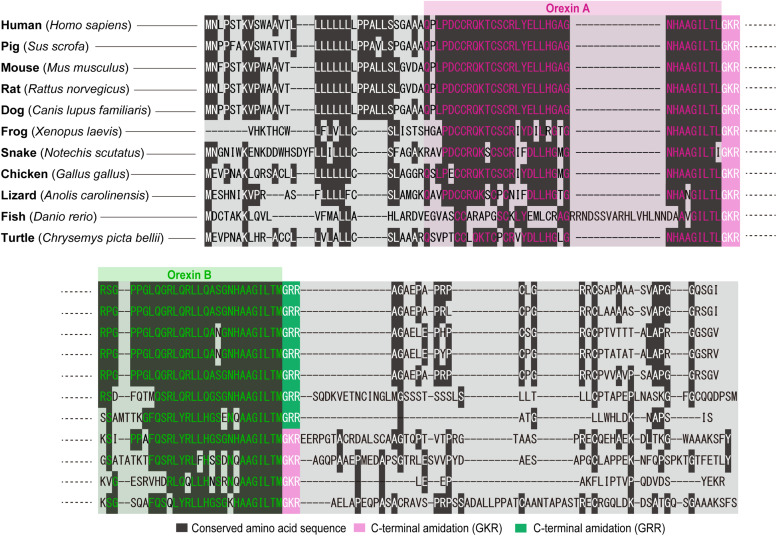
Orexins are hypothalamic neuropeptides that were initially identified in the rat brain as endogenous ligands for an (previously) orphan G-protein-coupled receptor (GPCR). They are multitasking peptides involved in many physiological functions, including regulation of feeding behavior, wakefulness and autonomic/neuroendocrine functions, and sleep/wakefulness states in mammals. There are two isopeptides of orexin, orexin A and orexin B, which are produced from a common precursor peptide, prepro-orexin. Structures of orexins, as well as orexin genes, are highly conserved throughout mammalian species, suggesting strong evolutionary pressure that maintains the structures. Their lengths and structure suggested that orexin B is the ancestral form of the orexin neuropeptide. In mammals, orexins bind to two subtypes of GPCRs, i.e., orexin 1 receptor (OX1R) and orexin 2 receptor (OX2R). Phylogenetically, the orexin system is present exclusively in vertebrates. In genomes of species outside mammals, there is only one orexin receptor, which is similar to OX2R, suggesting that OX2R is the prototype receptor for orexins. OX1R is likely to have evolved during early mammalian evolution. Orexin-producing neurons (orexin neurons) are mainly located in the lateral hypothalamic area (LHA) in mammals and are also found in hypothalamic regions in many other vertebrates. Orexins are likely to be closely related to the regulation of active, motivated behavior in many species. The orexin system seems to have evolved as a system that supports active and purposeful behavior which is closely related with wakefulness.
食欲素是下丘脑神经肽,最初在大鼠脑中被鉴定为一种(之前的)孤儿G蛋白偶联受体(GPCR)的内源性配体。它们是多功能肽,参与许多生理功能,包括调节哺乳动物的摄食行为、觉醒以及自主神经/神经内分泌功能和睡眠/觉醒状态。食欲素有两种异肽,即食欲素A和食欲素B,它们由共同的前体肽前食欲素原产生。食欲素的结构以及食欲素基因在整个哺乳动物物种中高度保守,这表明存在维持这些结构的强大进化压力。它们的长度和结构表明食欲素B是食欲素神经肽的原始形式。在哺乳动物中,食欲素与两种GPCR亚型结合,即食欲素1受体(OX1R)和食欲素2受体(OX2R)。从系统发育角度来看,食欲素系统仅存在于脊椎动物中。在非哺乳动物物种的基因组中,只有一种与OX2R相似的食欲素受体,这表明OX2R是食欲素的原型受体。OX1R可能在哺乳动物早期进化过程中演化而来。产生食欲素的神经元(食欲素神经元)主要位于哺乳动物的下丘脑外侧区(LHA),在许多其他脊椎动物的下丘脑区域也有发现。食欲素可能与许多物种中主动的、有动机的行为调节密切相关。食欲素系统似乎是作为一种支持与觉醒密切相关的主动和有目的行为的系统而进化的。