Eidel Matthias, Kübler Andrea
Institute of Psychology, University of Würzburg, Würzburg, Germany.
Front Hum Neurosci. 2020 Jul 10;14:265. doi: 10.3389/fnhum.2020.00265. eCollection 2020.
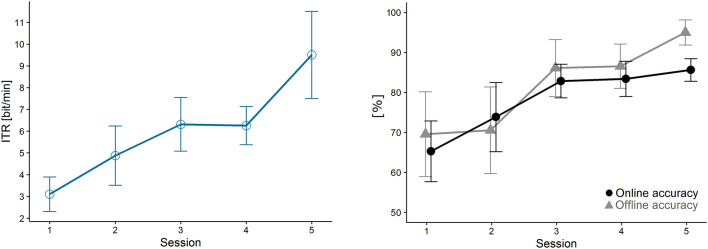
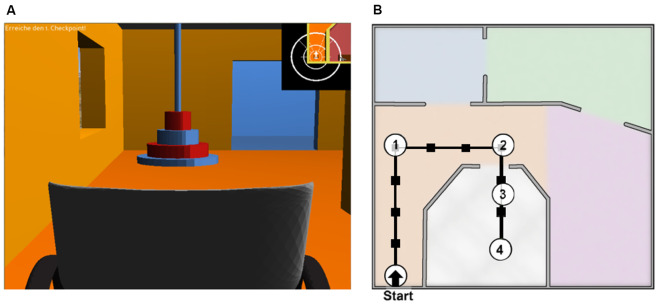
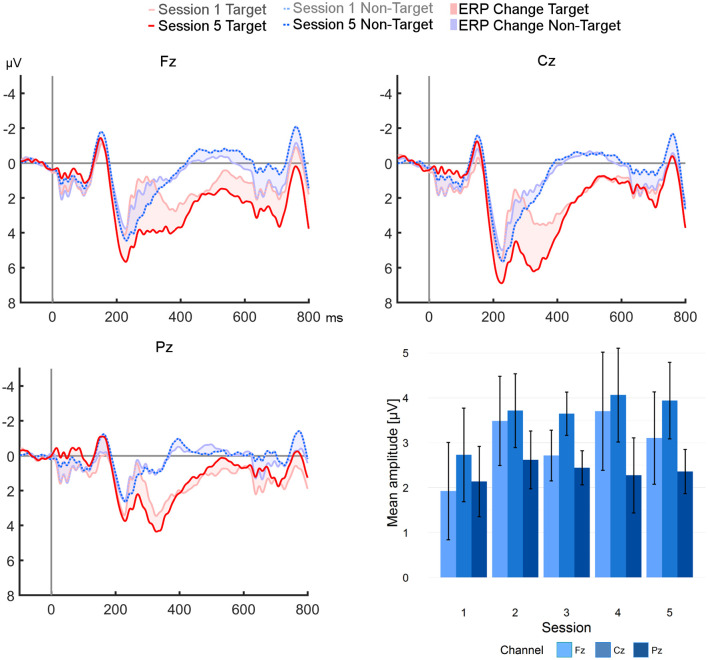
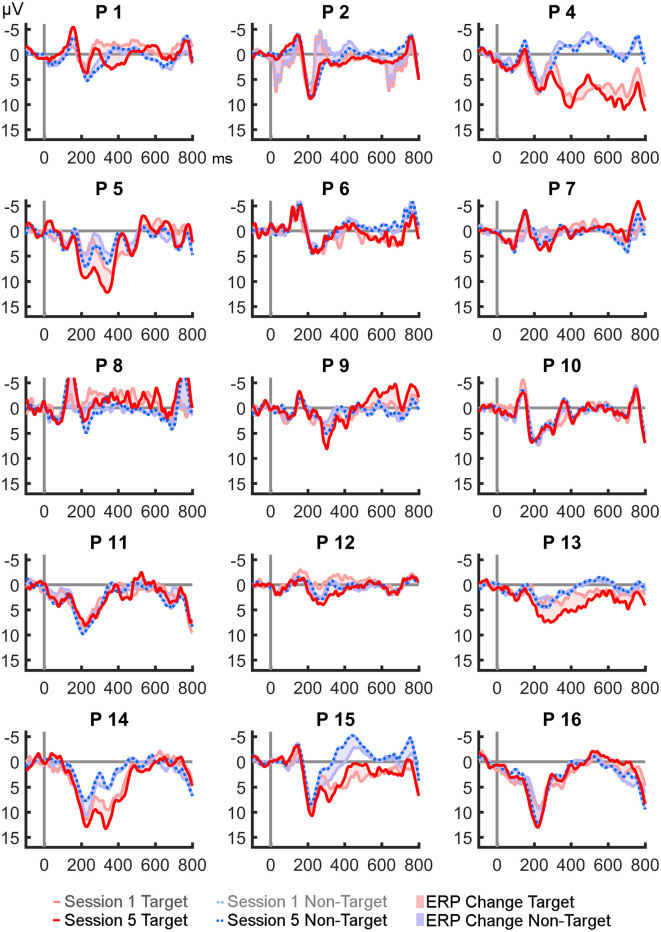
Tactile stimulation is less frequently used than visual for brain-computer interface (BCI) control, partly because of limitations in speed and accuracy. Non-visual BCI paradigms, however, may be required for patients who struggle with vision dependent BCIs because of a loss of gaze control. With the present study, we attempted to replicate earlier results by Herweg et al. (2016), with several minor adjustments and a focus on training effects and usability. We invited 16 healthy participants and trained them with a 4-class tactile P300-based BCI in five sessions. Their main task was to navigate a virtual wheelchair through a 3D apartment using the BCI. We found significant training effects on information transfer rate (ITR), which increased from a mean of 3.10-9.50 bits/min. Further, both online and offline accuracies significantly increased with training from 65% to 86% and 70% to 95%, respectively. We found only a descriptive increase of P300 amplitudes at Fz and Cz with training. Furthermore, we report subjective data from questionnaires, which indicated a relatively high workload and moderate to high satisfaction. Although our participants have not achieved the same high performance as in the Herweg et al. (2016) study, we provide evidence for training effects on performance with a tactile BCI and confirm the feasibility of the paradigm.
在脑机接口(BCI)控制中,触觉刺激的使用频率低于视觉刺激,部分原因是其在速度和准确性方面存在局限性。然而,对于因失去注视控制而难以使用依赖视觉的BCI的患者,可能需要非视觉BCI范式。在本研究中,我们试图重复Herweg等人(2016年)的早期研究结果,进行了一些小的调整,并重点关注训练效果和可用性。我们邀请了16名健康参与者,并在五个阶段使用基于4类触觉P300的BCI对他们进行训练。他们的主要任务是使用BCI在一个3D公寓中操控虚拟轮椅。我们发现信息传输率(ITR)有显著的训练效果,其平均值从3.10比特/分钟提高到了9.50比特/分钟。此外,在线和离线准确率随着训练分别从65%显著提高到86%和从70%显著提高到95%。我们发现随着训练,Fz和Cz处的P300波幅仅出现了描述性的增加。此外,我们报告了问卷调查中的主观数据,这些数据表明工作量相对较高,满意度为中等至高。尽管我们的参与者没有达到Herweg等人(2016年)研究中的相同高性能,但我们提供了关于触觉BCI训练对性能影响的证据,并证实了该范式的可行性。