Halder Sebastian, Takano Kouji, Kansaku Kenji
Systems Neuroscience Section, Department of Rehabilitation for Brain Functions, Research Institute of National Rehabilitation Center for Persons with Disabilities, Tokorozawa, Saitama, Japan.
Department of Molecular Medicine, University of Oslo, Oslo, Norway.
Front Hum Neurosci. 2018 Jun 6;12:228. doi: 10.3389/fnhum.2018.00228. eCollection 2018.
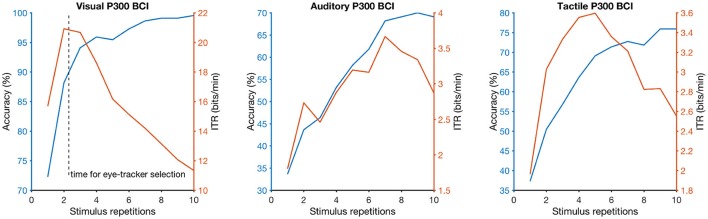
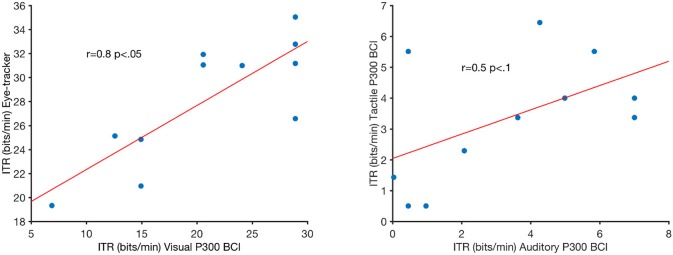
Severe motor impairments can affect the ability to communicate. The ability to see has a decisive influence on the augmentative and alternative communication (AAC) systems available to the user. To better understand the initial impressions users have of AAC systems we asked naïve healthy participants to compare two visual (a visual P300 brain-computer interface (BCI) and an eye-tracker) and two non-visual systems (an auditory and a tactile P300 BCI). Eleven healthy participants performed 20 selections in a five choice task with each system. The visual P300 BCI used face stimuli, the auditory P300 BCI used Japanese Hiragana syllables and the tactile P300 BCI used a stimulator on the small left finger, middle left finger, right thumb, middle right finger and small right finger. The eye-tracker required a dwell time of 3 s on the target for selection. We calculated accuracies and information-transfer rates (ITRs) for each control method using the selection time that yielded the highest ITR and an accuracy above 70% for each system. Accuracies of 88% were achieved with the visual P300 BCI (4.8 s selection time, 20.9 bits/min), of 70% with the auditory BCI (19.9 s, 3.3 bits/min), of 71% with the tactile BCI (18 s, 3.4 bits/min) and of 100% with the eye-tracker (5.1 s, 28.2 bits/min). Performance between eye-tracker and visual BCI correlated strongly, correlation between tactile and auditory BCI performance was lower. Our data showed no advantage for either non-visual system in terms of ITR but a lower correlation of performance which suggests that choosing the system which suits a particular user is of higher importance for non-visual systems than visual systems.
严重的运动障碍会影响沟通能力。视力对用户可使用的辅助和替代沟通(AAC)系统具有决定性影响。为了更好地了解用户对AAC系统的初始印象,我们让未经培训的健康参与者比较两种视觉系统(一种视觉P300脑机接口(BCI)和一种眼动仪)以及两种非视觉系统(一种听觉P300 BCI和一种触觉P300 BCI)。11名健康参与者在一个五选任务中对每个系统进行了20次选择。视觉P300 BCI使用面部刺激,听觉P300 BCI使用日语平假名字母音节,触觉P300 BCI在左手小指、左手中指、右手拇指、右手中指和右手小指上使用刺激器。眼动仪需要在目标上停留3秒以进行选择。我们使用产生最高信息传输率(ITR)且每个系统准确率高于70%的选择时间,计算了每种控制方法的准确率和信息传输率(ITR)。视觉P300 BCI的准确率达到88%(选择时间4.8秒,20.9比特/分钟),听觉BCI为70%(19.9秒,3.3比特/分钟),触觉BCI为71%(18秒,3.4比特/分钟),眼动仪为100%(5.1秒,28.2比特/分钟)。眼动仪和视觉BCI之间的性能相关性很强,触觉和听觉BCI性能之间的相关性较低。我们的数据表明,就ITR而言,两种非视觉系统均无优势,但性能相关性较低,这表明对于非视觉系统而言,选择适合特定用户的系统比视觉系统更为重要。