Center of Infectious Disease, West China Hospital, Sichuan University, 37 Guoxue Lane, Chengdu, 610041, China.
West China Biomedical Big Data Center, West China Hospital, Sichuan University, Chengdu, China.
BMC Infect Dis. 2020 Aug 5;20(1):571. doi: 10.1186/s12879-020-05287-x.
The incidence of cryptococcal meningitis (CM) has gradually increased in recent years. Cerebrospinal fluid (CSF) cytology and cell count are very important for CM on etiology diagnosis and assessment of disease status and therapeutic response. However, the clinical significance of CSF white cell count (WCC) in CM patients is not fully understood. Using longitudinal data of CSF WCC and its relationship with clinical outcomes in CM patients, we aimed to elucidate the clinical significance of this test.
We retrospectively analyzed the medical records of 150 CM patients admitted to our hospital between January 2008 and December 2018.
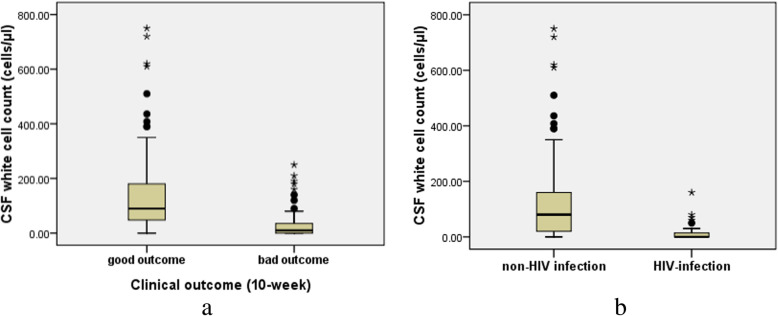
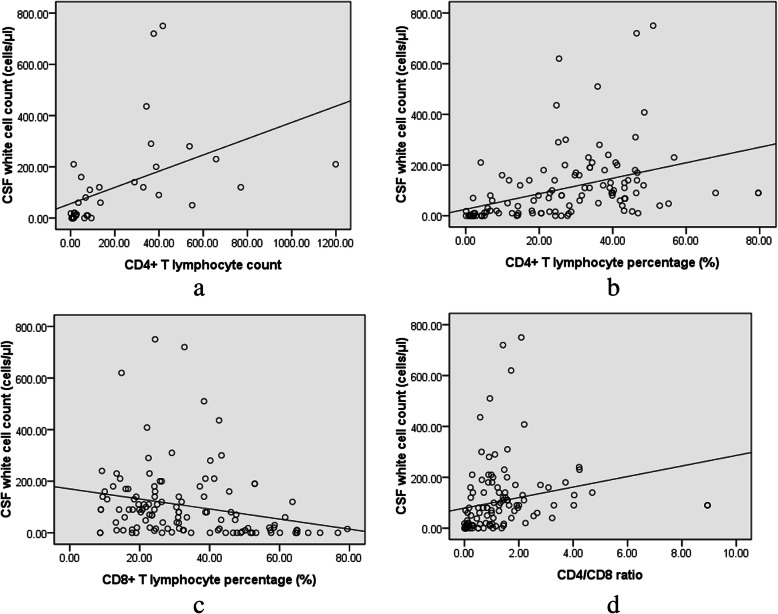
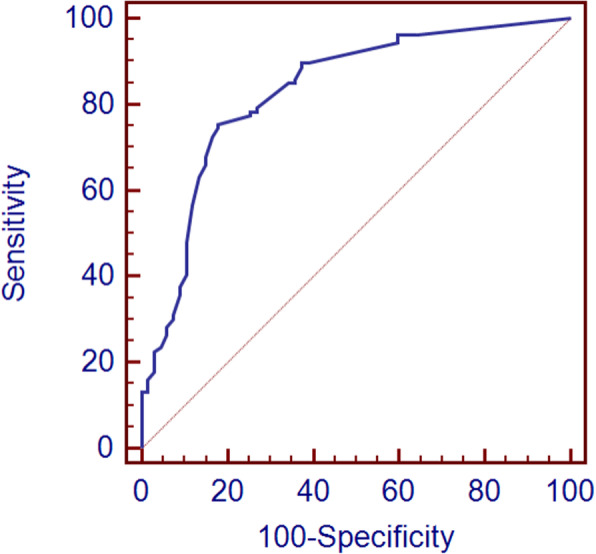
CM patients with lower baseline CSF WCC, CSF protein concentration or CD4/CD8 ratio, and those with altered mentation or HIV coinfection were more likely to have poor clinical outcome (P<0.05). CM patients with triple therapy during the induction period presented with a better clinical outcome (P<0.05). Baseline CSF WCC had a moderate positive correlation with peripheral CD4+ T lymphocyte count (r = 0.738, P < 0.001) and CD4+ T lymphocyte percentage (r = 0.616, P < 0.001). The best cut-off value to predict a poor clinical outcome was 40 cells/μL during baseline CSF WCC. The predictive model incorporating longitudinal data of CSF WCC had better sensitivity, specificity, and accuracy than a model incorporating only baseline CSF WCC data.
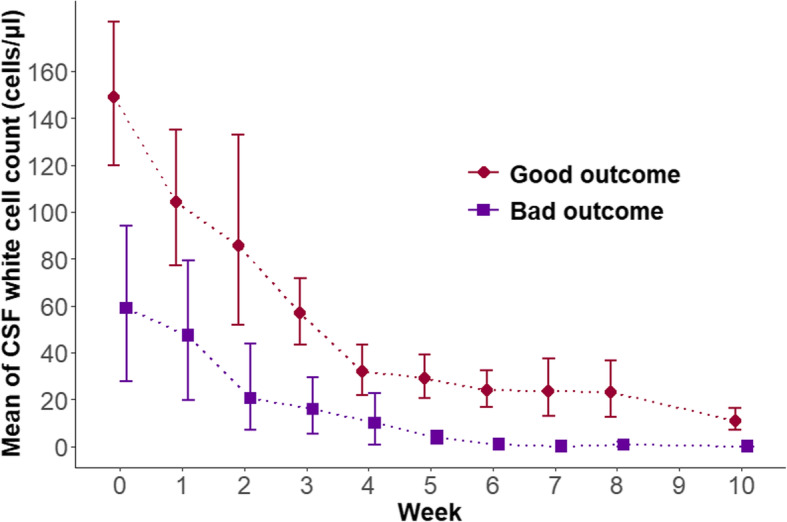
Our results indicated that baseline CSF WCC and changes in CSF WCC over time could be used to assess the prognosis of CM patients.
近年来,隐球菌性脑膜炎(CM)的发病率逐渐增高。脑脊液(CSF)细胞学和细胞计数对于隐球菌性脑膜炎的病因诊断、疾病状态评估和治疗反应非常重要。然而,CSF 白细胞计数(WCC)在 CM 患者中的临床意义尚未完全明确。本研究旨在通过 CM 患者的 CSF WCC 纵向数据及其与临床结局的关系,阐明该检测的临床意义。
我们回顾性分析了 2008 年 1 月至 2018 年 12 月我院收治的 150 例 CM 患者的病历资料。
基线 CSF WCC、CSF 蛋白浓度或 CD4/CD8 比值较低、意识改变或合并 HIV 感染的 CM 患者更可能预后不良(P<0.05)。诱导期接受三联治疗的 CM 患者临床结局更好(P<0.05)。基线 CSF WCC 与外周血 CD4+T 淋巴细胞计数(r = 0.738,P < 0.001)和 CD4+T 淋巴细胞百分比(r = 0.616,P < 0.001)呈中度正相关。预测基线 CSF WCC 预后不良的最佳截断值为 40 cells/μL。纳入 CSF WCC 纵向数据的预测模型比仅纳入基线 CSF WCC 数据的预测模型具有更高的敏感性、特异性和准确性。
本研究结果表明,基线 CSF WCC 及 CSF WCC 随时间的变化可用于评估 CM 患者的预后。