Graduate Institute of Medical Sciences, College of Medicine, Taipei Medical University, Taipei 11031, Taiwan.
Department of Microbiology & Immunology, Dalhousie University, Halifax, NS B3H 4R2, Canada.
Viruses. 2020 Aug 4;12(8):852. doi: 10.3390/v12080852.
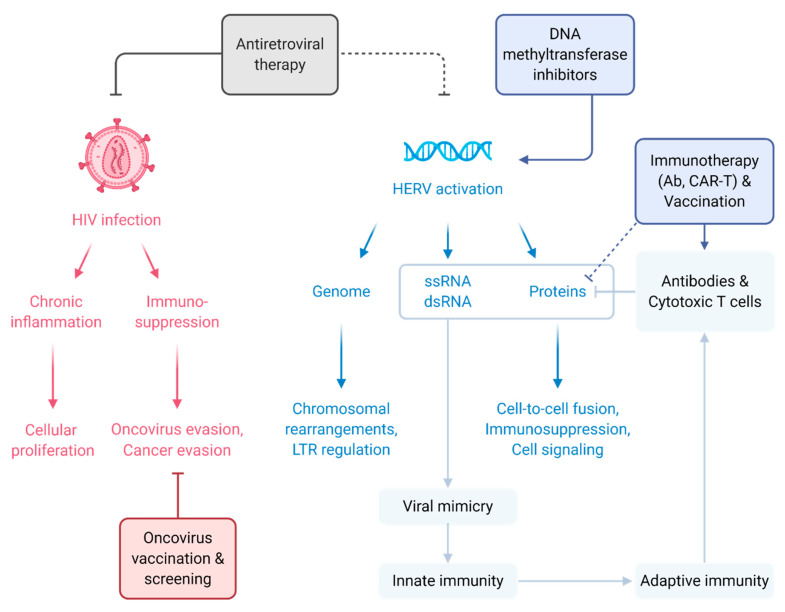
Animal retroviruses are known for their transforming potential, and this is also true for the ones hosted by humans, which have gathered expanding attention as one of the potent causative agents in various disease, including specific cancer types. For instance, Human T Lymphotropic virus (HTLV) is a well-studied class of oncoviruses causing T cell leukemia, while human immunodeficiency virus (HIV) leads to acquired immunodeficiency syndrome (AIDS), which is linked to a series of defining cancers including Kaposi sarcoma, certain types of non-Hodgkin lymphoma, and cervical cancer. Of note, in addition to these "modern" exogenous retroviruses, our genome harbors a staggering number of human endogenous retroviruses (HERVs). HERVs are the genetic remnants of ancient retroviral germline infection of human ancestors and are typically silenced in normal tissues due to inactivating mutations and sequence loss. While some HERV elements have been appropriated and contribute to human physiological functions, others can be reactivated through epigenetic dysregulations to express retroviral elements and promote carcinogenesis. Conversely, HERV replication intermediates or protein products can also serve as intrinsic pathogen-associated molecular patterns that cause the immune system to interpret it as an exogenous infection, thereby stimulating immune responses against tumors. As such, HERVs have also been targeted as a potential internal strategy to sensitize tumor cells for promising immunotherapies. In this review, we discuss the dynamic role of human retroviruses in cancer development, focusing on HIV and HERVs contribution. We also describe potential treatment strategies, including immunotherapeutic targeting of HERVs, inhibiting DNA methylation to expose HERV signatures, and the use of antiretroviral drugs against HIV and HERVs, which can be employed as prospective anti-cancer modalities.
动物逆转录病毒以其转化潜能而闻名,人类携带的逆转录病毒也是如此,它们作为各种疾病(包括特定癌症类型)的潜在致病因子之一,引起了越来越多的关注。例如,人类 T 淋巴细胞白血病病毒(HTLV)是一类研究充分的致癌逆转录病毒,可导致 T 细胞白血病,而人类免疫缺陷病毒(HIV)导致获得性免疫缺陷综合征(AIDS),这与一系列明确的癌症有关,包括卡波西肉瘤、某些类型的非霍奇金淋巴瘤和宫颈癌。值得注意的是,除了这些“现代”外源性逆转录病毒外,我们的基因组还含有大量的人类内源性逆转录病毒(HERV)。HERV 是人类祖先远古逆转录病毒种系感染的遗传残余物,由于失活突变和序列丢失,通常在正常组织中沉默。虽然一些 HERV 元件已被利用并有助于人类生理功能,但其他元件可通过表观遗传失调重新激活,表达逆转录病毒元件并促进致癌作用。相反,HERV 复制中间体或蛋白产物也可作为固有病原体相关分子模式,使免疫系统将其解释为外源性感染,从而刺激针对肿瘤的免疫反应。因此,HERV 也被作为一种潜在的内部策略,用于使肿瘤细胞对有前途的免疫疗法敏感。在这篇综述中,我们讨论了人类逆转录病毒在癌症发展中的动态作用,重点讨论了 HIV 和 HERV 的作用。我们还描述了潜在的治疗策略,包括针对 HERV 的免疫治疗靶向、抑制 DNA 甲基化以暴露 HERV 特征以及使用抗逆转录病毒药物针对 HIV 和 HERV,这些策略可作为有前途的抗癌方式。