Amanzio Martina, Bartoli Massimo, Cipriani Giuseppina Elena, Palermo Sara
Department of Psychology, University of Turin, Turin, Italy.
European Innovation Partnership on Active and Healthy Ageing, Brussels, Belgium.
Front Psychol. 2020 Jul 14;11:1697. doi: 10.3389/fpsyg.2020.01697. eCollection 2020.
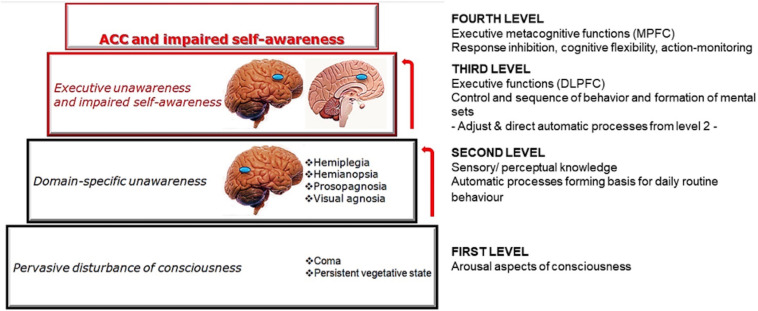
Awareness of deficits in patients with neurological disorders may be described as a theoretical unitary phenomenon, which has been analysed reaching interesting results in the last decades. Awareness of deficits manifests itself in a continuum ranging from full awareness to total absence. In line with a neurocognitive approach, a reduction in self-awareness could be explained considering executive dysfunction associated with prefrontal cortex anatomo-functional changes. Our mini-review will focus on reduced self-awareness in neurological disorders, such as Alzheimer's disease, behavioural Frontotemporal Dementia and Acquired Brain Injuries. Results achieved thanks to an explanatory investigative approach combined with a theoretical reference model will be presented. Data suggest the key role of executive functions in supporting adequate self-awareness towards patients' cognitive-behavioural profile and instrumental activity autonomy. The Cognitive Awareness Model seems to be one of the best theoretical model to better approach this phenomenon.
对神经疾病患者缺陷的认知可被描述为一种理论上的单一现象,在过去几十年里,对这一现象的分析取得了有趣的结果。对缺陷的认知表现为一个连续体,范围从完全意识到完全缺失。根据神经认知方法,考虑到与前额叶皮质解剖功能变化相关的执行功能障碍,可以解释自我意识的降低。我们的小型综述将聚焦于神经疾病中自我意识的降低,如阿尔茨海默病、行为性额颞叶痴呆和获得性脑损伤。将展示通过解释性研究方法与理论参考模型相结合所取得的结果。数据表明执行功能在支持患者对自身认知行为特征和工具性活动自主性的充分自我意识方面起着关键作用。认知意识模型似乎是更好地处理这一现象的最佳理论模型之一。