Department of Psychiatry, Austin Health, University of Melbourne, LTB10, 145 Studley Road, Heidelberg, VIC, 3084, Australia.
Department of Psychiatry, The Melbourne Clinic, University of Melbourne, Richmond, VIC, Australia.
BMC Psychiatry. 2020 Aug 6;20(1):397. doi: 10.1186/s12888-020-02793-9.
Most patients with Posttraumatic Stress Disorder (PTSD) suffer residual symptoms following first-line treatment. Oxidative stress has been implicated in the pathophysiology of PTSD. N-acetylcysteine (NAC) is a precursor of the brain's primary antioxidant, glutathione, and may diminish oxidative cellular damage. An 8-week pilot study of NAC in veterans with PTSD found that symptoms were significantly reduced in the NAC group compared to placebo. This study aims to confirm these findings with a larger sample in a double-blind, placebo-controlled trial to further explore the efficacy of NAC as an adjunctive therapy in treatment-resistant PTSD.
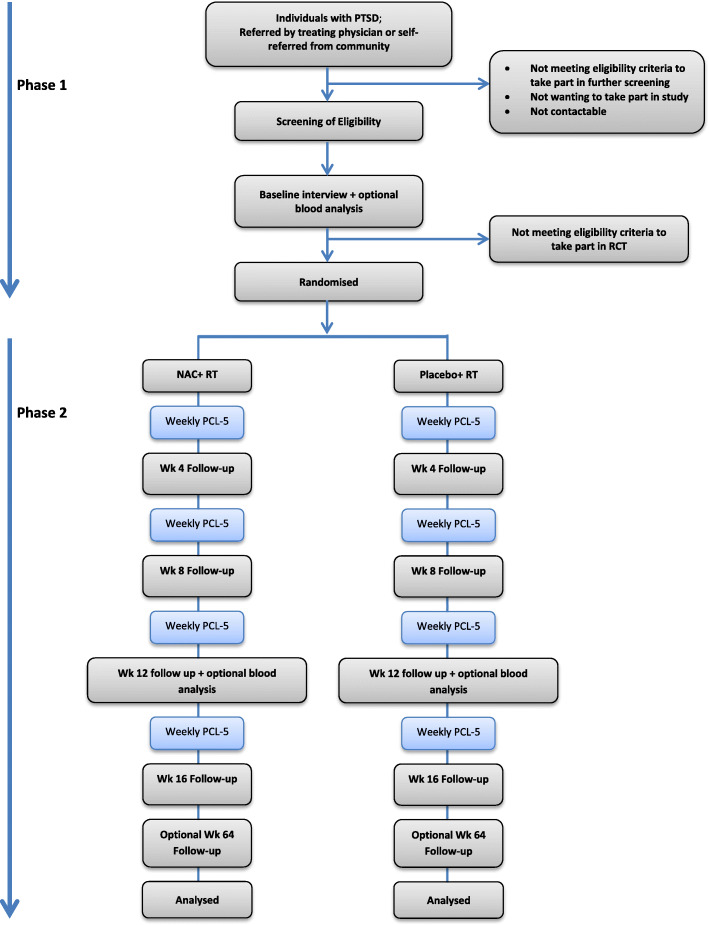
A multicentre, randomised, double-blind, placebo-controlled trial for adult patients who still meet criteria for PTSD following first-line treatment. The intervention comprises either NAC as a fixed dose regime of 2.7 g/day (900 mg three times daily) administered orally for 12 weeks, or placebo. Standard care for PTSD will continue in addition, including other pharmacotherapies. Detailed clinical data will be collected at randomisation and weeks 4, 8, 12, 16, and 64 post-randomisation, with self-report measures completed weekly from baseline to 16 weeks and at 64 weeks post-randomisation. Blood-based biomarkers will be collected at baseline and 12 weeks to assess the mechanism of effect. The primary outcome measure will be change in Clinician-Administered PTSD Scale for DSM-5 at 12 weeks compared with baseline. Secondary outcomes will be change in quality of life, depression, anxiety, substance use and craving, and somatic symptoms. With 126 completed participants (63 per arm), the study is powered at 80% to detect a true difference in the primary outcome measure using a two-tailed analysis with alpha = 0.05, beta = 0.2.
This is the first multicentre, double blind, randomised, placebo-controlled trial of adjunctive NAC for treatment-resistant PTSD. NAC has an established safety profile, is readily available and easy to administer, and has a favourable tolerability profile, therefore making it an attractive adjunctive therapy. Inclusion of blood analyses to assess potential target engagement biomarkers of oxidative stress and neuroinflammation may help gauge the biological mechanisms of effect of NAC.
ACTRN12618001784202, retrospectively registered 31/10/2018, URL: http://www.anzctr.org.au/Trial/Registration/TrialReview.aspx?id=376004 .
大多数创伤后应激障碍(PTSD)患者在一线治疗后仍有残留症状。氧化应激与 PTSD 的病理生理学有关。N-乙酰半胱氨酸(NAC)是大脑主要抗氧化剂谷胱甘肽的前体,可能减少氧化细胞损伤。一项针对 PTSD 退伍军人的 NAC 为期 8 周的试点研究发现,与安慰剂组相比,NAC 组的症状明显减轻。本研究旨在通过一项更大样本的双盲、安慰剂对照试验证实这些发现,以进一步探讨 NAC 作为治疗抵抗性 PTSD 的辅助治疗的疗效。
这是一项多中心、随机、双盲、安慰剂对照试验,纳入了在一线治疗后仍符合 PTSD 标准的成年患者。干预措施包括 NAC 固定剂量方案,每天 2.7g(每天 900mg,分 3 次服用),持续 12 周,或安慰剂。此外,还将为 PTSD 患者提供标准护理,包括其他药物治疗。随机化时和随机化后第 4、8、12、16 和 64 周收集详细的临床数据,自我报告量表从基线到 16 周和随机化后 64 周每周完成一次。基线和 12 周时采集血液生物标志物,以评估作用机制。主要结局测量指标为 12 周时与基线相比,DSM-5 临床医生管理 PTSD 量表的变化。次要结局测量指标为生活质量、抑郁、焦虑、物质使用和渴求以及躯体症状的变化。完成 126 名参与者(每组 63 名)的研究,使用双侧分析(alpha=0.05,beta=0.2),检测主要结局测量指标的真实差异,具有 80%的功率。
这是第一项关于辅助 NAC 治疗治疗抵抗性 PTSD 的多中心、双盲、随机、安慰剂对照试验。NAC 具有良好的安全性、易于获得和管理,并且具有良好的耐受性,因此是一种有吸引力的辅助治疗方法。纳入血液分析以评估氧化应激和神经炎症的潜在靶向生物标志物,可能有助于评估 NAC 的作用机制。
ACTRN12618001784202,回顾性注册于 2018 年 10 月 31 日,网址:http://www.anzctr.org.au/Trial/Registration/TrialReview.aspx?id=376004。