Institute of Bioprocess Engineering and Pharmaceutical Technology, University of Applied Sciences Mittelhessen (THM), Giessen, Germany.
Department of Immunology, University of Tuebingen, Tuebingen, Germany.
J Biotechnol. 2020 Nov 10;323:62-72. doi: 10.1016/j.jbiotec.2020.07.023. Epub 2020 Aug 5.
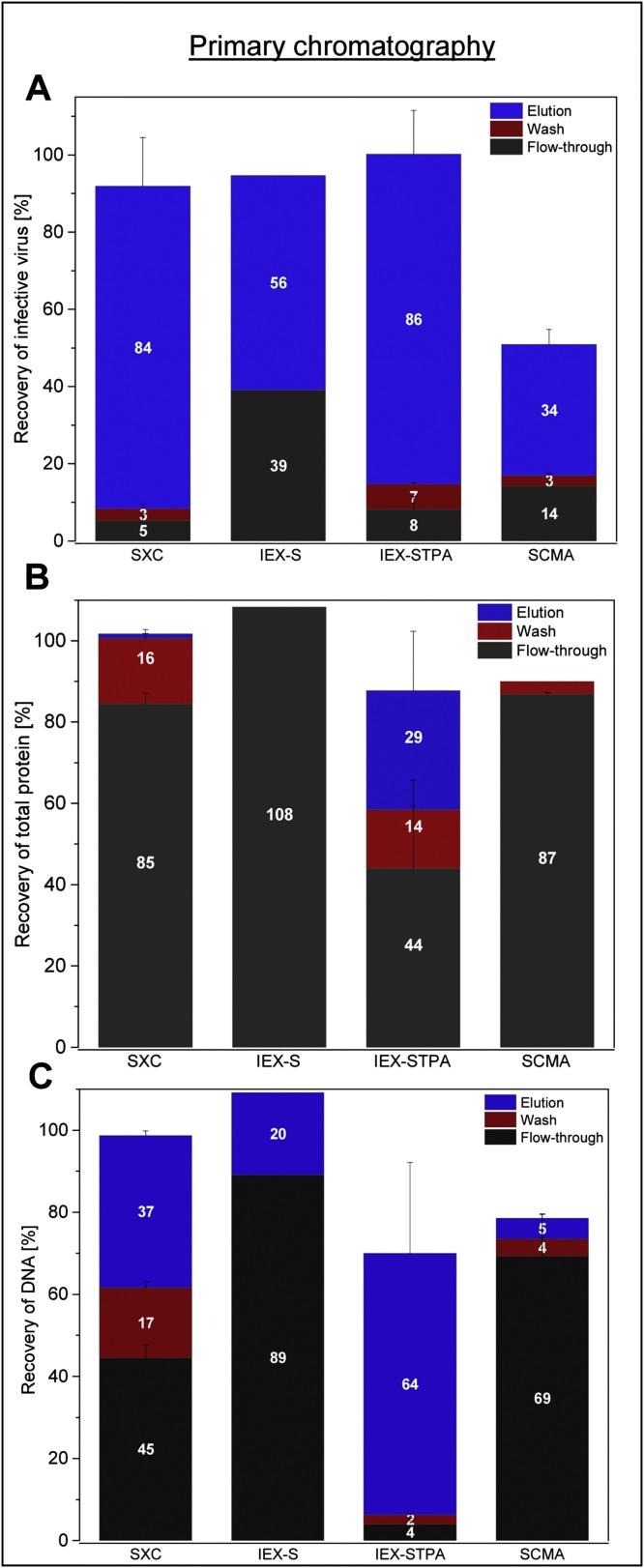
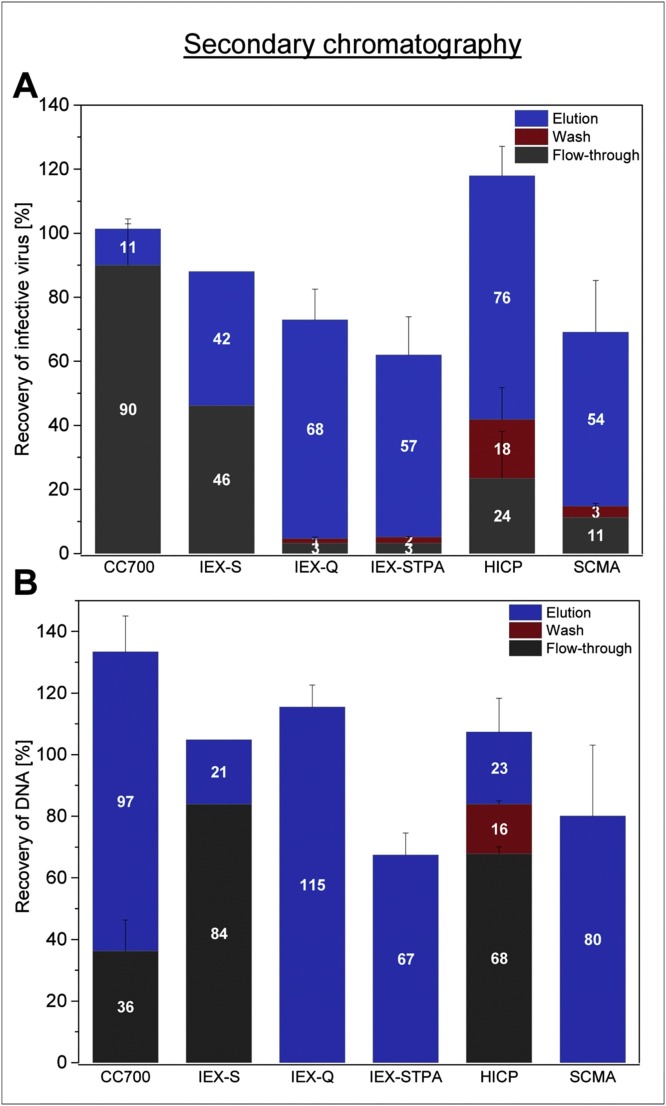
In recent years, the Orf virus has become a promising tool for protective recombinant vaccines and oncolytic therapy. However, suitable methods for an Orf virus production, including up- and downstream, are very limited. The presented study focuses on downstream processing, describing the evaluation of different chromatographic unit operations. In this context, ion exchange-, pseudo-affinity- and steric exclusion chromatography were employed for the purification of the cell culture-derived Orf virus, aiming at a maximum in virus recovery and contaminant depletion. The most promising chromatographic methods for capturing the virus particles were the steric exclusion- or salt-tolerant anion exchange membrane chromatography, recovering 84 % and 86 % of the infectious virus. Combining the steric exclusion chromatography with a subsequent Capto™ Core 700 resin or hydrophobic interaction membrane chromatography as a secondary chromatographic step, overall virus recoveries of up to 76 % were achieved. Furthermore, a complete cellular protein removal and a host cell DNA depletion of up to 82 % was possible for the steric exclusion membranes and the Capto™ Core 700 combination. The study reveals a range of possible unit operations suited for the chromatographic purification of the cell culture-derived Orf virus, depending on the intended application, i.e. a human or veterinary use, and the required purity.
近年来,口疮病毒已成为保护性重组疫苗和溶瘤治疗的有前途的工具。然而,口疮病毒的生产方法(包括上下游)非常有限。本研究侧重于下游处理,描述了不同色谱单元操作的评估。在这方面,离子交换、拟亲和和排阻色谱被用于纯化细胞培养衍生的口疮病毒,旨在最大限度地提高病毒回收率和减少污染物。最有前途的用于捕获病毒颗粒的色谱方法是排阻或耐盐阴离子交换膜色谱,可回收 84%和 86%的感染性病毒。将排阻色谱与随后的 Capto Core 700 树脂或疏水性相互作用膜色谱结合作为二级色谱步骤,可实现高达 76%的总病毒回收率。此外,对于排阻膜和 Capto Core 700 组合,可以实现高达 82%的完整细胞蛋白去除和宿主细胞 DNA 耗尽。该研究揭示了一系列可能的单元操作,适用于细胞培养衍生的口疮病毒的色谱纯化,具体取决于预期的应用,即人类或兽医用途,以及所需的纯度。