McCaskey Ursina, von Aster Michael, O'Gorman Ruth, Kucian Karin
Center for MR-Research, University Children's Hospital, Zurich, Switzerland.
Children's Research Center, University Children's Hospital, Zurich, Switzerland.
Front Hum Neurosci. 2020 Jul 17;14:272. doi: 10.3389/fnhum.2020.00272. eCollection 2020.
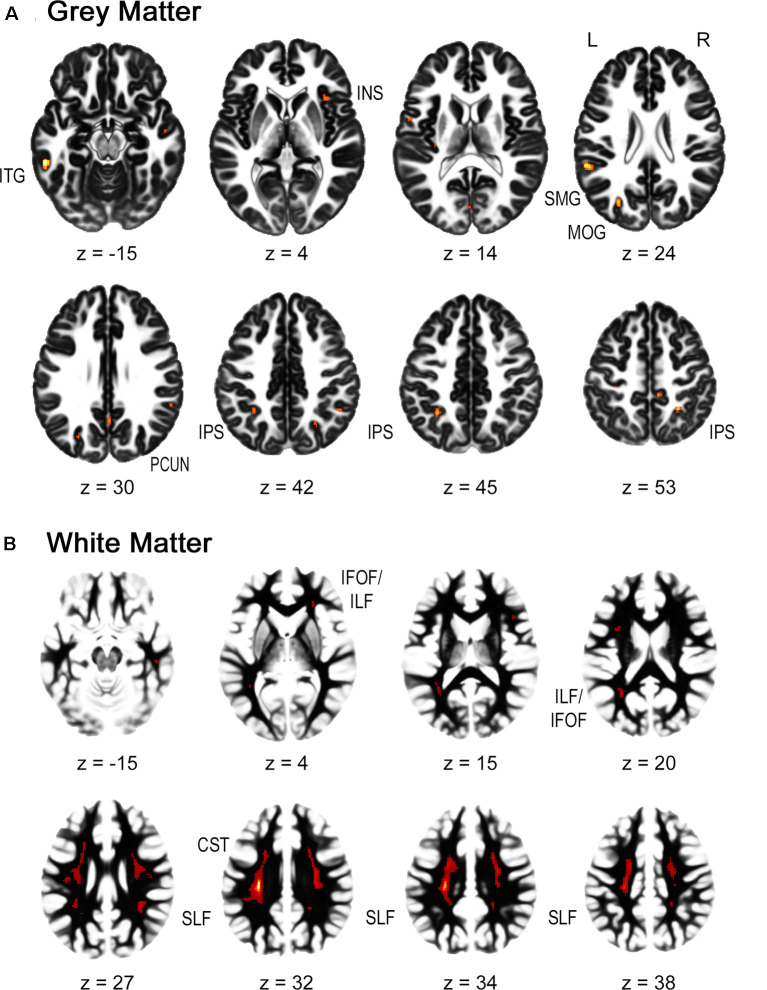
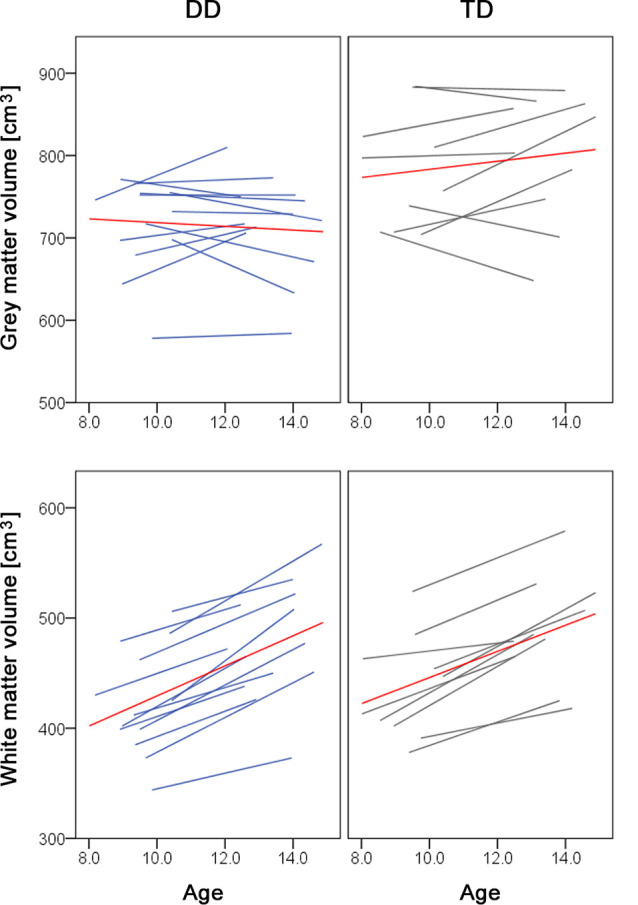
Developmental dyscalculia (DD) is a learning disability affecting the acquisition of numerical-arithmetical skills. Affected people show persistent deficits in number processing, which are associated with aberrant brain activation and structure. Reduced gray matter has been reported in DD for the parietal cortex including the intraparietal sulcus (IPS), but also the frontal and occipito-temporal cortex. Furthermore, dyscalculics show white matter differences for instance in the inferior (ILF) and superior longitudinal fasciculus (SLF). However, the longitudinal development of these structural differences is unknown. Therefore, our goal was to investigate the developmental trajectory of gray and white matter in children with and without DD. In this longitudinal study, neuropsychological measures and T1-weighted structural images were collected twice with an interval of 4 years from 13 children with DD (8.2-10.4 years) and 10 typically developing (TD) children (8.0-10.4 years). Voxel-wise estimation of gray and white matter volumes was assessed using voxel-based morphometry for longitudinal data. The present findings reveal for the first time that DD children show persistently reduced gray and white matter volumes over development. Reduced gray matter was found in the bilateral inferior parietal lobes including the IPS, supramarginal gyri, left precuneus, cuneus, right superior occipital gyrus, bilateral inferior and middle temporal gyri, and insula. White matter volumes were reduced in the bilateral ILF and SLF, inferior fronto-occipital fasciculus (IFOF), corticospinal tracts, and right anterior thalamic radiation (ATR). Behaviorally, children with DD performed significantly worse in various numerical tasks at baseline and follow-up, corroborating persistent deficits in number processing. The present results are in line with the literature showing that children with DD have reduced gray and white matter volumes in the numerical network. Our study further sheds light on the trajectory of brain development, revealing that these known structural differences in the long association fibers and the adjacent regions of the temporal- and frontoparietal cortex persist in dyscalculic children from childhood into adolescence. In conclusion, our results underscore that DD is a persistent learning disorder accompanied by deficits in number processing and reduced gray and white matter volumes in number related brain areas.
发育性计算障碍(DD)是一种影响数字运算技能习得的学习障碍。患者在数字处理方面存在持续缺陷,这与大脑激活异常和结构异常有关。据报道,DD患者顶叶皮质(包括顶内沟[IPS])以及额叶和枕颞叶皮质的灰质减少。此外,计算障碍患者在例如下纵束(ILF)和上纵束(SLF)等白质方面存在差异。然而,这些结构差异的纵向发展情况尚不清楚。因此,我们的目标是研究患和未患DD儿童的灰质和白质发育轨迹。在这项纵向研究中,对13名DD儿童(8.2 - 10.4岁)和10名发育正常(TD)儿童(8.0 - 10.4岁)每隔4年进行两次神经心理学测量和T1加权结构图像采集。使用基于体素的形态测量法对纵向数据进行灰质和白质体积的体素估计。目前的研究结果首次表明,DD儿童在发育过程中灰质和白质体积持续减少。在双侧下顶叶包括IPS、缘上回、左侧楔前叶、楔叶、右侧枕上回、双侧颞下回和中回以及岛叶发现灰质减少。双侧ILF和SLF、额枕下束(IFOF)、皮质脊髓束以及右侧丘脑前辐射(ATR)的白质体积减少。在行为方面,DD儿童在基线和随访时的各种数字任务中表现明显更差,证实了数字处理方面的持续缺陷。目前的结果与文献一致,表明DD儿童在数字网络中的灰质和白质体积减少。我们的研究进一步揭示了大脑发育轨迹,表明这些在长联合纤维以及颞叶和额顶叶皮质相邻区域已知的结构差异在计算障碍儿童从童年到青春期持续存在。总之,我们的结果强调DD是一种持续的学习障碍,伴有数字处理缺陷以及与数字相关脑区的灰质和白质体积减少。