Department of Psychology, Faculty of Health, York University, Toronto, Canada; Department of Psychology, National Research University Higher School of Economics, Moscow, Russian Federation.
Department of Psychology, Faculty of Health, York University, Toronto, Canada.
Dev Cogn Neurosci. 2018 Apr;30:239-250. doi: 10.1016/j.dcn.2017.08.002. Epub 2017 Aug 8.
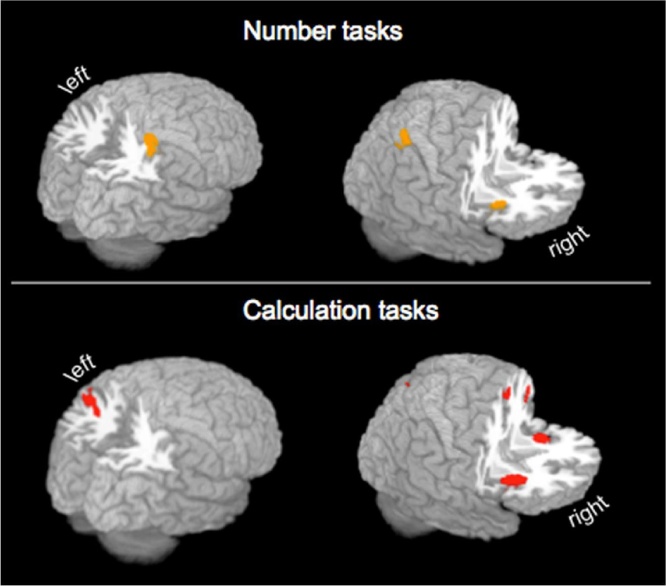
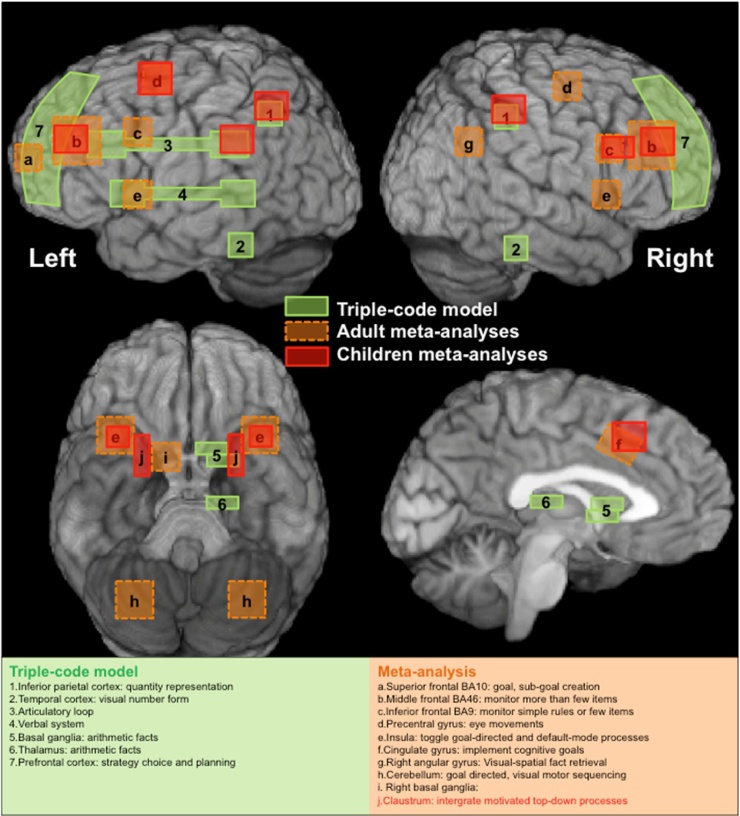
Children use numbers every day and typically receive formal mathematical training from an early age, as it is a main subject in school curricula. Despite an increase in children neuroimaging studies, a comprehensive neuropsychological model of mathematical functions in children is lacking. Using quantitative meta-analyses of functional magnetic resonance imaging (fMRI) studies, we identify concordant brain areas across articles that adhere to a set of selection criteria (e.g., whole-brain analysis, coordinate reports) and report brain activity to tasks that involve processing symbolic and non-symbolic numbers with and without formal mathematical operations, which we called respectively number tasks and calculation tasks. We present data on children 14 years and younger, who solved these tasks. Results show activity in parietal (e.g., inferior parietal lobule and precuneus) and frontal (e.g., superior and medial frontal gyri) cortices, core areas related to mental-arithmetic, as well as brain regions such as the insula and claustrum, which are not typically discussed as part of mathematical problem solving models. We propose a topographical atlas of mathematical processes in children, discuss findings within a developmental constructivist theoretical model, and suggest practical methodological considerations for future studies.
儿童每天都在使用数字,并且通常在很小的时候就接受正式的数学培训,因为数学是学校课程的主要科目。尽管儿童神经影像学研究有所增加,但缺乏针对儿童数学功能的全面神经心理学模型。我们使用功能磁共振成像 (fMRI) 研究的定量荟萃分析,确定了符合一组选择标准(例如,全脑分析、坐标报告)的文章中的一致脑区,并报告了涉及处理符号和非符号数字的脑活动,包括带有和不带有正式数学运算的任务,我们分别称之为数字任务和计算任务。我们提供了 14 岁及以下儿童解决这些任务的数据。结果显示,在顶叶(例如,下顶叶和楔前叶)和额叶(例如,额上和额中回)皮层中存在活动,这些区域与心算有关,以及脑岛和屏状核等区域,这些区域通常不作为数学问题解决模型的一部分进行讨论。我们提出了儿童数学过程的地形图集,在发展建构主义理论模型中讨论了研究结果,并为未来的研究提出了实用的方法学考虑因素。