Department of Neurosurgery, Qilu Hospital and Institute of Brain and Brain-Inspired Science, Cheeloo College of Medicine, Shandong University, Jinan, China.
Shandong Key Laboratory of Brain Function Remodeling, Shandong University, Jinan, China.
Front Immunol. 2020 Jul 16;11:1281. doi: 10.3389/fimmu.2020.01281. eCollection 2020.
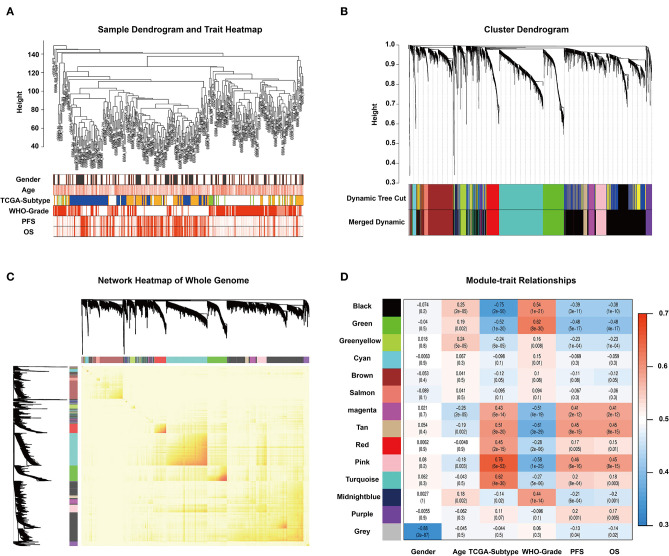
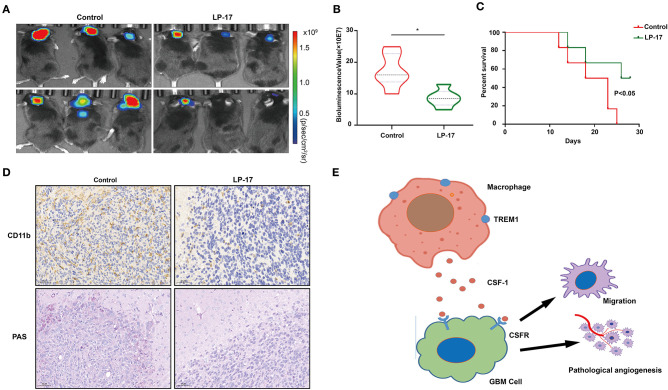
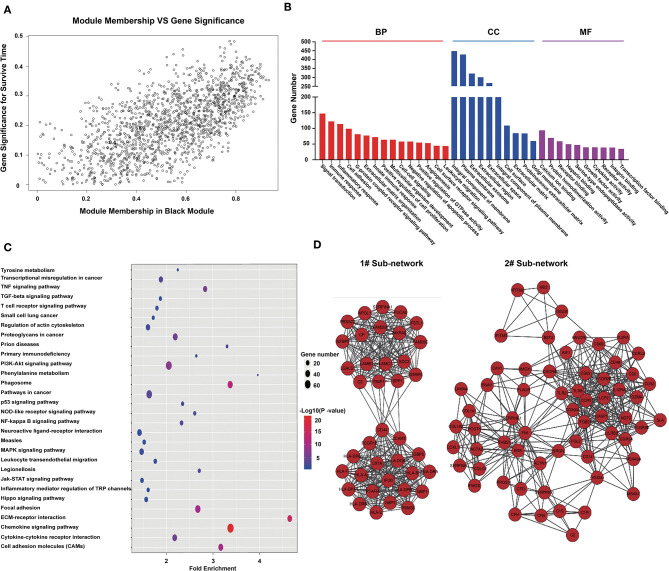
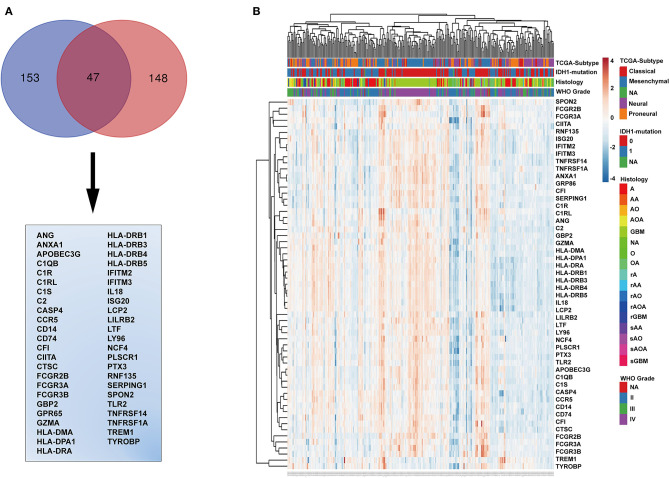
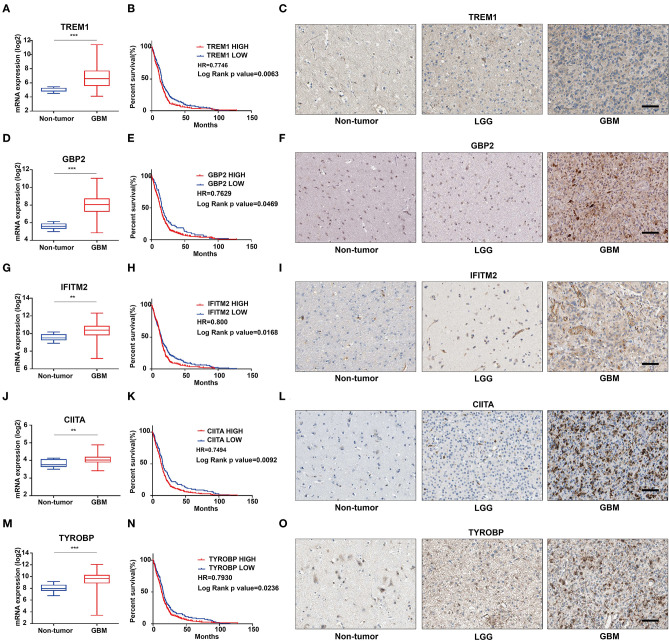
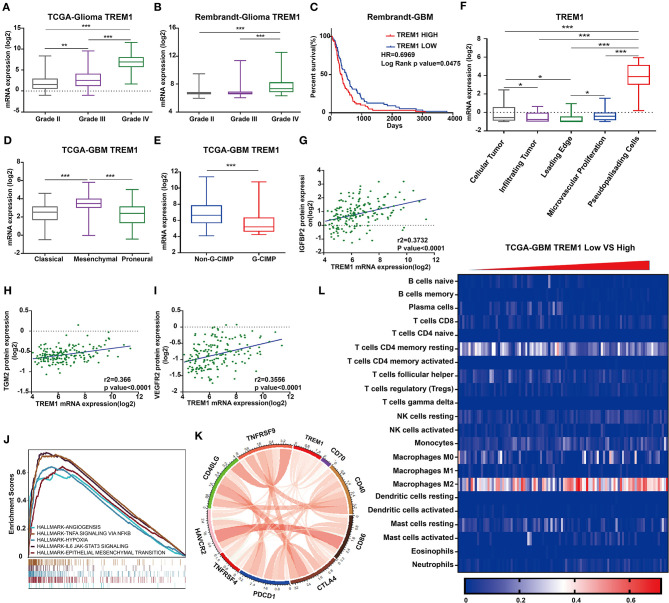
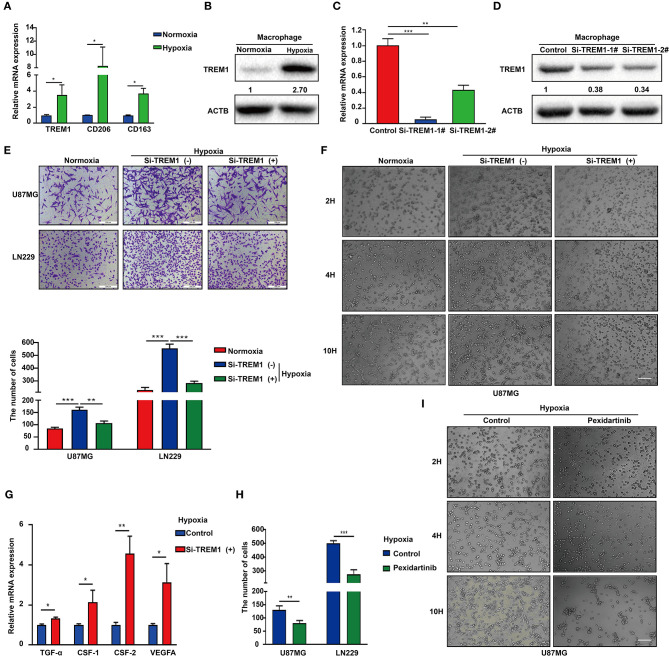
The tumor microenvironment (TME) of human glioblastoma (GBM) exhibits considerable immune cell infiltration, and such cell types have been shown to be widely involved in the development of GBM. Here, weighted correlation network analysis (WGCNA) was performed on publicly available datasets to identify immune-related molecules that may contribute to the progression of GBM and thus be exploited as potential therapeutic targets. WGCNA was used to identify highly correlated gene clusters in Chinese Glioma Genome Atlas glioma dataset. Immune-related genes in significant modules were subsequently validated in the Cancer Genome Atlas (TCGA) and Rembrandt databases, and impact on GBM development was examined in migration and vascular mimicry assays and in an orthotopic xenograft model (GL261 luciferase-GFP cells) in mice. WGCNA yielded 14 significant modules, one of which (black) contained genes involved in immune response and extracellular matrix formation. The intersection of these genes with a GO immune-related gene set yielded 47 immune-related genes, five of which exhibited increased expression and association with worse prognosis in GBM. One of these genes, , was highly expressed in areas of pseudopalisading cells around necrosis and associated with other proteins induced in angiogenesis/hypoxia. In macrophages induced from THP1 cells, expression levels were increased under hypoxic conditions and associated with markers of macrophage M2 polarization. siRNA knockdown in induced macrophages reduced their ability to promote migration and vascular mimicry in GBM cells , and treatment of mice with LP-17 peptide, which blocks TREM1, inhibited growth of GL261 orthotopic xenografts. Finally, blocking the cytokine receptor for CSF1 in induced macrophages also impeded their potential to promote tumor migration and vascular mimicry in GBM cells. Our results demonstrated that TREM1 could be used as a novel immunotherapy target for glioma patients.
人类胶质母细胞瘤(GBM)的肿瘤微环境(TME)表现出相当大的免疫细胞浸润,并且这些细胞类型已被证明广泛参与 GBM 的发展。在这里,对公开可用的数据集进行了加权相关网络分析(WGCNA),以鉴定可能有助于 GBM 进展的免疫相关分子,并将其用作潜在的治疗靶点。WGCNA 用于识别中国脑肿瘤基因组图谱胶质瘤数据集的高度相关基因簇。随后在癌症基因组图谱(TCGA)和 Rembrandt 数据库中验证了显著模块中的免疫相关基因,并在迁移和血管模拟测定以及在小鼠的原位异种移植模型(GL261 荧光素酶-GFP 细胞)中检查了它们对 GBM 发展的影响。WGCNA 产生了 14 个显著模块,其中一个(黑色)包含参与免疫反应和细胞外基质形成的基因。这些基因与 GO 免疫相关基因集的交集产生了 47 个免疫相关基因,其中 5 个在 GBM 中表达增加且与预后不良相关。其中一个基因 ,在坏死周围假栅状细胞区域高度表达,与血管生成/缺氧诱导的其他蛋白质相关。在从 THP1 细胞诱导的巨噬细胞中,在缺氧条件下表达水平增加,并与巨噬细胞 M2 极化的标志物相关。在诱导的巨噬细胞中用 siRNA 敲低 表达水平降低了它们促进 GBM 细胞迁移和血管模拟的能力,用 LP-17 肽(阻断 TREM1)治疗小鼠抑制了 GL261 原位异种移植的生长。最后,阻断诱导的巨噬细胞中的细胞因子受体 CSF1 也阻碍了它们促进 GBM 细胞迁移和血管模拟的潜力。我们的结果表明,TREM1 可作为胶质母细胞瘤患者的新型免疫治疗靶标。