Chaló Daniela, Marques Joana, Mendes Henrique, Sancho Consuelo
Department of Physiology and Pharmacology, Faculty of Medicine, University of Salamanca, Salamanca, Spain.
Department of Anesthesiology, Centro Hospitalar do Baixo Vouga, Aveiro, Portugal.
Adv Simul (Lond). 2020 Jul 31;5:16. doi: 10.1186/s41077-020-00134-0. eCollection 2020.
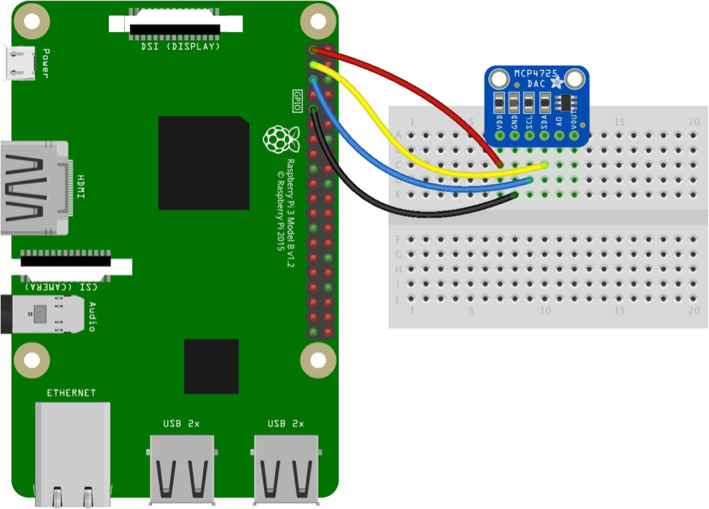
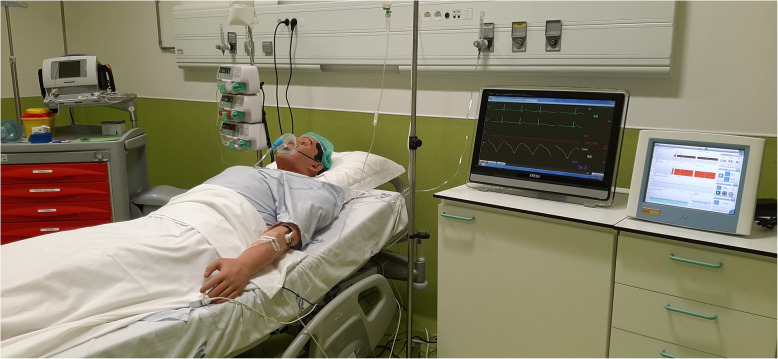
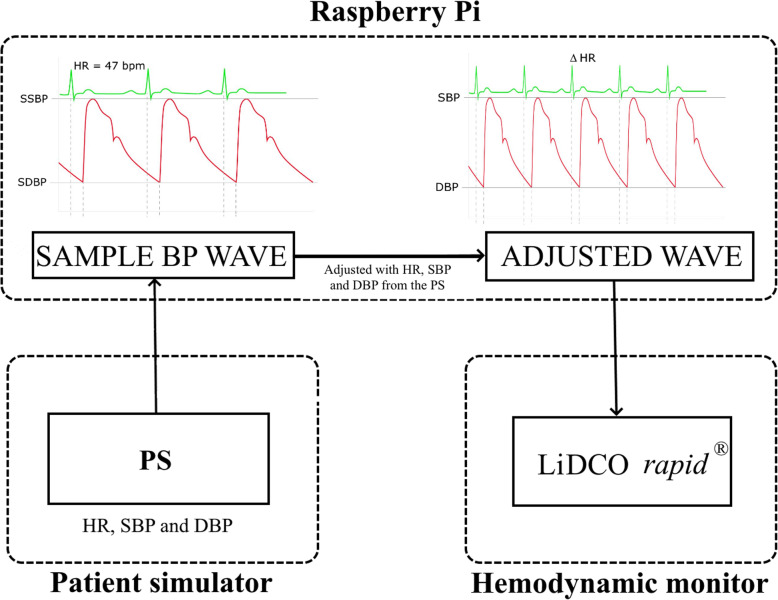
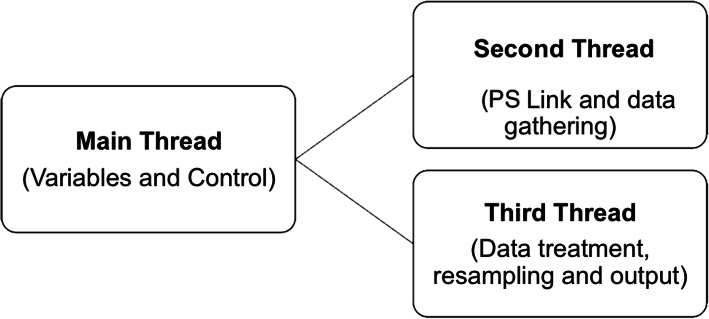
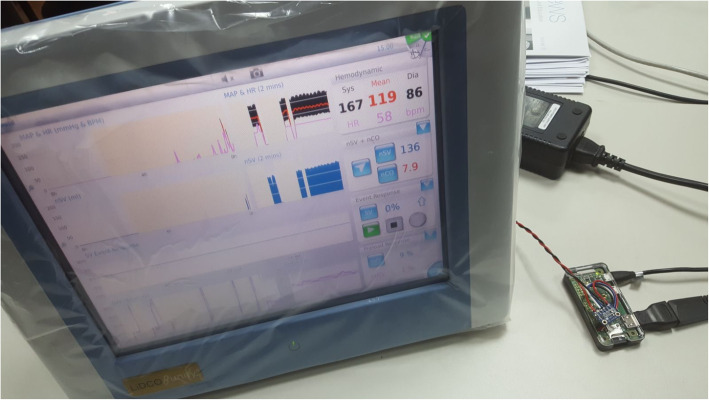
Cardiovascular physiology can be simulated in patient simulators but is limited to the simulator monitor curves and parameters, missing some important data that today is known as essential to fluid management and therapeutic decision in critical ill and high-risk surgical patients. Our main objective was to project and implement a unidirectional communication channel between a pre-existing patient simulator and a minimally invasive cardiac output monitor (LiDCO ®); a monitor that connects to real patients and interprets the arterial wave. To connect the patient simulator to the hemodynamic monitor, firstly, we had to assess both systems and design a communication channel between them. LiDCO monitor accepts as an input an analog voltage varying between 0 V and 5 V and that every volt is directly proportional to a blood pressure (mmHg) value ranging from 0 mmHg (0 V) to 500 mmHg (5 V). A Raspberry Pi 0 (Rpi0) with a WIFI chip integrated was needed and added to a digital analogue converter connected to the board. We designed a system that allowed us to collect, interpret and modify data, and feed it to the LiDCO ® monitor. We had developed a Python® script with three independent threads and a circular buffer to handle the data transmission between both systems. The LiDCO hemodynamic monitor successfully received data sent from our setup like a real patient arterial wave pulse and interpreted it to estimate several hemodynamic parameters, as cardiac output, stroke volume, systemic vascular resistance, pulse pressure variation, and stroke volume variation. The connection between the patient simulator and the LiDCO monitor is being used to create arterial curves and other hemodynamic parameters for clinical scenarios where residents and anesthesiologists can simulate a variety of unstable hemodynamic conditions, preparing them to face similar situations with real patients in a safe environment and with their own monitors.
心血管生理学可以在患者模拟器中进行模拟,但仅限于模拟器的监测曲线和参数,缺少一些如今已知对危重症和高危手术患者的液体管理及治疗决策至关重要的重要数据。我们的主要目标是在现有的患者模拟器和微创心输出量监测仪(LiDCO®)之间建立并实现一个单向通信通道;该监测仪可连接到真实患者并解读动脉波形。为了将患者模拟器与血流动力学监测仪相连,首先,我们必须评估这两个系统并设计它们之间的通信通道。LiDCO监测仪接受0 V至5 V之间变化的模拟电压作为输入,且每伏特电压与0 mmHg(0 V)至500 mmHg(5 V)范围内的血压(mmHg)值成正比。需要一个集成了WIFI芯片的树莓派0(Rpi0),并将其添加到连接到主板的数字模拟转换器上。我们设计了一个系统,该系统能够收集、解读和修改数据,并将其输入到LiDCO®监测仪中。我们开发了一个带有三个独立线程和一个循环缓冲区的Python®脚本,以处理两个系统之间的数据传输。LiDCO血流动力学监测仪成功接收了从我们的装置发送来的数据,就像接收真实患者的动脉波脉冲一样,并对其进行解读以估算多个血流动力学参数,如心输出量、每搏输出量、全身血管阻力、脉压变异度和每搏输出量变异度。患者模拟器与LiDCO监测仪之间的连接正被用于为临床场景创建动脉曲线和其他血流动力学参数,住院医师和麻醉医师可以在这些场景中模拟各种不稳定的血流动力学状况,让他们在安全的环境中使用自己的监测仪,为面对真实患者的类似情况做好准备。