Division of Molecular Oncology and Immunology, Oncode Institute, The Netherlands Cancer Institute, Amsterdam, The Netherlands.
Division of Surgical Oncology, The Netherlands Cancer Institute, Amsterdam, The Netherlands.
Nat Commun. 2020 Aug 7;11(1):3946. doi: 10.1038/s41467-020-17739-8.
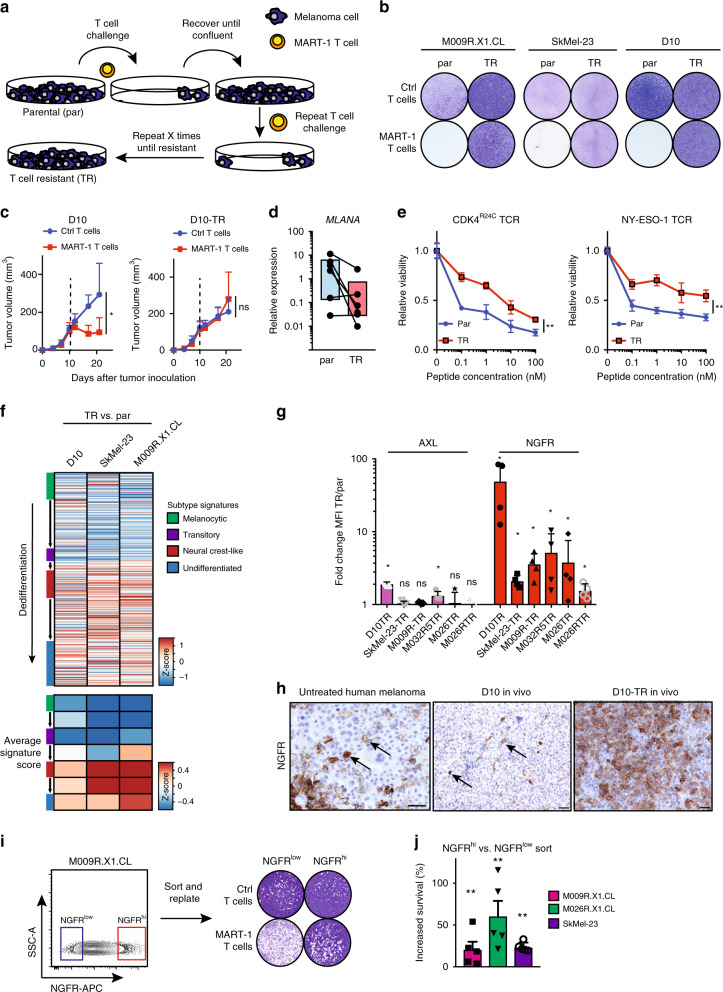
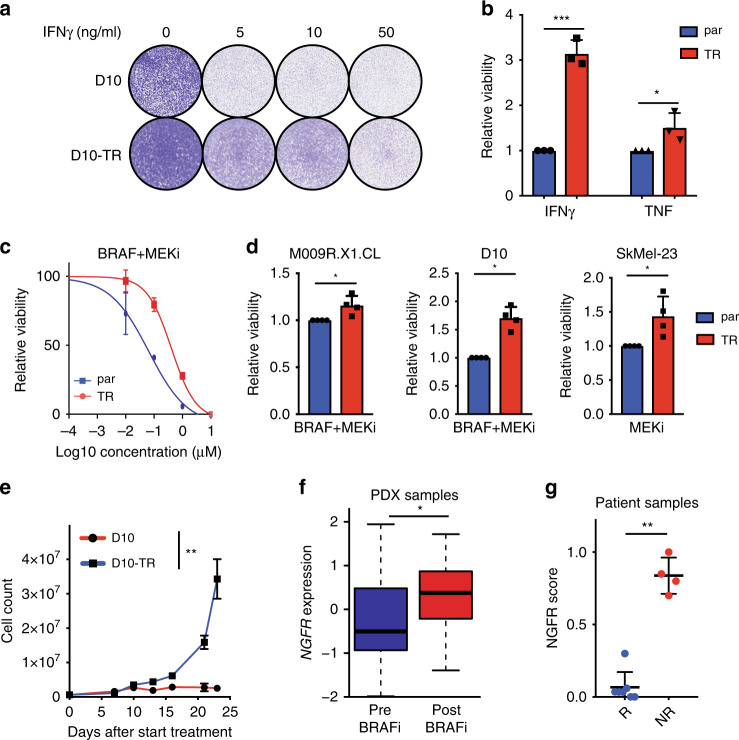
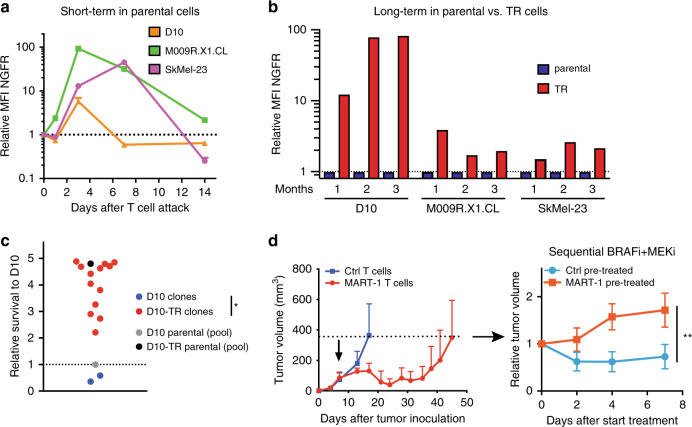
Melanomas can switch to a dedifferentiated cell state upon exposure to cytotoxic T cells. However, it is unclear whether such tumor cells pre-exist in patients and whether they can be resensitized to immunotherapy. Here, we chronically expose (patient-derived) melanoma cell lines to differentiation antigen-specific cytotoxic T cells and observe strong enrichment of a pre-existing NGFR population. These fractions are refractory also to T cells recognizing non-differentiation antigens, as well as to BRAF + MEK inhibitors. NGFR cells induce the neurotrophic factor BDNF, which contributes to T cell resistance, as does NGFR. In melanoma patients, a tumor-intrinsic NGFR signature predicts anti-PD-1 therapy resistance, and NGFR tumor fractions are associated with immune exclusion. Lastly, pharmacologic NGFR inhibition restores tumor sensitivity to T cell attack in vitro and in melanoma xenografts. These findings demonstrate the existence of a stable and pre-existing NGFR multitherapy-refractory melanoma subpopulation, which ought to be eliminated to revert intrinsic resistance to immunotherapeutic intervention.
黑色素瘤在暴露于细胞毒性 T 细胞后可以转变为去分化细胞状态。然而,目前尚不清楚这些肿瘤细胞是否预先存在于患者体内,以及它们是否可以重新对免疫疗法敏感。在这里,我们长期将(患者来源的)黑色素瘤细胞系暴露于分化抗原特异性细胞毒性 T 细胞中,观察到预先存在的 NGFR 群体强烈富集。这些分数对识别非分化抗原的 T 细胞以及 BRAF+MEK 抑制剂也具有抗性。NGFR 细胞诱导神经营养因子 BDNF,这有助于 T 细胞抵抗,NGFR 也是如此。在黑色素瘤患者中,肿瘤内在的 NGFR 特征预示着对 PD-1 治疗的耐药性,而 NGFR 肿瘤分数与免疫排斥有关。最后,药物 NGFR 抑制在体外和黑色素瘤异种移植物中恢复了肿瘤对 T 细胞攻击的敏感性。这些发现表明存在一种稳定的、预先存在的多疗法耐药性 NGFR 黑色素瘤亚群,应该消除该亚群以逆转对免疫治疗干预的内在耐药性。