State Key Laboratory of Oncology in South China, Collaborative Innovation Center for Cancer Medicine, Sun Yat-Sen University Cancer Center, Guangzhou, 510060, China.
Department of Pathology, Sun Yat-Sen University Cancer Center, 651# Dong Feng Road East, Guangzhou, 510060, Guangdong, China.
Cancer Immunol Immunother. 2021 Feb;70(2):417-429. doi: 10.1007/s00262-020-02691-9. Epub 2020 Aug 7.
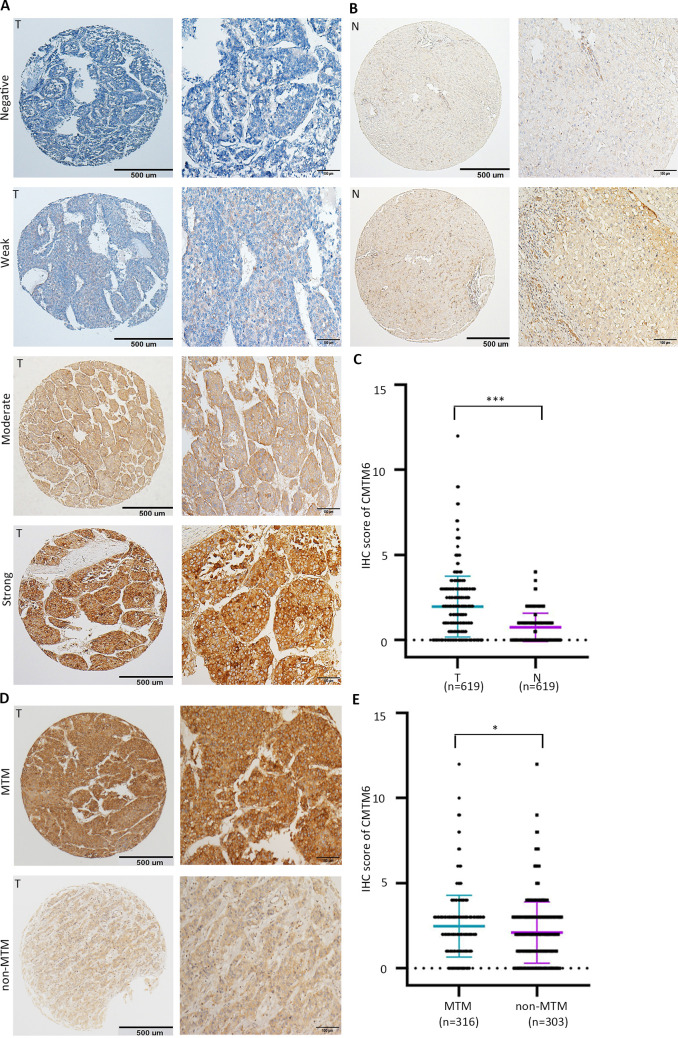
The "macrotrabecular-massive" (MTM) pattern of hepatocellular carcinoma (HCC) has been suggested to represent a distinct HCC subtype and is associated with specific molecular features. Since the immune microenvironment is heterogenous in HCC, it is important to evaluate the immune microenvironment of this novel variant. CMTM6, a key regulator of PD-L1, is an important immunocheckpoint inhibitor. This study aimed to evaluate the prognostic effect of CMTM6/PD-L1 coexpression and its relationship with inflammatory cells in HCC. We analyzed 619 HCC patients and tumors were classified into MTM and non-MTM HCC subtypes. The expression levels of CMTM6 and PD-L1 in tumor and inflammatory cells were evaluated by immunohistochemistry. The density of inflammatory cells in the cancer cell nest was calculated. Tumoral PD-L1 expression and inflammatory cell density were higher in the MTM type than in the non-MTM type. CMTM6-high expression was significantly associated with shorter OS and DFS than CMTM6-low expression in the whole HCC patient population and the MTM HCC patient population. Moreover, MTM HCC patients with CMTM6/PD-L1 coexpression experienced a higher risk of HCC progression and death. In addition, CMTM6/PD-L1 coexpression was shown to be related to a high density of inflammatory cells. Notably, a new immune classification, based on CMTM6/PD-L1 coexpression and inflammatory cells, successfully stratified OS and DFS in MTM HCC. CMTM6/PD-L1 coexpression has an adverse effect on the prognosis of HCC patients, especially MTM HCC patients. Our study provides evidence for the combination of immune status assessment with anti-CMTM6 and anti-PD-L1 therapy in MTM HCC patients.
肝细胞癌(HCC)的“巨梁-块状”(MTM)模式被认为代表了一种独特的 HCC 亚型,并与特定的分子特征相关。由于 HCC 的免疫微环境具有异质性,因此评估这种新型变体的免疫微环境非常重要。CMTM6 是 PD-L1 的关键调节因子,是一种重要的免疫检查点抑制剂。本研究旨在评估 CMTM6/PD-L1 共表达的预后效应及其与 HCC 中炎症细胞的关系。我们分析了 619 例 HCC 患者,将肿瘤分为 MTM 和非-MTM HCC 亚型。通过免疫组织化学评估肿瘤和炎症细胞中 CMTM6 和 PD-L1 的表达水平。计算肿瘤细胞巢中炎症细胞的密度。与非-MTM 型相比,MTM 型肿瘤中的 PD-L1 表达和炎症细胞密度更高。在整个 HCC 患者人群和 MTM HCC 患者人群中,CMTM6 高表达与 OS 和 DFS 显著缩短相关。此外,CMTM6/PD-L1 共表达的 MTM HCC 患者 HCC 进展和死亡的风险更高。此外,CMTM6/PD-L1 共表达与炎症细胞密度高有关。值得注意的是,基于 CMTM6/PD-L1 共表达和炎症细胞的新免疫分类成功地对 MTM HCC 的 OS 和 DFS 进行了分层。CMTM6/PD-L1 共表达对 HCC 患者的预后有不良影响,尤其是 MTM HCC 患者。我们的研究为 MTM HCC 患者的免疫状态评估与抗 CMTM6 和抗 PD-L1 治疗相结合提供了证据。