Department of Thoracic Oncology, Aichi Cancer Center Hospital, Nagoya, Japan.
Department of Respiratory Medicine, Allergy and Clinical Immunology, Nagoya City University Graduate School of Medicine Sciences, Nagoya, Japan.
Cancer Sci. 2020 Dec;111(12):4442-4452. doi: 10.1111/cas.14605. Epub 2020 Oct 31.
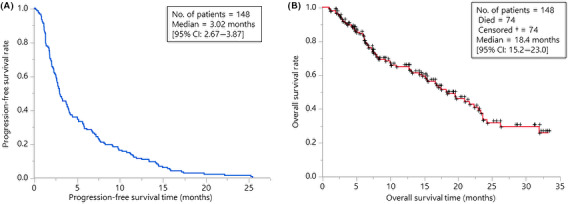
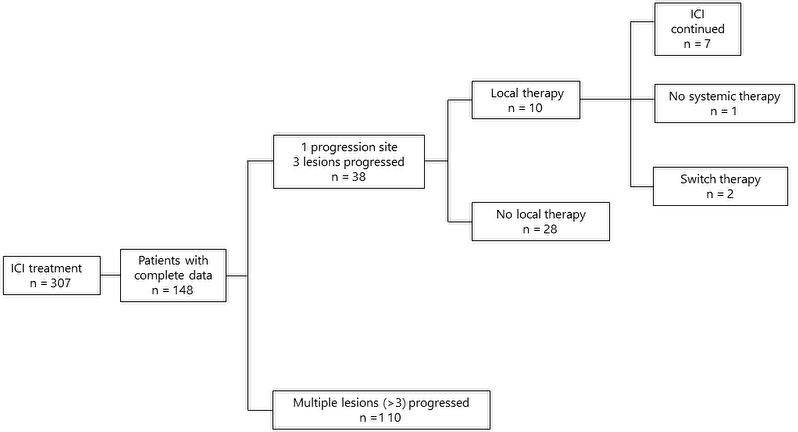
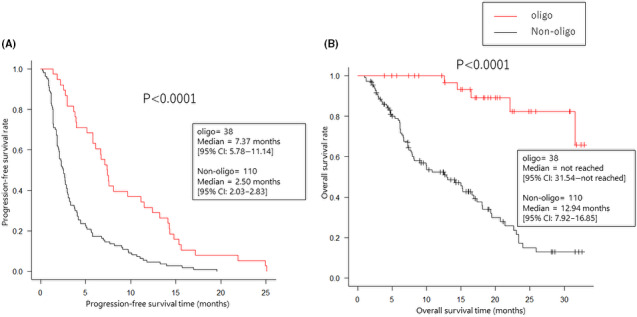
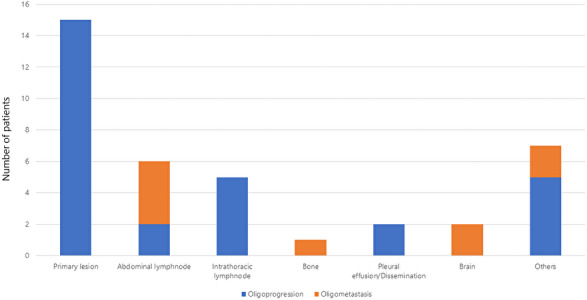
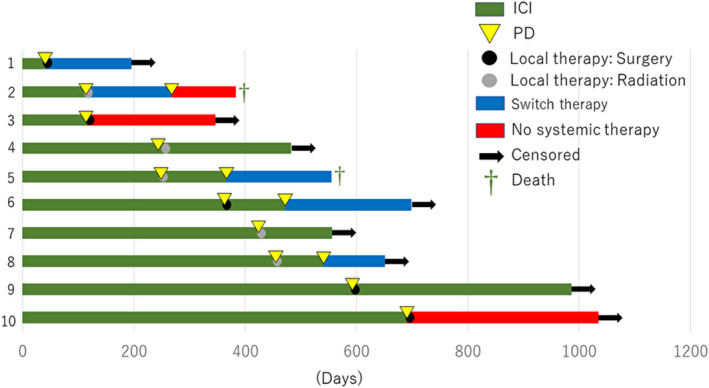
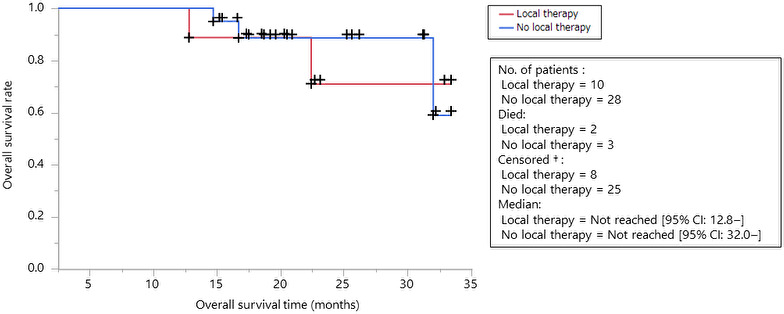
Immune checkpoint inhibitors (ICIs) have dramatically changed the strategy used to treat patients with non-small-cell lung cancer (NSCLC); however, the vast majority of patients eventually develop progressive disease (PD) and acquire resistance to ICIs. Some patients experience oligoprogressive disease. Few retrospective studies have evaluated clinical efficacy in patients with oligometastatic progression who received local therapy after ICI treatment. We conducted a retrospective analysis of advanced NSCLC patients who received PD-1 inhibitor monotherapy with nivolumab or pembrolizumab to evaluate the effects of ICIs on the patterns of progression and the efficacy of local therapy for oligoprogressive disease. Of the 307 patients treated with ICIs, 148 were evaluated in our study; 42 were treated with pembrolizumab, and 106 were treated with nivolumab. Thirty-eight patients showed oligoprogression. Male sex, a lack of driver mutations, and smoking history were significantly correlated with the risk of oligoprogression. Primary lesions were most frequently detected at oligoprogression sites (15 patients), and 6 patients experienced abdominal lymph node (LN) oligoprogression. Four patients showed evidence of new abdominal LN oligometastases. There was no significant difference in overall survival (OS) between the local therapy group and the switch therapy group (reached vs. not reached, P = .456). We summarized clinical data on the response of oligoprogressive NSCLC to ICI therapy. The results may help to elucidate the causes of ICI resistance and indicate that the use of local therapy as the initial treatment in this setting is feasible treatment option.
免疫检查点抑制剂 (ICIs) 极大地改变了治疗非小细胞肺癌 (NSCLC) 患者的策略;然而,绝大多数患者最终会出现疾病进展 (PD) 并对 ICI 产生耐药性。一些患者出现寡进展性疾病。少数回顾性研究评估了接受 ICI 治疗后局部治疗的寡转移性进展患者的临床疗效。我们对接受 PD-1 抑制剂纳武单抗或帕博利珠单抗单药治疗的晚期 NSCLC 患者进行了回顾性分析,以评估 ICI 对进展模式的影响以及局部治疗对寡进展性疾病的疗效。在接受 ICI 治疗的 307 例患者中,有 148 例在我们的研究中进行了评估;42 例接受了帕博利珠单抗治疗,106 例接受了纳武单抗治疗。38 例患者出现寡进展。男性、无驱动基因突变和吸烟史与寡进展的风险显著相关。寡进展部位最常检测到原发病灶(15 例),6 例出现腹部淋巴结 (LN) 寡进展。4 例出现新的腹部 LN 寡转移。局部治疗组和转换治疗组的总生存期 (OS) 无显著差异(达到 vs. 未达到,P=0.456)。我们总结了寡进展性 NSCLC 对 ICI 治疗的反应的临床数据。结果可能有助于阐明 ICI 耐药的原因,并表明在这种情况下使用局部治疗作为初始治疗是可行的治疗选择。