Division of Translational and Clinical Oncology, Cancer Research Institute, Kanazawa University, Kanazawa, Japan.
Department of Gastroenterology and Metabolism, Nagoya City University Graduate School of Medical Sciences, Nagoya, Japan.
J Pathol. 2020 Nov;252(3):330-342. doi: 10.1002/path.5529. Epub 2020 Sep 12.
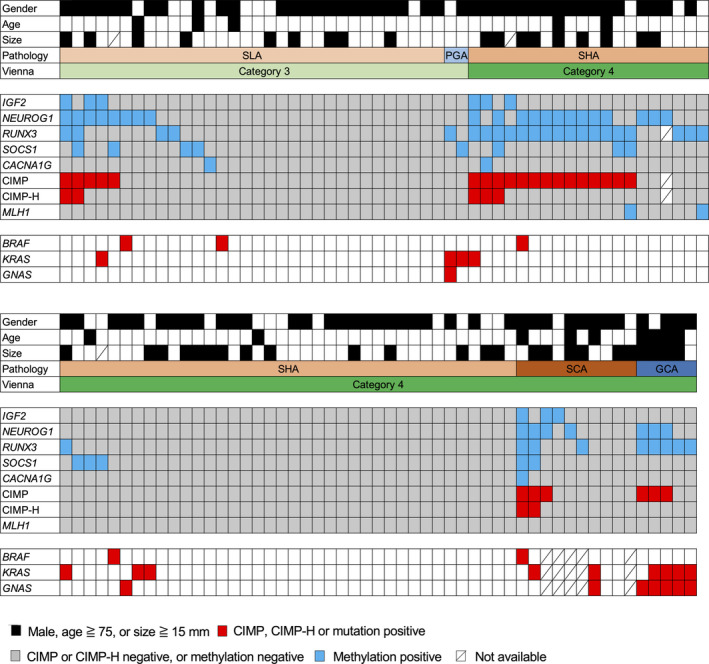
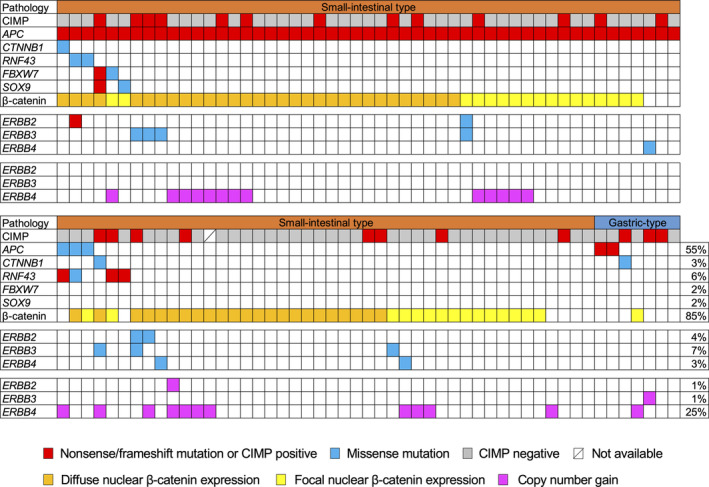
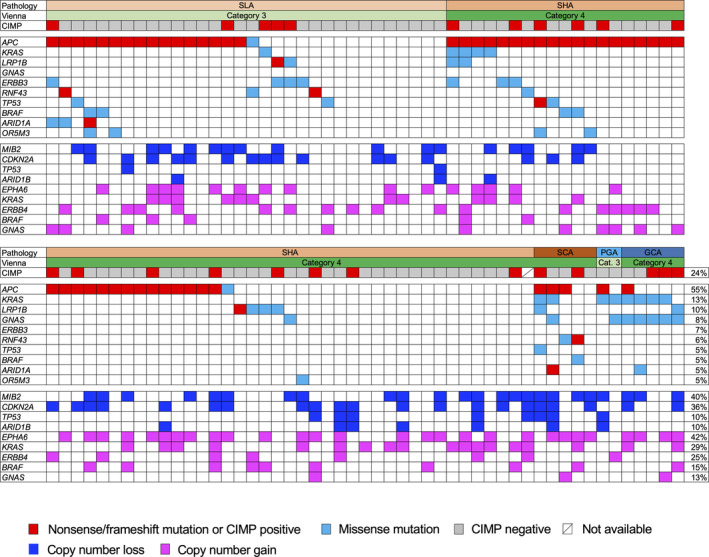
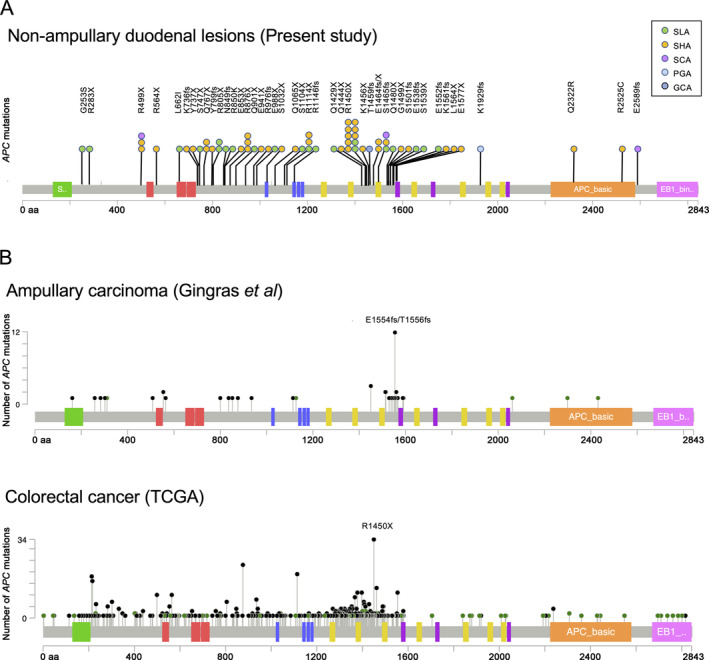
The molecular and clinical characteristics of non-ampullary duodenal adenomas and intramucosal adenocarcinomas are not fully understood because they are rare. To clarify these characteristics, we performed genetic and epigenetic analysis of cancer-related genes in these lesions. One hundred and seven non-ampullary duodenal adenomas and intramucosal adenocarcinomas, including 100 small intestinal-type tumors (90 adenomas and 10 intramucosal adenocarcinomas) and 7 gastric-type tumors (2 pyloric gland adenomas and 5 intramucosal adenocarcinomas), were investigated. Using bisulfite pyrosequencing, we assessed the methylation status of CpG island methylator phenotype (CIMP) markers and MLH1. Then using next-generation sequencing, we performed targeted exome sequence analysis within 75 cancer-related genes in 102 lesions. There were significant differences in the clinicopathological and molecular variables between small intestinal- and gastric-type tumors, which suggests the presence of at least two separate carcinogenic pathways in non-ampullary duodenal adenocarcinomas. The prevalence of CIMP-positive lesions was higher in intramucosal adenocarcinomas than in adenomas. Thus, concurrent hypermethylation of multiple CpG islands is likely associated with development of non-ampullary duodenal intramucosal adenocarcinomas. Mutation analysis showed that APC was the most frequently mutated gene in these lesions (56/102; 55%), followed by KRAS (13/102; 13%), LRP1B (10/102; 10%), GNAS (8/102; 8%), ERBB3 (7/102; 7%), and RNF43 (6/102; 6%). Additionally, the high prevalence of diffuse or focal nuclear β-catenin accumulation (87/102; 85%) as well as mutations of WNT pathway components (60/102; 59%) indicates the importance of WNT signaling to the initiation of duodenal adenomas. The higher than previously reported frequency of APC gene mutations in small bowel adenocarcinomas as well as the difference in the APC mutation distributions between small intestinal-type adenomas and intramucosal adenocarcinomas may indicate that the adenoma-carcinoma sequence has only limited involvement in duodenal carcinogenesis. © 2020 The Authors. The Journal of Pathology published by John Wiley & Sons, Ltd. on behalf of The Pathological Society of Great Britain and Ireland.
非壶腹十二指肠腺瘤和黏膜内腺癌的分子和临床特征尚未完全了解,因为它们很少见。为了阐明这些特征,我们对这些病变中的癌症相关基因进行了遗传和表观遗传分析。研究了 107 例非壶腹十二指肠腺瘤和黏膜内腺癌,包括 100 例小肠型肿瘤(90 例腺瘤和 10 例黏膜内腺癌)和 7 例胃型肿瘤(2 例幽门腺腺瘤和 5 例黏膜内腺癌)。使用亚硫酸氢盐焦磷酸测序,我们评估了 CpG 岛甲基化表型(CIMP)标志物和 MLH1 的甲基化状态。然后,使用下一代测序,我们在 102 个病变中的 75 个癌症相关基因内进行了靶向外显子序列分析。小肠型和胃型肿瘤在临床病理和分子变量方面存在显著差异,这表明非壶腹十二指肠腺癌中至少存在两种独立的致癌途径。黏膜内腺癌中 CIMP 阳性病变的发生率高于腺瘤。因此,多个 CpG 岛的协同过度甲基化可能与非壶腹十二指肠黏膜内腺癌的发生有关。突变分析显示,APC 是这些病变中最常突变的基因(56/102;55%),其次是 KRAS(13/102;13%)、LRP1B(10/102;10%)、GNAS(8/102;8%)、ERBB3(7/102;7%)和 RNF43(6/102;6%)。此外,弥漫性或局灶性核β-连环蛋白积聚(87/102;85%)以及 WNT 通路成分突变(60/102;59%)的高发生率表明 WNT 信号对十二指肠腺瘤的发生很重要。小肠腺癌中 APC 基因突变的频率高于先前的报道,以及小肠型腺瘤和黏膜内腺癌之间 APC 基因突变分布的差异,可能表明腺瘤-癌序列在十二指肠癌变中仅有限参与。