Department of Pharmacology, Institute of Neuroscience and Physiology, The Sahlgrenska Academy at the University of Gothenburg, Gothenburg, Sweden.
Addiction Biology Unit, Department of Psychiatry and Neurochemistry, Institute of Neuroscience and Physiology, The Sahlgrenska Academy at the University of Gothenburg, Gothenburg, Sweden.
Addict Biol. 2021 May;26(3):e12953. doi: 10.1111/adb.12953. Epub 2020 Aug 8.
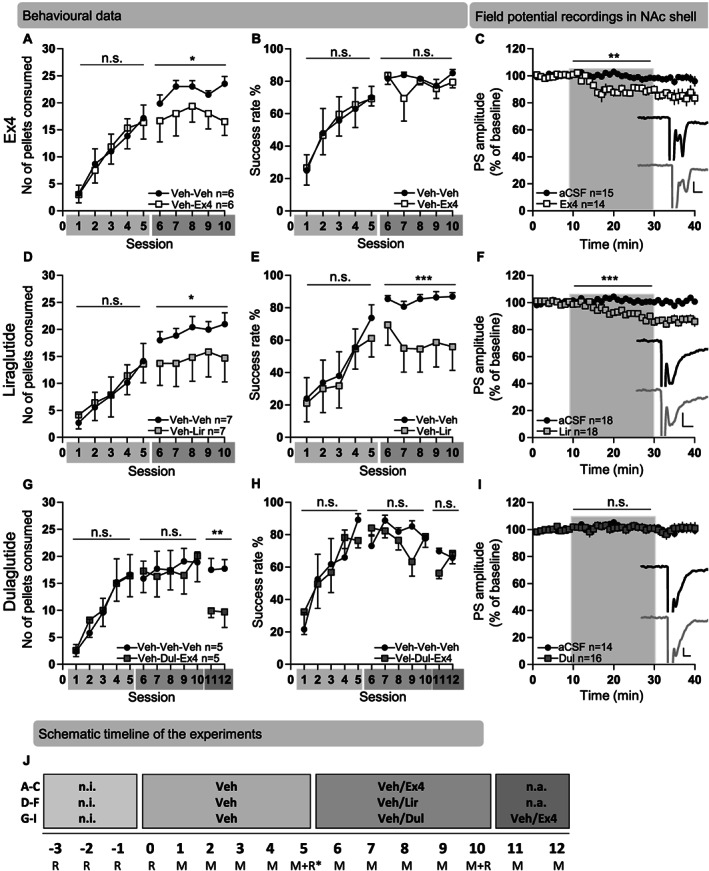
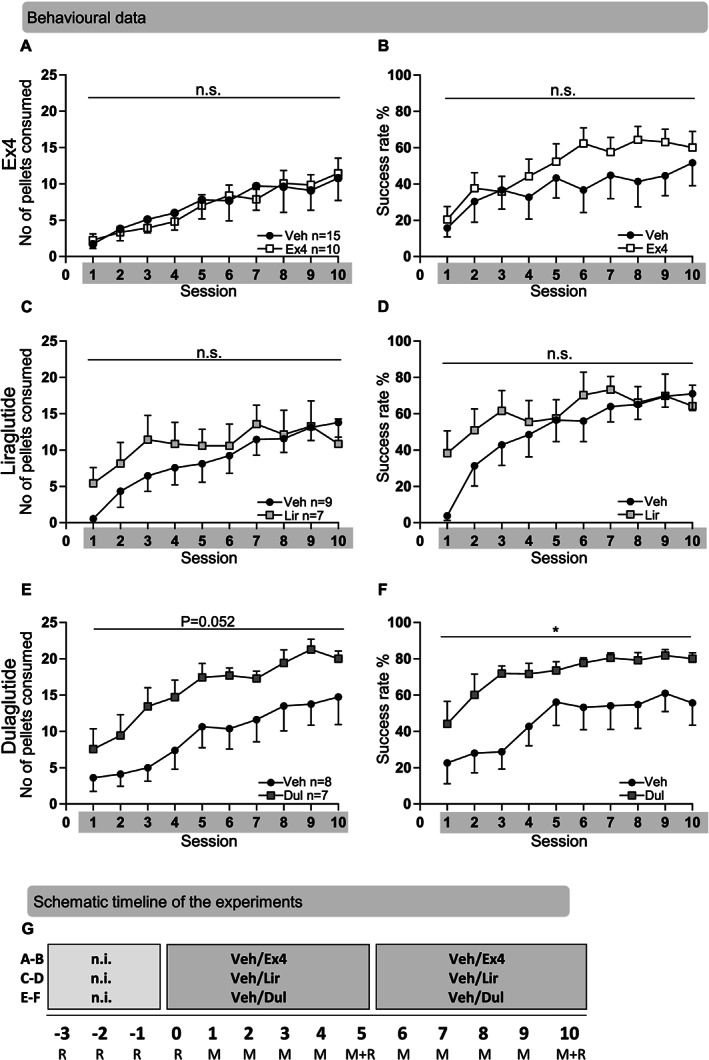
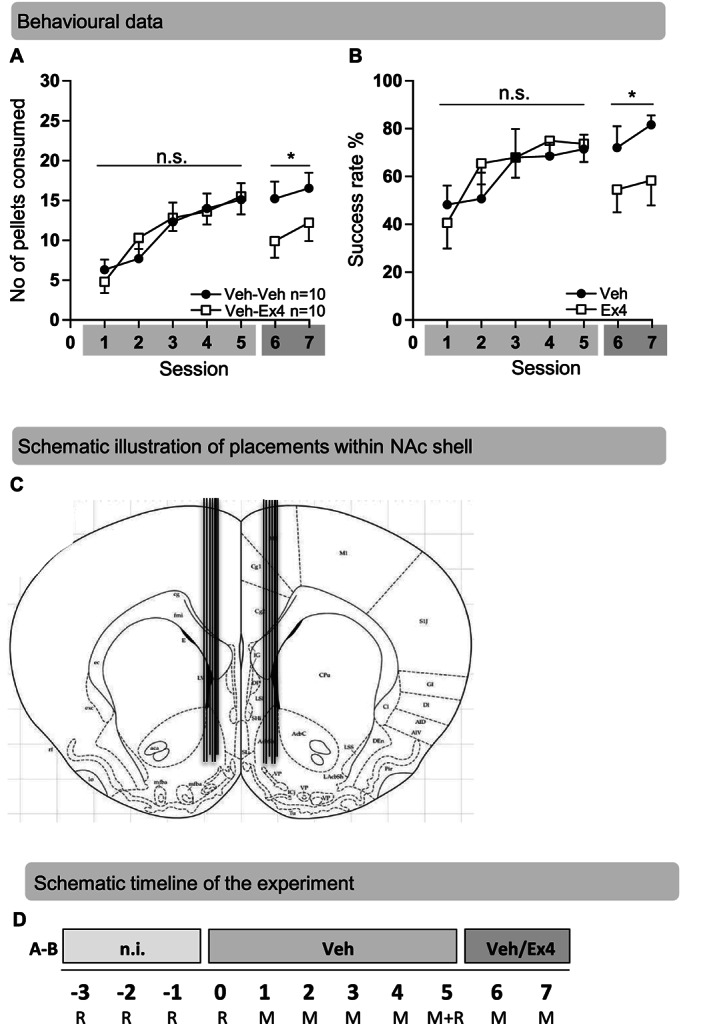
Glucagon-like peptide-1 receptor (GLP-1R) agonists, such as exendin-4 (Ex4), liraglutide and dulaglutide, regulate glucose homeostasis and are thus used to treat diabetes type II. GLP-1 also contributes towards a variety of additional physiological functions, including suppression of reward and improvement of learning. Acute activation of GLP-1R in the nucleus accumbens (NAc) shell, an area essential for motivation, reduces the motivation to consume sucrose or alcohol when assessed in a simple motor task. However, the effects of repeated administration of the different GLP-1R agonists on behaviours in a more complex motor task are unknown. The aim was therefore to investigate the effects of repeated Ex4, liraglutide or dulaglutide on the motivation and learning of a complex motor tasks such as skilled reach foraging in the Montoya staircase test. To explore the neurophysiological correlates of the different GLP-1R agonists on motivation, ex vivo electrophysiological recordings were conducted. In rats with an acquired skilled reach performance, Ex4 or liraglutide but not dulaglutide reduced the motivation of skilled reach foraging. In trained rats, Ex4 infusion into NAc shell decreased this motivated behaviour, and both Ex4 and liraglutide supressed the evoked field potentials in NAc shell. In rats without prior Montoya experience, dulaglutide but not Ex4 or liraglutide enhanced the learning of skilled reach foraging. Taken together, these findings indicate that the tested GLP-1R agonists have different behavioural outcomes depending on the context.
胰高血糖素样肽-1 受体 (GLP-1R) 激动剂,如 exendin-4 (Ex4)、利拉鲁肽和度拉鲁肽,可调节葡萄糖稳态,因此可用于治疗 II 型糖尿病。GLP-1 还可促进多种其他生理功能,包括抑制奖励和改善学习。在评估简单运动任务时,急性激活伏隔核 (NAc) 壳中的 GLP-1R,这是一个对动机至关重要的区域,可降低消耗蔗糖或酒精的动机。然而,重复给予不同 GLP-1R 激动剂对更复杂运动任务中的行为的影响尚不清楚。因此,本研究旨在调查重复给予 Ex4、利拉鲁肽或度拉鲁肽对复杂运动任务(如在蒙托亚阶梯测试中熟练取食)的动机和学习的影响。为了探索不同 GLP-1R 激动剂对动机的神经生理相关性,进行了离体电生理记录。在获得熟练取食表现的大鼠中,Ex4 或利拉鲁肽而非度拉鲁肽降低了熟练取食的动机。在训练有素的大鼠中,NAc 壳内给予 Ex4 可降低这种主动行为,并且 Ex4 和利拉鲁肽均可抑制 NAc 壳中的诱发场电位。在没有蒙托亚经验的大鼠中,只有度拉鲁肽而非 Ex4 或利拉鲁肽增强了熟练取食的学习。总之,这些发现表明,所测试的 GLP-1R 激动剂根据情况具有不同的行为结果。