Eren-Yazicioglu Candan Yasemin, Yigit Arya, Dogruoz Ramazan Efe, Yapici-Eser Hale
Koç University, Research Center for Translational Medicine (KUTTAM), Istanbul, Turkey.
School of Medicine, Koç University, Istanbul, Turkey.
Front Behav Neurosci. 2021 Jan 18;14:614884. doi: 10.3389/fnbeh.2020.614884. eCollection 2020.
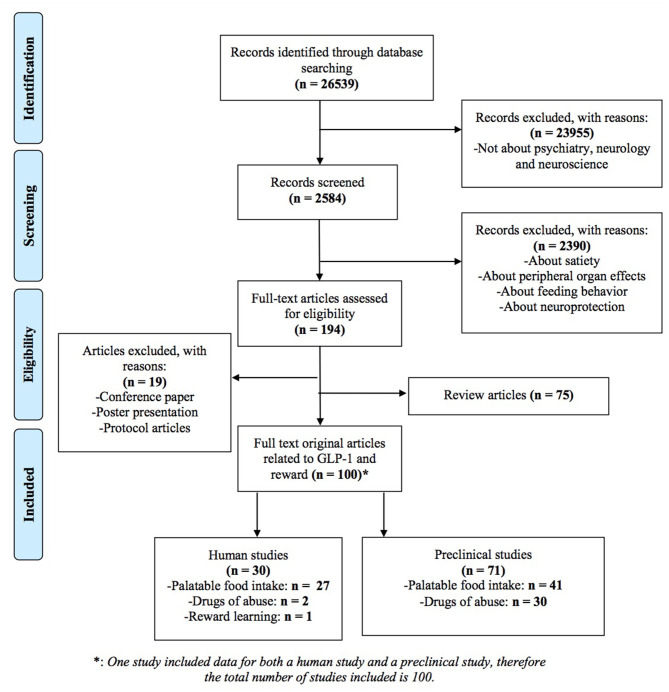
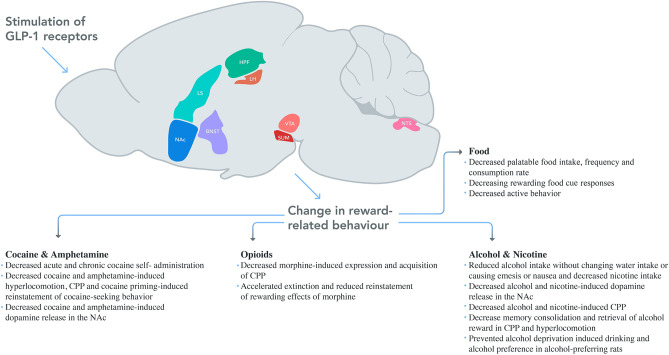
The role of glucagon-like peptide 1 (GLP-1) in insulin-dependent signaling is well-known; GLP-1 enhances glucose-dependent insulin secretion and lowers blood glucose in diabetes. GLP-1 receptors (GLP-1R) are also widely expressed in the brain, and in addition to its role in neuroprotection, it affects reward pathways. This systematic review aimed to analyze the studies on GLP-1 and reward pathways and its currently identified mechanisms. "Web of Science" and "Pubmed" were searched to identify relevant studies using GLP-1 as the keyword. Among the identified 26,539 studies, 30 clinical, and 71 preclinical studies were included. Data is presented by grouping rodent studies on palatable food intake, drugs of abuse, and studies on humans focusing on GLP-1 and reward systems. GLP-1Rs are located in reward-related areas, and GLP-1, its agonists, and DPP-IV inhibitors are effective in decreasing palatable food intake, along with reducing cocaine, amphetamine, alcohol, and nicotine use in animals. GLP-1 modulates dopamine levels and glutamatergic neurotransmission, which results in observed behavioral changes. In humans, GLP-1 alters palatable food intake and improves activity deficits in the insula, hypothalamus, and orbitofrontal cortex (OFC). GLP-1 reduces food cravings partially by decreasing activity to the anticipation of food in the left insula of obese patients with diabetes and may inhibit overeating by increasing activity to the consumption of food in the right OFC of obese and left insula of obese with diabetes. Current preclinical studies support the view that GLP-1 can be a target for reward system related disorders. More translational research is needed to evaluate its efficacy on human reward system related disorders.
胰高血糖素样肽1(GLP-1)在胰岛素依赖信号传导中的作用已广为人知;GLP-1可增强葡萄糖依赖性胰岛素分泌,并降低糖尿病患者的血糖。GLP-1受体(GLP-1R)也在大脑中广泛表达,除了具有神经保护作用外,它还影响奖赏通路。本系统评价旨在分析关于GLP-1与奖赏通路及其目前已确定机制的研究。以GLP-1为关键词,检索了“科学网”和“PubMed”以确定相关研究。在检索到的26539项研究中,纳入了30项临床研究和71项临床前研究。数据通过对啮齿动物关于美味食物摄入、滥用药物的研究以及对人类关于GLP-1和奖赏系统的研究进行分组呈现。GLP-1R位于与奖赏相关的区域,GLP-1及其激动剂以及二肽基肽酶-IV抑制剂可有效减少美味食物的摄入量,同时减少动物对可卡因、苯丙胺、酒精和尼古丁的使用。GLP-1调节多巴胺水平和谷氨酸能神经传递,从而导致观察到的行为变化。在人类中,GLP-1改变美味食物的摄入量,并改善岛叶、下丘脑和眶额皮质(OFC)的活动缺陷。GLP-1部分通过降低糖尿病肥胖患者左侧岛叶对食物预期的活动来减少食物渴望,并且可能通过增加肥胖者右侧OFC和糖尿病肥胖者左侧岛叶对食物消耗的活动来抑制暴饮暴食。目前的临床前研究支持GLP-1可成为与奖赏系统相关疾病靶点的观点。需要更多的转化研究来评估其对人类奖赏系统相关疾病的疗效。