Department of Internal Medicine, Chi Mei Medical Center, Chiali, Taiwan.
Division of Neurosurgery, Department of Surgery, National Taiwan University Hospital, Taipei, Taiwan.
BMC Nephrol. 2020 Aug 8;21(1):333. doi: 10.1186/s12882-020-01972-w.
Coronary artery disease is common in patients with end-stage renal disease (ESRD). Patients with ESRD are a high-risk group for cardiac surgery and have increased morbidity and mortality. Most studies comparing ESRD patients receiving coronary artery bypass grafting (CABG) or percutaneous coronary intervention have found that the long-term survival is good in ESRD patients after CABG. The aim of our study was to compare ESRD patients who underwent CABG with the general population who underwent CABG, in terms of prognosis and hospital costs.
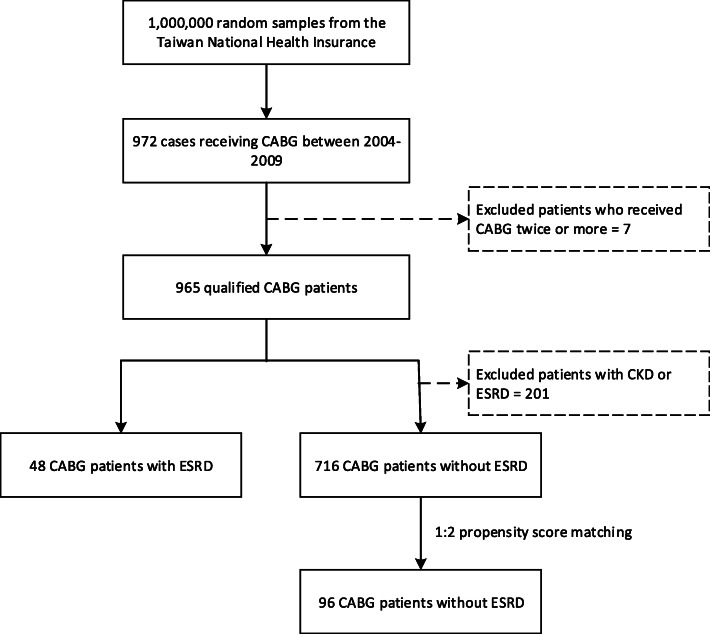
This study analyzed data from the National Health Insurance Research Database in Taiwan for patients who were diagnosed with ESRD and received CABG (ICD-9-CM codes 585 or 586) between January 1, 2004, and December 31, 2009. The ESRD patients included in this study all received catastrophic illness cards with the major illness listed as ESRD from the Ministry of Health and Welfare in Taiwan. The control subjects were randomly selected patients without ESRD after propensity score matching with ESRD patients according to age, gender, and comorbidities at a 2:1 ratio from the same dataset.
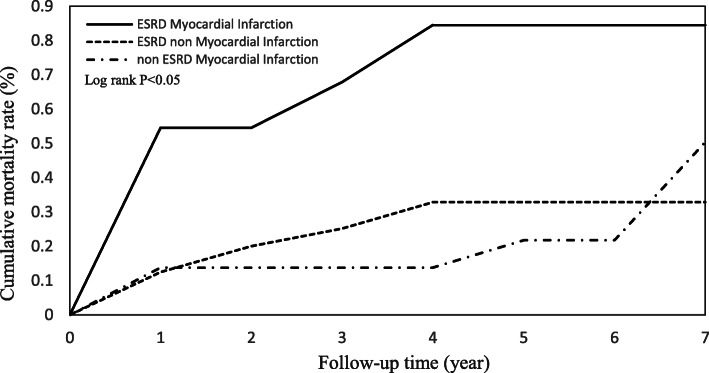
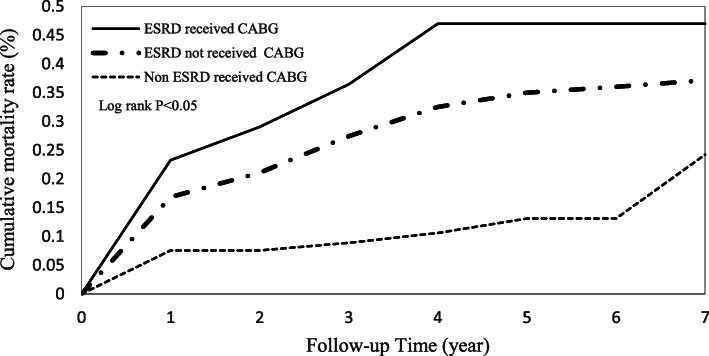
A total of 48 ESRD patients received CABG, and their mean age was 62.04 ± 10.04 years. Of these patients, 29.2% were aged ≥70 years, and 66.7% were male. ESRD patients had marginally higher intensive care unit (ICU) stays (11.06 vs 7.24 days) and significantly higher ICU costs (28,750 vs 17,990 New Taiwan Dollars (NTD)) than non-ESRD patients. Similarly, ESRD patients had significantly higher surgical costs (565,200 vs. 421,890 NTD), a higher perioperative mortality proportion (10.4% vs 2.1%) and a higher postoperative mortality proportion (33.3% vs 11.5%) than non-ESRD patients.
After CABG, ESRD patients had a higher risk of mortality than non-ESRD patients, and ICU and surgery costs were also higher among the ESRD patients than among patients without ESRD.
冠心病在终末期肾病(ESRD)患者中很常见。ESRD 患者是心脏手术的高危人群,发病率和死亡率较高。大多数比较 ESRD 患者接受冠状动脉旁路移植术(CABG)或经皮冠状动脉介入治疗的研究发现,CABG 后 ESRD 患者的长期生存率良好。我们的研究目的是比较接受 CABG 的 ESRD 患者和接受 CABG 的普通人群的预后和住院费用。
本研究分析了台湾全民健康保险研究数据库中 2004 年 1 月 1 日至 2009 年 12 月 31 日期间被诊断为 ESRD 并接受 CABG(ICD-9-CM 代码 585 或 586)的患者的数据。本研究中的 ESRD 患者均从台湾卫生福利部获得了重大疾病卡,该卡将 ESRD 列为主要疾病。对照病例是从同一数据集中按照年龄、性别和合并症以 2:1 的比例与 ESRD 患者进行倾向评分匹配后随机选择的无 ESRD 患者。
共有 48 名 ESRD 患者接受了 CABG,平均年龄为 62.04±10.04 岁。其中 29.2%的患者年龄≥70 岁,66.7%为男性。ESRD 患者的重症监护病房(ICU)停留时间(11.06 天比 7.24 天)和 ICU 费用(28750 新台币比 17990 新台币)略高。同样,ESRD 患者的手术费用(565200 新台币比 421890 新台币)、围手术期死亡率比例(10.4%比 2.1%)和术后死亡率比例(33.3%比 11.5%)均明显高于非 ESRD 患者。
CABG 后,ESRD 患者的死亡率高于非 ESRD 患者,且 ESRD 患者的 ICU 和手术费用也高于非 ESRD 患者。