Biogen, Inc., Cambridge, MA, USA.
Invicro, LLC, Boston, MA, USA.
J Transl Med. 2020 Aug 8;18(1):309. doi: 10.1186/s12967-020-02461-2.
The intrathecal (IT) dosing route introduces drugs directly into the CSF to bypass the blood-brain barrier and gain direct access to the CNS. We evaluated the use of convective forces acting on the cerebrospinal fluid as a means for increasing rostral delivery of IT dosed radioactive tracer molecules and antisense oligonucleotides (ASO) in the monkey CNS. We also measured the cerebral spinal fluid (CSF) volume in a group of cynomolgus monkeys.
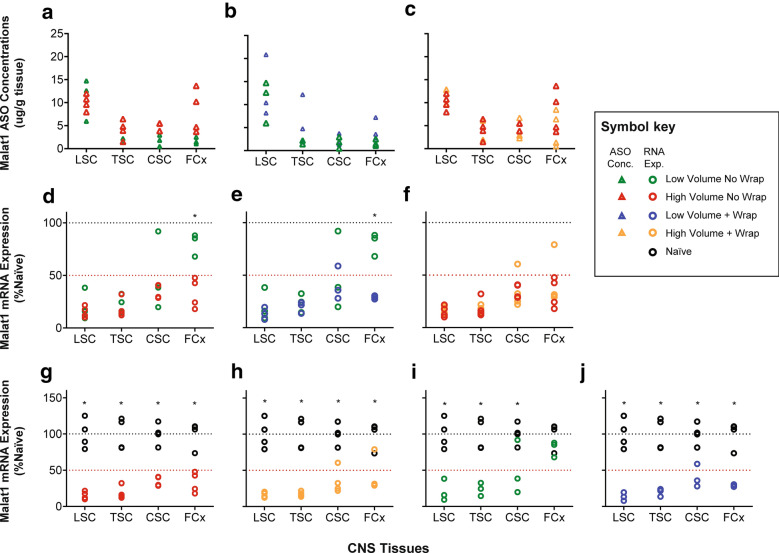
There are three studies presented, in each of which cynomolgus monkeys were injected into the IT space with radioactive tracer molecules and/or ASO by lumbar puncture in either a low or high volume. The first study used the radioactive tracer Cu-DOTA and PET imaging to evaluate the effect of the convective forces. The second study combined the injection of the radioactive tracer Tc-DTPA and ASO, then used SPECT imaging and ex vivo tissue analysis of the effects of convective forces to bridge between the tracer and the ASO distributions. The third experiment evaluated the effects of different injection volumes on the distribution of an ASO. In the course of performing these studies we also measured the CSF volume in the subject monkeys by Magnetic Resonance Imaging.
It was consistently found that larger bolus dose volumes produced greater rostral distribution along the neuraxis. Thoracic percussive treatment also increased rostral distribution of low volume injections. There was little added benefit on distribution by combining the thoracic percussive treatment with the high-volume injection. The CSF volume of the monkeys was found to be 11.9 ± 1.6 cm.
These results indicate that increasing convective forces after IT injection increases distribution of molecules up the neuraxis. In particular, the use of high IT injection volumes will be useful to increase rostral CNS distribution of therapeutic ASOs for CNS diseases in the clinic.
鞘内(IT)给药途径将药物直接引入脑脊液中,以绕过血脑屏障并直接进入中枢神经系统。我们评估了利用作用于脑脊液的对流力来增加 IT 给药放射性示踪分子和反义寡核苷酸(ASO)在猴中枢神经系统中的头端传递。我们还测量了一组食蟹猴的脑脊液(CSF)体积。
本研究共进行了三项研究,在每项研究中,通过腰椎穿刺向 IT 空间注入放射性示踪分子和/或 ASO,注入体积或低或高。第一项研究使用放射性示踪剂 Cu-DOTA 和 PET 成像来评估对流力的影响。第二项研究将放射性示踪剂 Tc-DTPA 和 ASO 结合使用,然后使用 SPECT 成像和示踪剂与 ASO 分布之间的体外组织分析来评估对流力的影响。第三个实验评估了不同注射体积对 ASO 分布的影响。在进行这些研究的过程中,我们还通过磁共振成像测量了受试猴的 CSF 体积。
结果一致表明,较大的推注剂量体积会产生更大的沿神经轴的头端分布。胸叩治疗也增加了低容量注射的头端分布。将胸叩治疗与高容量注射结合使用对分布的改善作用不大。猴 CSF 体积为 11.9±1.6cm。
这些结果表明,IT 注射后增加对流力会增加分子在神经轴上的分布。特别是,在临床上使用高 IT 注射体积将有助于增加治疗性 ASO 在 CNS 疾病中的头端 CNS 分布。