Yanagawa Senichiro, Karakuchi Nozomi, Mochizuki Tetsuya, Kodama Shinya, Takeshima Yukio, Sumimoto Kazuo
Department of Surgery, Yoshida General Hospital, Akitakata City, Japan.
Department of Gastroenterological and Transplant Surgery, Graduate School of Biomedical and Health Sciences, Hiroshima University, Hiroshima, Japan.
Case Rep Oncol. 2020 Jul 2;13(2):768-773. doi: 10.1159/000507985. eCollection 2020 May-Aug.
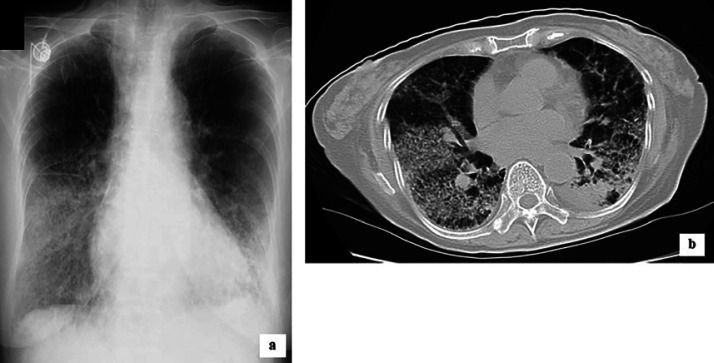
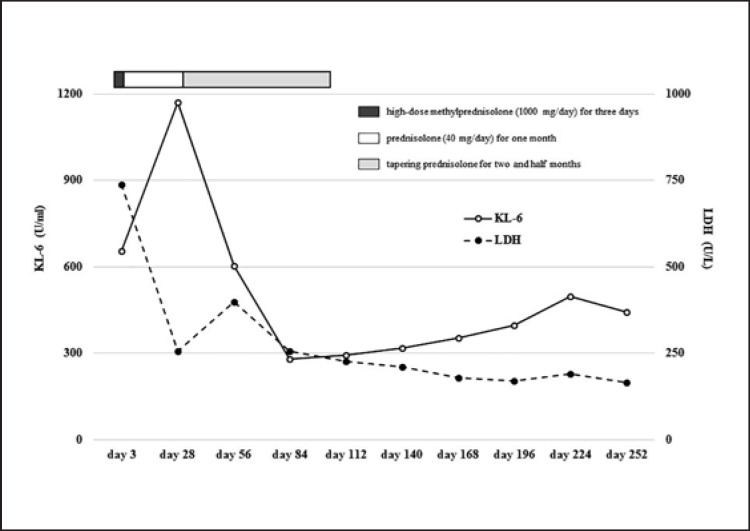
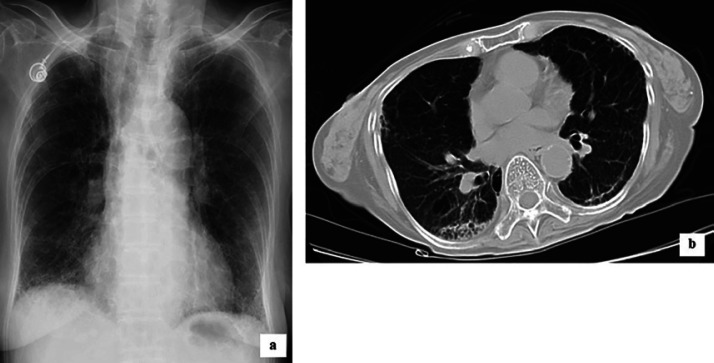
The regimen of oxaliplatin with 5-fluorouracil plus l-leucovorin (FOLFOX) has become one of the most commonly used first-line chemotherapy for patients with advanced colorectal cancer and it provides an increase in disease-free survival as well as an overall survival benefit. Although FOLFOX chemotherapy has helped to improve the clinical outcomes in these patients, the regimen is associated with some therapeutic issues or uncontrolled side effects. Gastrointestinal, neurosensory, and hematological toxicities have frequently been observed in patients treated with FOLFOX, and consequently, some palliative treatment has been established to combat such complications. However, pulmonary toxicities including drug-induced interstitial pneumonia (DI-IP) is rarely observed in these patients and a curative treatment is yet to be established. DI-IP due to chemotherapy is most commonly observed in patients treated with mitomycin, paclitaxel, docetaxel, or gemcitabine. Steroid therapy is mostly used to treat DI-IP, although the efficacy of such treatments is not supported with adequate evidence. FOLFOX-induced interstitial pneumonia (FIIP) is rarely observed, and several case reports of FIIP treated with steroids have been published previously that showed the mortality is extremely high. Here, we present a 74-year-old woman who received modified FOLFOX6 as adjuvant chemotherapy after rectal cancer surgery. The patient experienced FIIP, which improved after application of steroid pulse (high-dose methylprednisolone at 1,000 mg/day for 3 days) and tapering (starting with prednisolone at 40 mg/day) therapy. Our data suggest that such a steroid therapy could represent an effective treatment option for FIIP.
奥沙利铂联合5-氟尿嘧啶加亚叶酸钙(FOLFOX)方案已成为晚期结直肠癌患者最常用的一线化疗方案之一,它能提高无病生存期并带来总生存获益。尽管FOLFOX化疗有助于改善这些患者的临床结局,但该方案存在一些治疗问题或无法控制的副作用。接受FOLFOX治疗的患者经常出现胃肠道、神经感觉和血液学毒性,因此,已确立了一些姑息治疗方法来对抗此类并发症。然而,在这些患者中很少观察到包括药物性间质性肺炎(DI-IP)在内的肺部毒性,且尚未确立治愈性治疗方法。化疗引起的DI-IP最常见于接受丝裂霉素、紫杉醇、多西他赛或吉西他滨治疗的患者。类固醇疗法大多用于治疗DI-IP,尽管此类治疗的疗效缺乏充分证据支持。FOLFOX诱导的间质性肺炎(FIIP)很少见,此前已发表了几篇用类固醇治疗FIIP的病例报告,显示死亡率极高。在此,我们报告一名74岁女性,她在直肠癌手术后接受改良FOLFOX6作为辅助化疗。该患者发生了FIIP,在应用类固醇冲击(1000 mg/天的高剂量甲泼尼龙,共3天)和逐渐减量(从40 mg/天的泼尼松龙开始)治疗后病情好转。我们的数据表明,这种类固醇疗法可能是FIIP的一种有效治疗选择。