De Weerdt Annick, Dendooven Amélie, Snoeckx Annemie, Pen Jan, Lammens Martin, Jorens Philippe G
Department of Intensive Care Medicine, Antwerp University Hospital, University of Antwerp, Wilrijkstraat 10, 2650, Edegem, Belgium.
Department of Pathology, Antwerp University Hospital, University of Antwerp, Edegem, Belgium.
BMC Cancer. 2017 Aug 29;17(1):586. doi: 10.1186/s12885-017-3576-y.
The FOLFOX regimen, i.e., folinic acid (FOL), fluorouracil (F) and oxaliplatin (OX), is a drug cocktail that is used to treat gastric and colorectal cancers. Despite the concomitant improvements in response rate, duration of response and patient survival, reports of serious toxic pulmonary side effects have progressively emerged.
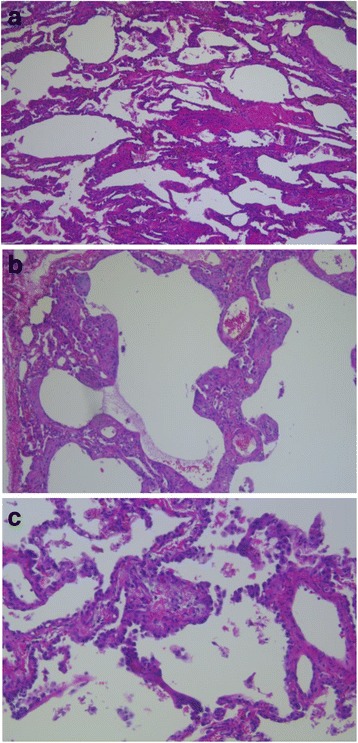
We describe a patient who was treated with FOLFOX as an adjuvant to a rectosigmoidal resection of a rectosigmoidal carcinoma and who developed respiratory insufficiency requiring mechanical ventilation. Computed tomography (CT) imaging and open lung biopsy findings were compatible with interstitial pneumonia (IP). She received multimodal combination treatment (acetylcysteine, corticosteroids, immune globulins and cyclophosphamide) and survived. We performed a systematic literature search and reviewed all 45 reported cases of FOLFOX-related lung toxicity and/or pulmonary fibrosis for their clinical characteristics and their outcomes related to therapy.
We found that for the 45 cases with available data, the median age was 70 years, and the male-female ratio was 3.5: 1. In the patients exhibiting only mild respiratory symptoms, discontinuation of the culprit drug (oxaliplatin) resulted in a 100% regression of the symptoms. However the prognosis of the respiratory insufficient patient proved to be grim: death occurred in 76.9% of the cases despite conventional treatment with corticosteroids. We therefore urge oncologists and critical care specialists not to limit their interventions to the discontinuation of chemotherapy, artificial ventilation, corticosteroids and glutathione replenishment and to consider the gradual introduction of additional immune-modulating agents whenever life-threatening respiratory symptoms in oxaliplatin-treated patients do not subside; all the more so considering the fact that our analysis showed that every patient who survived intubation and mechanical ventilation experienced a full clinical recovery.
FOLFOX方案,即亚叶酸(FOL)、氟尿嘧啶(F)和奥沙利铂(OX),是一种用于治疗胃癌和结直肠癌的药物组合。尽管在缓解率、缓解持续时间和患者生存率方面都有改善,但严重的肺部毒性副作用报告却逐渐出现。
我们描述了一名患者,该患者在接受乙状结肠直肠癌乙状结肠直肠切除术后接受FOLFOX辅助治疗,随后出现呼吸功能不全,需要机械通气。计算机断层扫描(CT)成像和开胸肺活检结果与间质性肺炎(IP)相符。她接受了多模式联合治疗(乙酰半胱氨酸、皮质类固醇、免疫球蛋白和环磷酰胺)并存活下来。我们进行了系统的文献检索,并回顾了所有45例报告的FOLFOX相关肺毒性和/或肺纤维化病例的临床特征及其治疗结果。
我们发现,对于有可用数据的45例病例,中位年龄为70岁,男女比例为3.5:1。在仅表现出轻度呼吸道症状的患者中,停用致病药物(奥沙利铂)后症状100%消退。然而,呼吸功能不全患者的预后严峻:尽管接受了皮质类固醇的常规治疗,但76.9%的病例发生了死亡。因此,我们敦促肿瘤学家和重症监护专家不要将干预措施局限于停止化疗、人工通气、使用皮质类固醇和补充谷胱甘肽,并且当奥沙利铂治疗的患者出现危及生命的呼吸道症状没有消退时,要考虑逐步引入额外的免疫调节剂;尤其要考虑到我们的分析表明,每一位在插管和机械通气后存活下来的患者都实现了完全的临床康复。