Division of Pulmonary and Critical Care, University of California, San Francisco, San Francisco, CA, United States.
Department of Epidemiology and Biostatistics, University of California, San Francisco, San Francisco, CA, United States.
Front Immunol. 2020 Jul 22;11:1129. doi: 10.3389/fimmu.2020.01129. eCollection 2020.
Interferon-gamma (IFN-γ) is a key mediator of sarcoidosis-related granulomatous inflammation. Previous findings of IFN-γ-producing Th17 cells in bronchoalveolar lavage fluid from sarcoidosis patients invokes the transition of Th17.0 cells to Th17.1 cells in the disease's pathogenesis. Since the T-bet transcription factor is crucial for this transition, the goal of this study was to determine if T-bet expression in Th17.0 cells reflects the extent of granulomatous inflammation in sarcoidosis patients as assessed by clinical outcomes. Using a case-control study design, we identified two groups of sarcoidosis subjects (total = 43) with pulmonary function tests (PFTs) that either (1) changed (increased or decreased) longitudinally or (2) were stable. We used flow cytometry to measure the transcription factors T-bet and RORγt in Th1, Th17.0, and Th17.1 cell subsets defined by CCR6, CCR4 and CXCR3 in blood samples. We compared the percentages of T-bet cells in RORγtTh17.0 cells (defined as CCR6CCR4CXCR3) based on subjects' PFT group. We also assessed the relationship between the direction of change in PFTs with the changes in %T-bet frequencies using mixed effects modeling. We found that T-bet expression in subjects' RORγtTh17.0 cells varied based on clinical outcome. The T-bet percentage of RORγtTh17.0 cells was higher in the cases (subject group with PFT changes) as compared to controls (stable group) (27 vs. 16%, = 0.0040). In comparisons before and after subjects' PFT changes, the T-bet frequency of RORγtTh17.0 cells increased or decreased in the opposite direction of the PFT change. The percentage of these T-bet cells was also higher in those with greater numbers of involved organs. Serum levels of interferon-γ-induced chemokines, CXCL9, CXCL10, and CXCL11, and whole blood gene expression of IFN-γ-related genes including , and were independently positively associated with the T-bet frequencies of RORγtTh17.0 cells. These data suggest that expression of T-bet in Th17.0 cells could reflect the extent of granulomatous inflammation in sarcoidosis patients because they represent a transition state leading to the Th17.1 cell phenotype. These findings indicate that Th17 plasticity may be part of the disease paradigm.
干扰素-γ(IFN-γ)是结节病相关肉芽肿性炎症的关键介质。先前在结节病患者的支气管肺泡灌洗液中发现 IFN-γ 产生的 Th17 细胞,这就引出了在疾病发病机制中 Th17.0 细胞向 Th17.1 细胞的转变。由于 T 细胞转录因子(T-bet)对于这种转变至关重要,因此本研究的目的是确定 Th17.0 细胞中的 T-bet 表达是否反映了结节病患者肉芽肿性炎症的程度,而这种程度是通过临床结果来评估的。
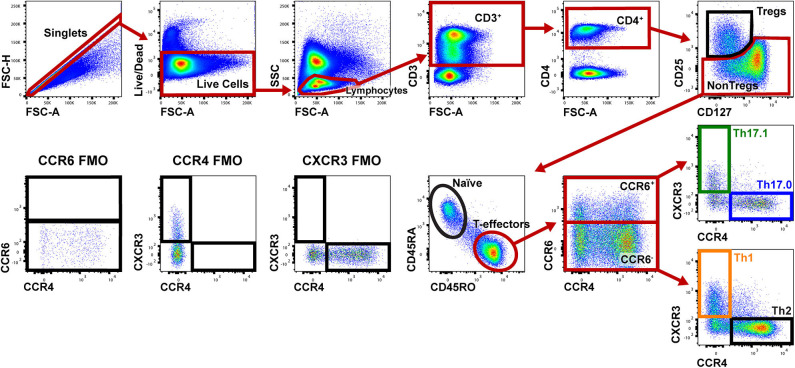
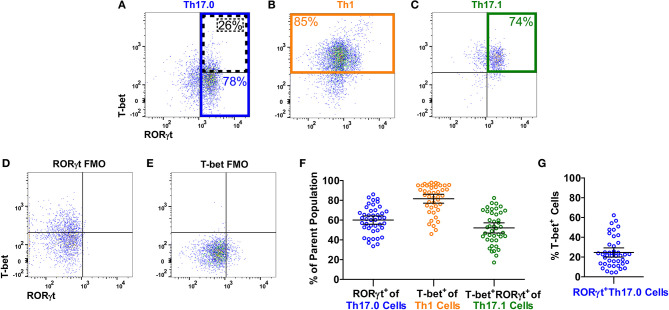
使用病例对照研究设计,我们确定了两组结节病患者(共 43 例),他们的肺功能测试(PFT)要么(1)纵向变化(增加或减少),要么(2)稳定。我们使用流式细胞术测量了血液样本中通过 CCR6、CCR4 和 CXCR3 定义的 Th1、Th17.0 和 Th17.1 细胞亚群中 T 细胞转录因子(T-bet)和 RORγt 的转录因子。我们根据患者的 PFT 组比较了 RORγtTh17.0 细胞(定义为 CCR6CCR4CXCR3)中 T-bet 细胞的百分比。我们还使用混合效应模型评估了 PFT 变化的方向与 T-bet 频率变化之间的关系。
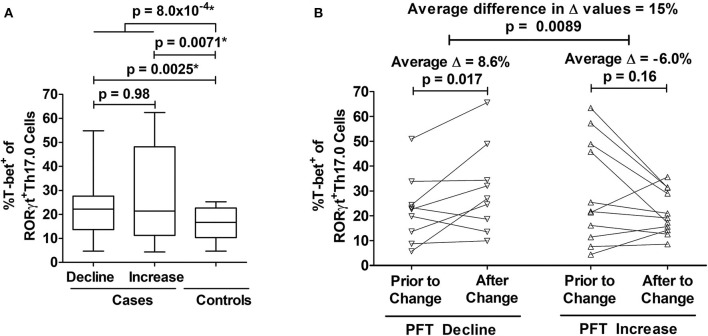
我们发现,根据临床结果,患者的 RORγtTh17.0 细胞中的 T-bet 表达存在差异。与对照组(稳定组)相比,病例组(PFT 变化组)的 RORγtTh17.0 细胞中的 T-bet 百分比更高(27%对 16%, = 0.0040)。在患者 PFT 变化前后的比较中,RORγtTh17.0 细胞的 T-bet 频率增加或减少与 PFT 变化的方向相反。这些 T 细胞的百分比在涉及更多器官的患者中也更高。干扰素-γ诱导的趋化因子 CXCL9、CXCL10 和 CXCL11 的血清水平以及包括 、 和 在内的 IFN-γ 相关基因的全血基因表达与 RORγtTh17.0 细胞中的 T-bet 频率独立呈正相关。
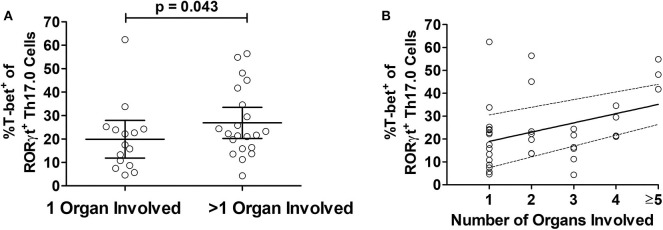
这些数据表明,Th17.0 细胞中的 T-bet 表达可能反映了结节病患者肉芽肿性炎症的程度,因为它们代表了导致 Th17.1 细胞表型的过渡状态。这些发现表明 Th17 可塑性可能是疾病发病机制的一部分。