da Rosa Saulo V, Moysés Samuel J, Theis Laís C, Soares Renata C, Moysés Simone T, Werneck Renata I, Rocha Juliana S
School of Life Sciences, Pontifical Catholic University of Paraná, Curitiba 80215-901, Paraná, Brazil.
School of Medicine, Pontifical Catholic University of Paraná, Curitiba 80215-901, Paraná, Brazil.
Int J Dent. 2020 Jul 23;2020:9074618. doi: 10.1155/2020/9074618. eCollection 2020.
People with disabilities tend to have greater oral health problems compared to those without disabilities. This may be due to barriers they come across in accessing dental services.
The objective of this systematic review was to provide a critical digest of the scientific literature concerning barriers and facilitators of access to oral health services for people with disabilities.
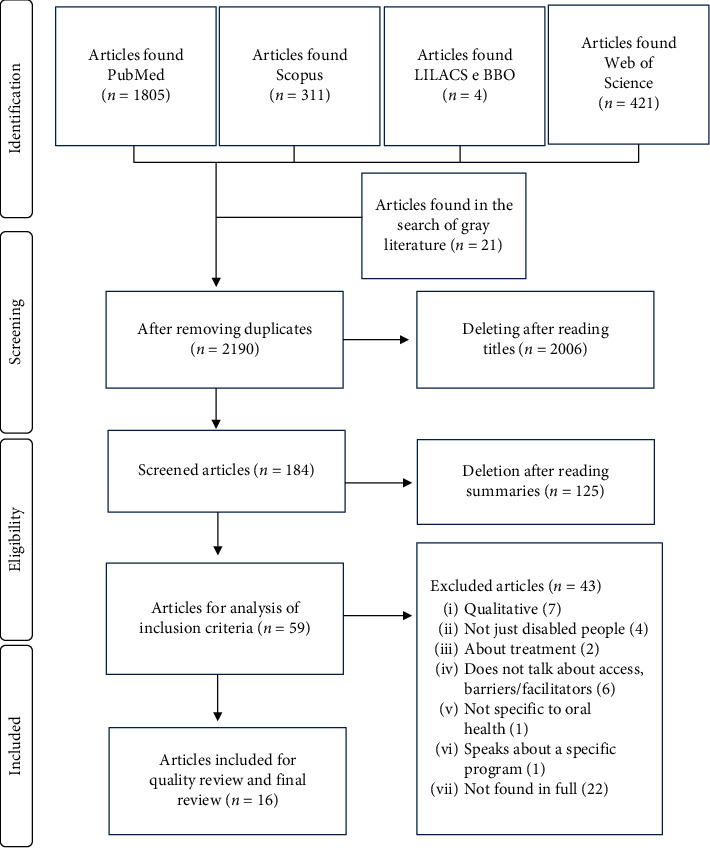
The electronic databases PubMed, Scopus, Web of Science, Latin American and Caribbean Health Sciences Literature (LILACS), and Brazilian Library of Dentistry (BBO) were searched using keywords relevant to the subject. The search was not restricted to specific languages or years of publication; all relevant studies were translated and reviewed.
Sixteen studies including 14 articles, a doctoral thesis, and a monograph were selected, and their quality was analysed using the Downs and Black assessment tool. Barriers to dental services were divided into physical or nonphysical based on the dentist's perspective, as per the perception of parents/guardians or by the persons with disabilities. The barriers that emerged included the dentist's lack of preparation to assist people with disabilities, structural problems of access to dental offices, communication difficulties, and lack of awareness regarding the need for dental treatment for the disabled person.
It is concluded that people with disabilities continue to run into complex physical, behavioural, or multidimensional barriers in accessing dental services. Improved training of dentists for the care of this population is hereby emphasized. The legal framework enabling access to dental care for people with disabilities must also be respected in each country.
与非残疾人士相比,残疾人士往往存在更多口腔健康问题。这可能是由于他们在获得牙科服务时遇到的障碍。
本系统评价的目的是对有关残疾人士获得口腔健康服务的障碍和促进因素的科学文献进行批判性综述。
使用与该主题相关的关键词搜索电子数据库PubMed、Scopus、Web of Science、拉丁美洲和加勒比健康科学文献数据库(LILACS)以及巴西牙科学图书馆(BBO)。搜索不限于特定语言或出版年份;所有相关研究均进行翻译和评审。
共筛选出16项研究,包括14篇文章、1篇博士论文和1篇专著,并使用唐斯和布莱克评估工具对其质量进行分析。根据牙医的观点、父母/监护人的认知或残疾人士的认知,将牙科服务的障碍分为身体障碍或非身体障碍。出现的障碍包括牙医在协助残疾人士方面缺乏准备、进入牙科诊所的结构问题、沟通困难以及对残疾人士牙科治疗需求的认识不足。
得出的结论是,残疾人士在获得牙科服务时仍然面临复杂的身体、行为或多方面障碍。在此强调要加强对牙医照顾这一人群的培训。每个国家还必须尊重保障残疾人士获得牙科护理的法律框架。