Tsuk Sharon, Lev Yarden Har, Fox Orly, Carasso Rafael, Dunsky Ayelet
The Academic College at Wingate, Netanya, Israel.
The Hillel Yaffe Medical Center, Hadera, Israel.
J Hum Kinet. 2020 Jul 21;73:135-144. doi: 10.2478/hukin-2019-0138. eCollection 2020 Jul.
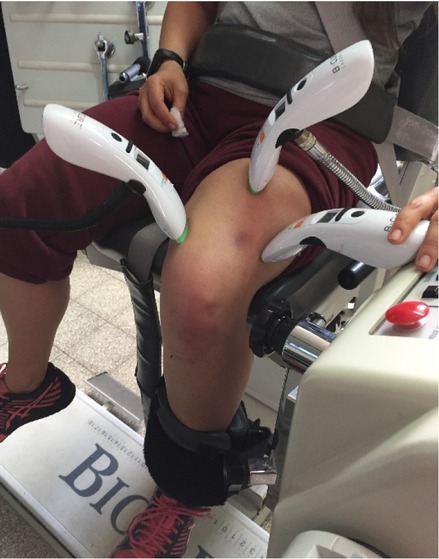
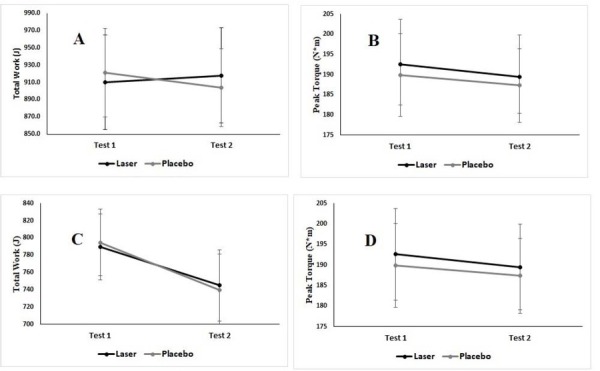
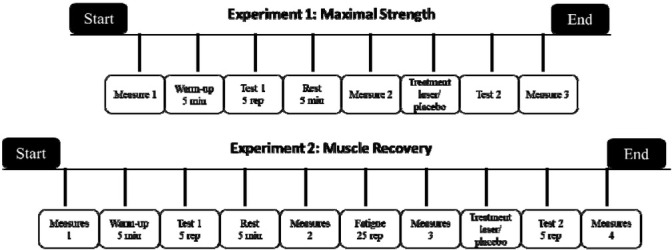
Photobiomodulation has been shown to improve tissue and cell functions. We evaluated the influence of photobiomodulation, using a B-Cure laser, on: 1) maximal performance, and 2) muscle recovery after resistance exercise. Two separate crossover randomized double-blinded placebo-controlled trials were conducted. Sixty healthy physical education students (28 men, 32 women), aged 20-35, were recruited (30 participants for each trial). Participants performed two interventions for each experiment, with real lasers (GaAlAs, 808 nm) on three quadricep locations in parallel (overall treatment energy of ~150J) or sham (placebo) treatment. In the first experiment muscle total work (TW) and peak torque (PT) were measured by an isokinetic dynamometer in five repetitions of knee extension, and in the second experiment muscle recovery was measured after the induction of muscle fatigue by evaluating TW and PT in five repetitions of knee extension. There were no differences between treatments (real or sham) regarding the TW (F(1,28) = 1.09, p = .31), or PT (F(1,29) = .056, p = .814). In addition, there was no effect of photobiomodulation on muscle recovery as measured by the TW (F(1,27) = .16, p = .69) or PT (F(1,29) = .056, p = .814). Applying photobiomodulation for 10 min immediately before exercise did not improve muscle function or muscle recovery after fatigue.
光生物调节已被证明可改善组织和细胞功能。我们评估了使用B-Cure激光进行光生物调节对以下方面的影响:1)最大运动表现,以及2)抗阻运动后的肌肉恢复。进行了两项独立的交叉随机双盲安慰剂对照试验。招募了60名年龄在20至35岁之间的健康体育专业学生(28名男性,32名女性)(每项试验30名参与者)。参与者在每个实验中进行两种干预,分别是在三个股四头肌部位平行使用真正的激光(GaAlAs,808 nm)(总治疗能量约为150焦耳)或假(安慰剂)治疗。在第一个实验中,通过等速测力计在五次膝关节伸展重复动作中测量肌肉总功(TW)和峰值扭矩(PT),在第二个实验中,通过在五次膝关节伸展重复动作中评估TW和PT来测量肌肉疲劳诱导后的肌肉恢复情况。在TW(F(1,28) = 1.09,p = 0.31)或PT(F(1,29) = 0.056,p = 0.814)方面,治疗(真治疗或假治疗)之间没有差异。此外,用光生物调节测量的肌肉恢复情况在TW(F(1,27) = 0.16,p = 0.69)或PT(F(1,29) = 0.056,p = 0.814)方面也没有影响。在运动前立即进行10分钟的光生物调节并不能改善疲劳后的肌肉功能或肌肉恢复。