Radersma Reinder, Noble Daniel W A, Uller Tobias
Department of Biology Lund University Lund Sweden.
Biometris Wageningen University & Research Wageningen The Netherlands.
Evol Lett. 2020 Jun 9;4(4):360-370. doi: 10.1002/evl3.185. eCollection 2020 Aug.
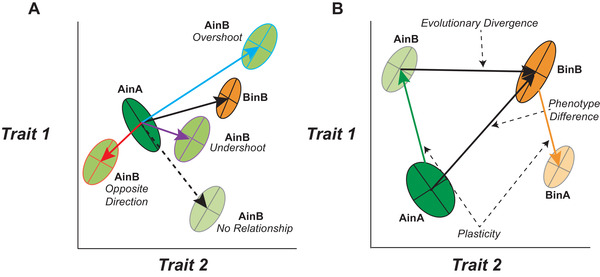
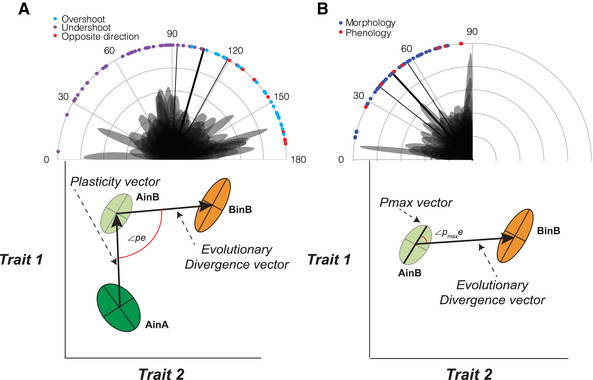
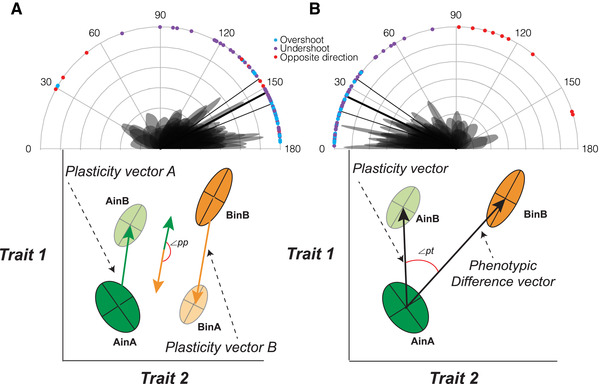
Phenotypic responses to a novel or extreme environment are initially plastic, only later to be followed by genetic change. Whether or not environmentally induced phenotypes are sufficiently recurrent and fit to leave a signature in adaptive evolution is debated. Here, we analyze multivariate data from 34 plant reciprocal transplant studies to test: (1) if plasticity is an adaptive source of developmental bias that makes locally adapted populations resemble the environmentally induced phenotypes of ancestors; and (2) if plasticity, standing phenotypic variation and genetic divergence align during local adaptation. Phenotypic variation increased marginally in foreign environments but, as predicted, the direction of ancestral plasticity was generally well aligned with the phenotypic difference between locally adapted populations, making plasticity appear to "take the lead" in adaptive evolution. Plastic responses were sometimes more extreme than the phenotypes of locally adapted plants, which can give the impression that plasticity and evolutionary adaptation oppose each other; however, environmentally induced and locally adapted phenotypes were rarely misaligned. Adaptive fine-tuning of phenotypes-genetic accommodation-did not fall along the main axis of standing phenotypic variation or the direction of plasticity, and local adaptation did not consistently modify the direction or magnitude of plasticity. These results suggest that plasticity is a persistent source of developmental bias that shapes how plant populations adapt to environmental change, even when plasticity does not constrain how populations respond to selection.
对新的或极端环境的表型反应最初是可塑性的,只有在之后才会伴随基因变化。环境诱导的表型是否足够频繁且适合在适应性进化中留下印记,这一点存在争议。在此,我们分析了来自34项植物 reciprocal 移植研究的多变量数据,以检验:(1)可塑性是否是发育偏差的适应性来源,使得局部适应的种群类似于祖先的环境诱导表型;以及(2)在局部适应过程中,可塑性、现存表型变异和遗传分化是否一致。在异域环境中,表型变异略有增加,但正如预期的那样,祖先可塑性的方向通常与局部适应种群之间的表型差异高度一致,这使得可塑性在适应性进化中似乎“领先一步”。可塑性反应有时比局部适应植物的表型更为极端,这可能给人一种可塑性与进化适应相互对立的印象;然而,环境诱导的表型和局部适应的表型很少不一致。表型的适应性微调——遗传顺应——并不沿着现存表型变异的主轴或可塑性方向进行,并且局部适应也没有始终如一地改变可塑性的方向或幅度。这些结果表明,可塑性是发育偏差的持续来源,它塑造了植物种群适应环境变化的方式,即使可塑性并不限制种群对选择的反应方式。