Li Fenfen, Zhang Caili, Weng Yunxuan
College of Chemistry and Materials Engineering, Beijing Technology and Business University, Beijing 100048, China.
Beijing Key Laboratory of Quality Evaluation Technology for Hygiene and Safety of Plastics, Beijing Technology and Business University, Beijing 100048, China.
ACS Omega. 2020 Jul 21;5(30):18675-18684. doi: 10.1021/acsomega.0c01405. eCollection 2020 Aug 4.
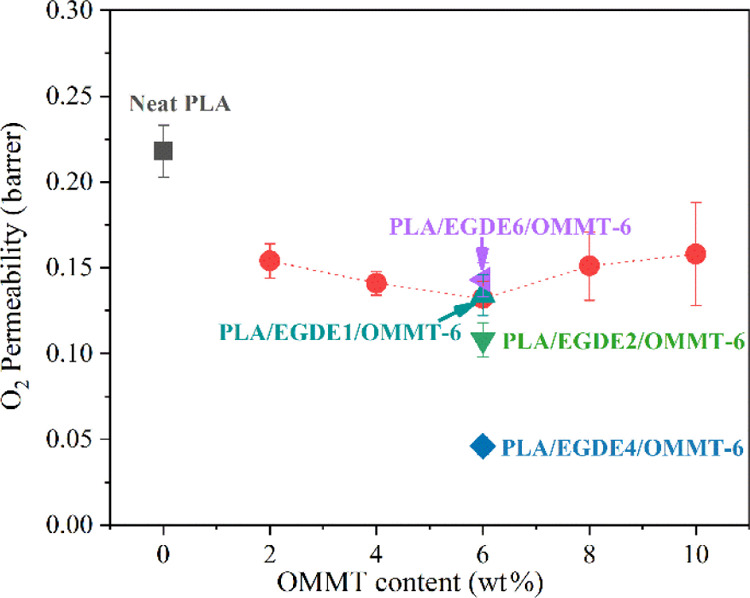
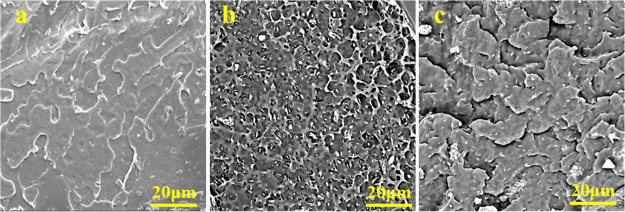
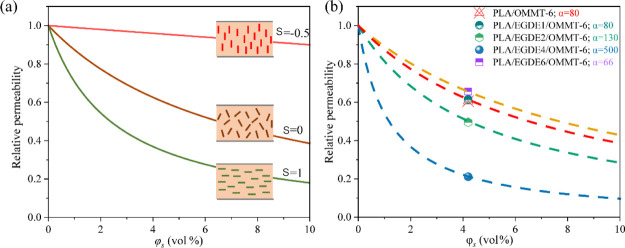
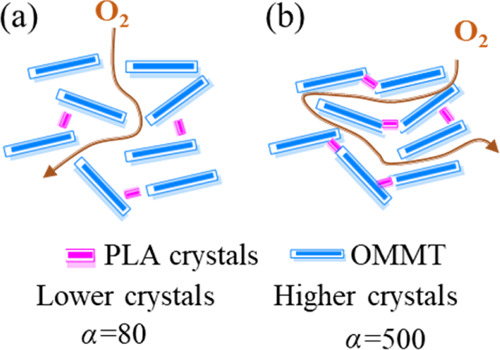
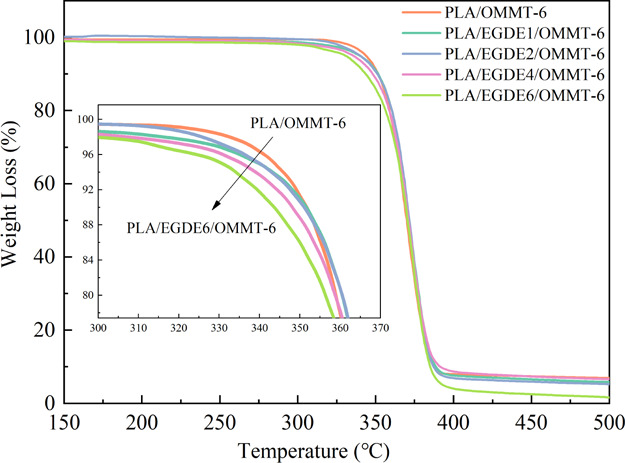
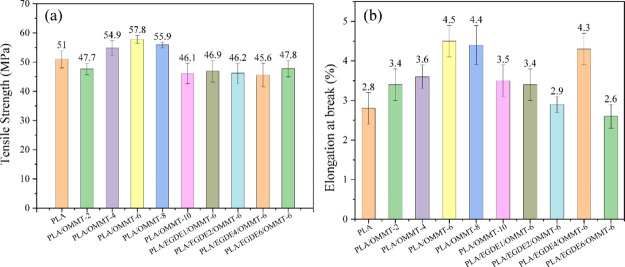
A high gas barrier performance should be ensured in case of biodegradable packing applications. However, the gas barrier properties of the biodegradable poly(lactic acid) (PLA) are not much effective. Nanocomposites can provide innovative solutions to enhance the barrier performance. In this study, different weight percentages of organically modified montmorillonite (OMMT) (0, 2, 4, 6, 8, and 10 wt %)-incorporated PLA/OMMT nanocomposites were prepared by melt mixing. Ethylene glycol diglycidyl ether (EGDE) was used to regulate the interlayer spacing of OMMT and increase the PLA crystallinity to further improve the gas barrier performance of the PLA/OMMT films. The crystallinity of PLA was significantly improved because EGDE-modified OMMT served as an efficient nucleating agent. The PLA/EGDE/OMMT films demonstrated a unique structure such that the adjacent OMMT layers were linked through the PLA crystals that serve as a bridge with respect to the spaces between the OMMT layers. The O permeability of the PLA/EGDE4/OMMT-6 film decreased by approximately 79% when compared with that of the neat PLA film. X-ray diffraction and differential scanning calorimetry analyses denoted that the reduced oxygen permeability of the PLA/EGDE4/OMMT-6 film can be primarily attributed to the high crystallinity of the PLA matrix and the bridging effect of the PLA crystals between two adjacent layers. Based on the experimental results, the relation between the relative permeability and vol % OMMT is in good agreement with that of the predicted values obtained using the Bharadwaj model when = 0. The added EGDE weakened the thermal stability and tensile strength, mainly because of degradation of the hydroxyl groups of EGDE formed by epoxy ring opening, and these hydroxyl groups can promote PLA matrix degradation. However, the practical application temperature of the packaging film is considerably lower than the thermal decomposition temperature; therefore, the reduction of the thermal decomposition temperature does not affect the use of the packaging film.
在生物可降解包装应用中,应确保具有高气体阻隔性能。然而,生物可降解聚乳酸(PLA)的气体阻隔性能不太理想。纳米复合材料可为提高阻隔性能提供创新解决方案。在本研究中,通过熔融共混制备了不同重量百分比(0、2、4、6、8和10 wt%)的有机改性蒙脱土(OMMT)增强的PLA/OMMT纳米复合材料。使用乙二醇二缩水甘油醚(EGDE)调节OMMT的层间距并提高PLA的结晶度,以进一步改善PLA/OMMT薄膜的气体阻隔性能。由于EGDE改性的OMMT作为有效的成核剂,PLA的结晶度显著提高。PLA/EGDE/OMMT薄膜呈现出独特的结构,相邻的OMMT层通过PLA晶体相连,PLA晶体在OMMT层之间的空间中起到桥梁作用。与纯PLA薄膜相比,PLA/EGDE4/OMMT-6薄膜的氧气渗透率降低了约79%。X射线衍射和差示扫描量热分析表明,PLA/EGDE4/OMMT-6薄膜氧气渗透率降低主要归因于PLA基体的高结晶度以及PLA晶体在两个相邻层之间的桥接作用。基于实验结果,当=0时,相对渗透率与OMMT体积%之间的关系与使用Bharadwaj模型获得的预测值吻合良好。添加的EGDE削弱了热稳定性和拉伸强度,主要是因为环氧环开环形成的EGDE羟基发生降解,这些羟基会促进PLA基体降解。然而,包装薄膜的实际应用温度远低于热分解温度;因此,热分解温度的降低不影响包装薄膜的使用。