Boyeva Veronika, Alabsi Hatim, Seidman Michael A, Paterson Ryan, Kur Jason, Chen Luke Y C, Chang Silvia D, Carruthers Mollie
Department of Medicine, University of British Columbia, 2775 Laurel Street, Vancouver, BC V5Z 1M9 Canada.
Department of Radiology, King Abdulaziz University, Al Ehtifalat St, Jeddah, 21589 Saudi Arabia.
BMC Rheumatol. 2020 Aug 6;4:40. doi: 10.1186/s41927-020-00140-9. eCollection 2020.
Retroperitoneal fibrosis (RPF) is characterized by the proliferation of fibrous tissue in the retroperitoneum. The majority of RPF cases are due to idiopathic or IgG4-related disease. Recent studies on IgG4-related disease have shown rituximab to be an effective treatment. The current first-line treatment for idiopathic RPF (iRPF) is glucocorticoid therapy. Relapse rates vary widely in the literature, and DMARDs remain poorly studied. We sought to evaluate the efficacy of rituximab in idiopathic RPF by quantifying changes in iRPF diameter on imaging pre- and post-rituximab therapy and response by lab parameters in 10 iRPF patients.
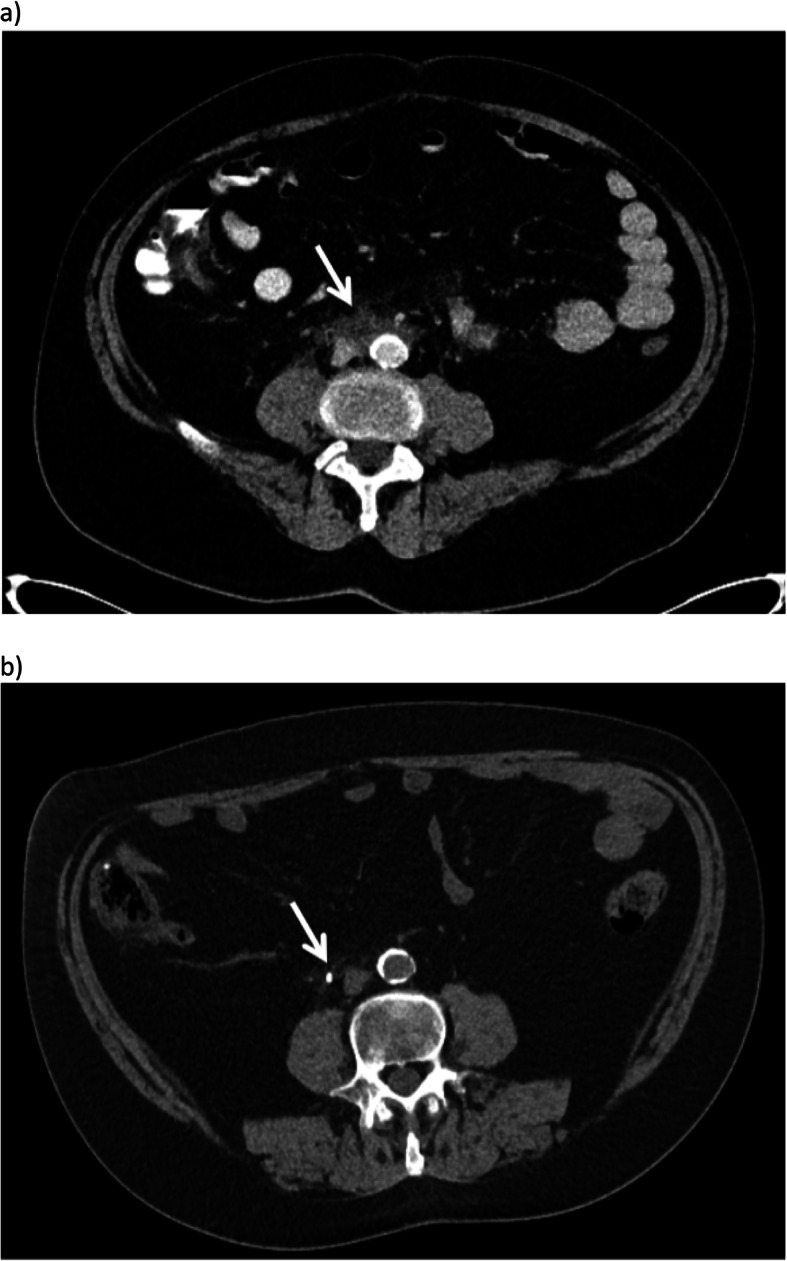
We selected 10 patients diagnosed with iRPF and previously treated with rituximab (1000 mg) in two doses approximately 2 weeks apart. Pre- and post-therapy contrast enhanced cross-sectional abdomen and pelvis imaging were compared. In all patients, the thickest portion of the peri-aortic disease was measured in the axial and coronal planes. The presence of acute or long standing back pressure related renal findings were documented. Details of clinical visits including patient demographics and laboratory evaluations were collected pre- and post-therapy. Statistical analysis was performed using a Wilcoxon signed rank test.
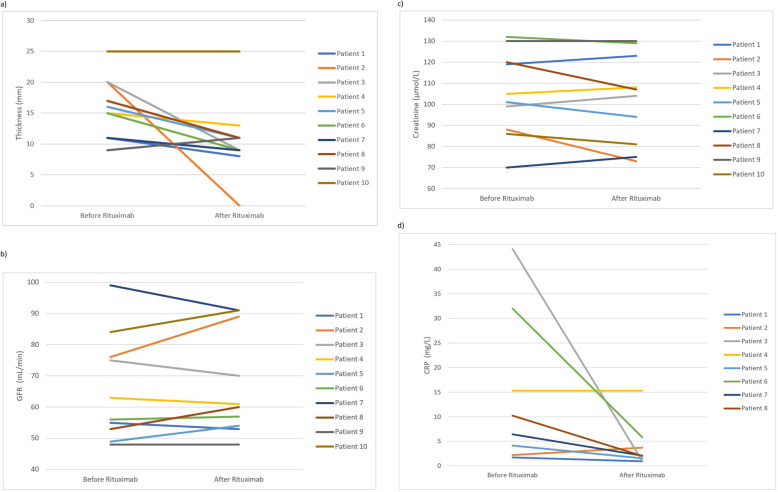
The RPF diameter around the aorta before and after therapy decreased from a mean of 15.9 ± 4.9 mm to 10.6 ± 6.1 mm, respectively ( < 0.01). The craniocaudal iRPF mean length decreased from 108.6 mm ± 40.4 mm to 90.6 mm ± 45.9 mm ( = 0.02).
A comparison of pre and post-rituximab imaging studies revealed a statistically significant decrease in iRPF diameter following treatment with rituximab.
腹膜后纤维化(RPF)的特征是腹膜后纤维组织增生。大多数RPF病例是特发性的或与IgG4相关疾病有关。最近关于IgG4相关疾病的研究表明,利妥昔单抗是一种有效的治疗方法。目前特发性RPF(iRPF)的一线治疗是糖皮质激素疗法。复发率在文献中的差异很大,而改善病情抗风湿药(DMARDs)的研究仍然很少。我们试图通过量化利妥昔单抗治疗前后iRPF直径的变化以及10例iRPF患者的实验室参数反应,来评估利妥昔单抗治疗iRPF的疗效。
我们选择了10例诊断为iRPF且先前接受过利妥昔单抗(1000mg)治疗的患者,分两剂给药,间隔约2周。比较治疗前后的腹部和盆腔增强CT成像。在所有患者中,在轴位和冠状位平面测量主动脉周围疾病最厚的部分。记录急性或长期背压相关肾脏表现的存在情况。收集治疗前后临床就诊的详细信息,包括患者人口统计学和实验室评估。使用Wilcoxon符号秩检验进行统计分析。
治疗前后主动脉周围的RPF直径分别从平均15.9±4.9mm降至10.6±6.1mm(P<0.01)。头尾方向的iRPF平均长度从108.6mm±40.4mm降至90.6mm±45.9mm(P=0.02)。
利妥昔单抗治疗前后影像学研究的比较显示,利妥昔单抗治疗后iRPF直径有统计学意义的减小。