Center for Clinical & Translational Research, The Abigail Wexner Research Institute at Nationwide Children's, Columbus, OH, USA.
Department of Pediatrics, The Ohio State University College of Medicine, Columbus, OH, USA.
Physiol Rep. 2020 Aug;8(15):e14515. doi: 10.14814/phy2.14515.
Thrombosis is a potentially life-threatening nephrotic syndrome (NS) complication. We have previously demonstrated that hypercoagulopathy is proportional to NS severity in rat models and that pioglitazone (Pio) reduces proteinuria both independently and in combination with methylprednisolone (MP), a glucocorticoid (GC). However, the effect of these treatments on NS-associated hypercoagulopathy remains unknown. We thus sought to determine the ability of Pio and GC to alleviate NS-associated hypercoagulopathy.
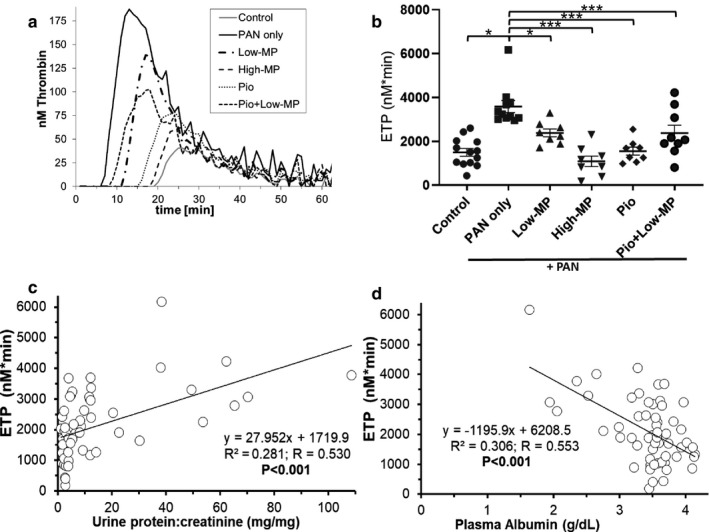
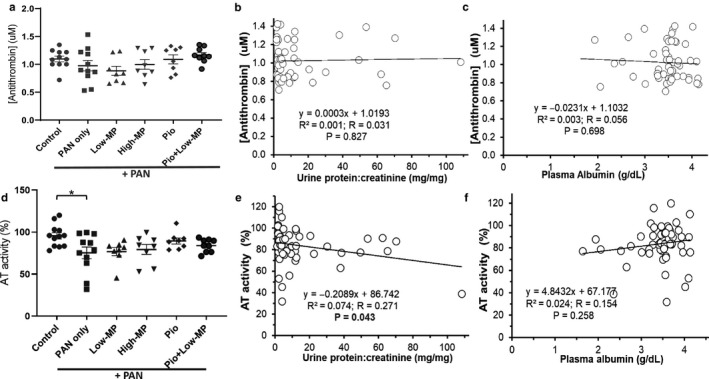
Puromycin aminonucleoside-induced rat NS was treated with sham, Low- or High-dose MP, Pio, or combination (Pio + Low-MP) and plasma was collected at day 11. Plasma samples were collected from children with steroid-sensitive NS (SSNS) and steroid-resistant NS (SRNS) upon presentation and after 7 weeks of GC therapy. Plasma endogenous thrombin potential (ETP), antithrombin (AT) activity, and albumin (Alb) were measured using thrombin generation, amidolytic, and colorimetric assays, respectively.
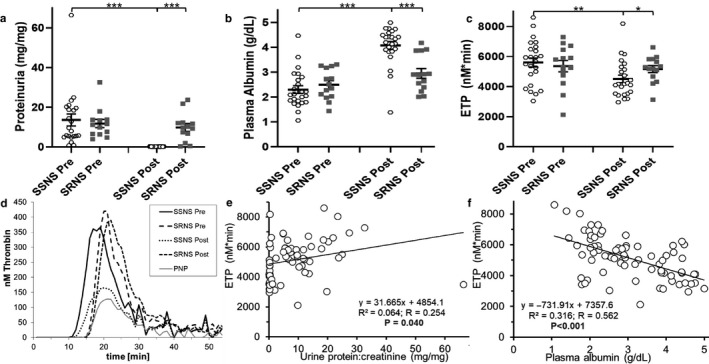
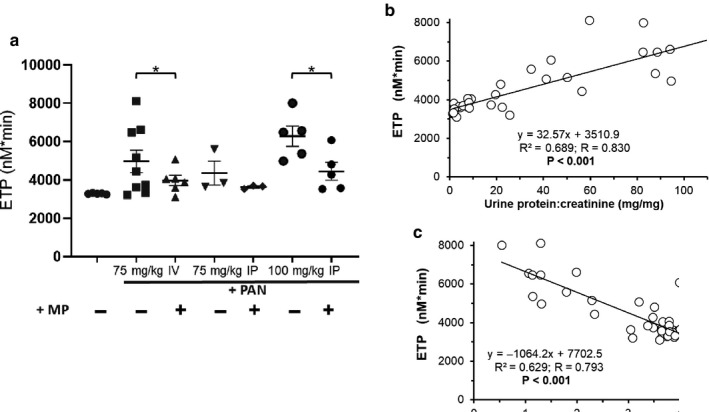
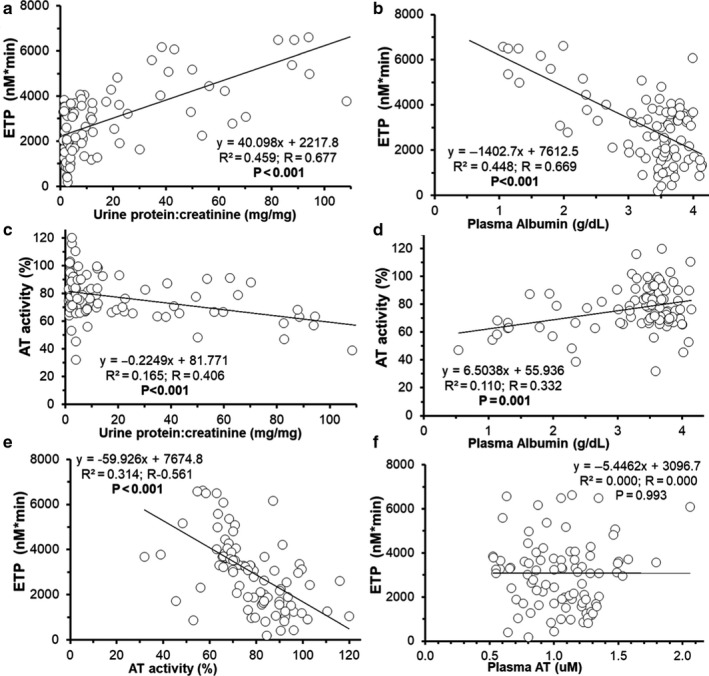
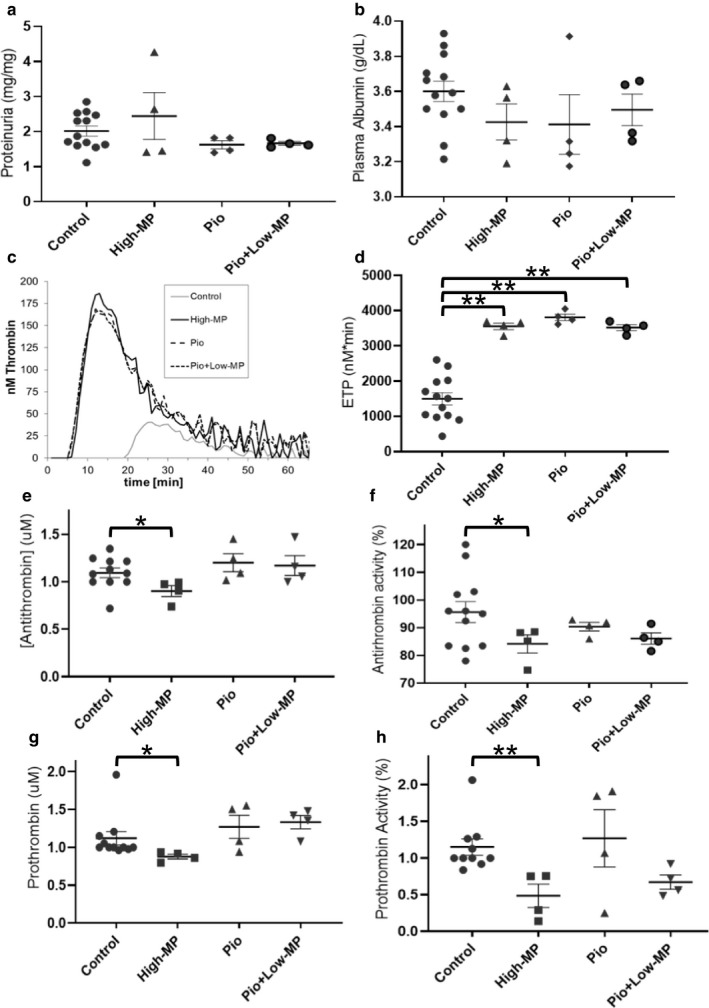
In a rat model of NS, both High-MP and Pio improved proteinuria and corrected hypoalbuminemia, ETP and AT activity (p < .05). Proteinuria (p = .005) and hypoalbuminemia (p < .001) were correlated with ETP. In childhood NS, while ETP was not different at presentation, GC therapy improved proteinuria, hypoalbuminemia, and ETP in children with SSNS (p < .001) but not SRNS (p = .330).
Both Pio and GC diminish proteinuria and significantly alleviate hypercoagulopathy. Both Pio and MP improved hypercoagulopathy in rats, and successful GC therapy (SSNS) also improved hypercoagulopathy in childhood NS. These data suggest that even a partial reduction in proteinuria may reduce NS-associated thrombotic risk.
血栓形成是一种潜在危及生命的肾病综合征(NS)并发症。我们之前已经证明,在大鼠模型中,高凝状态与 NS 的严重程度成正比,吡格列酮(Pio)可独立于甲泼尼龙(MP,一种糖皮质激素(GC)),也可与甲泼尼龙联合使用,降低蛋白尿。然而,这些治疗方法对 NS 相关高凝状态的影响尚不清楚。因此,我们试图确定 Pio 和 GC 减轻 NS 相关高凝状态的能力。
采用嘌呤霉素氨基核苷诱导的大鼠 NS 模型,分别用假手术、低剂量 MP、Pio 或联合(Pio+低剂量 MP)治疗,于第 11 天采集血浆。收集初诊时和接受 GC 治疗 7 周后的儿童激素敏感型 NS(SSNS)和激素抵抗型 NS(SRNS)患者的血浆样本。采用血栓生成、酶解和比色法分别检测血浆内源性凝血酶潜能(ETP)、抗凝血酶(AT)活性和白蛋白(Alb)。
在大鼠 NS 模型中,高剂量 MP 和 Pio 均改善蛋白尿,纠正低白蛋白血症、ETP 和 AT 活性(p<0.05)。蛋白尿(p=0.005)和低白蛋白血症(p<0.001)与 ETP 相关。在儿童 NS 中,虽然初诊时 ETP 无差异,但 GC 治疗可改善 SSNS 患儿的蛋白尿、低白蛋白血症和 ETP(p<0.001),但对 SRNS 患儿无影响(p=0.330)。
Pio 和 GC 均可减少蛋白尿,显著缓解高凝状态。Pio 和 MP 均可改善大鼠的高凝状态,GC 治疗成功(SSNS)也可改善儿童 NS 的高凝状态。这些数据表明,即使蛋白尿部分减少也可能降低 NS 相关的血栓形成风险。