Medical Department, University Hospital Marien Hospital Herne, Ruhr-University, Bochum, Germany.
Center for Translational Medicine, University Hospital Marien Hospital Herne, Ruhr-University, Bochum, Germany.
Am J Transplant. 2020 Nov;20(11):3210-3215. doi: 10.1111/ajt.16252. Epub 2020 Sep 9.
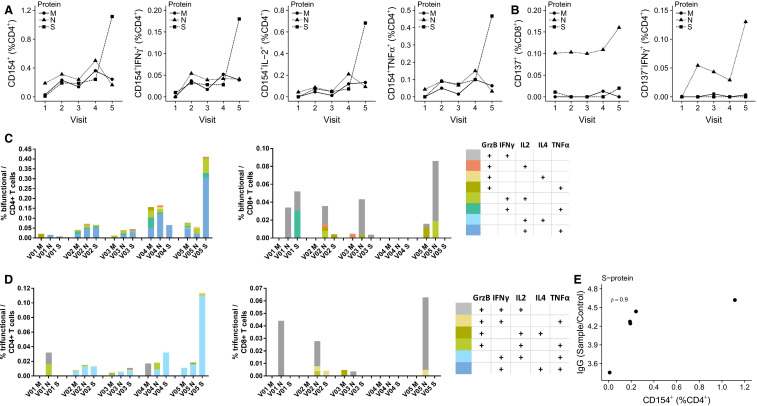
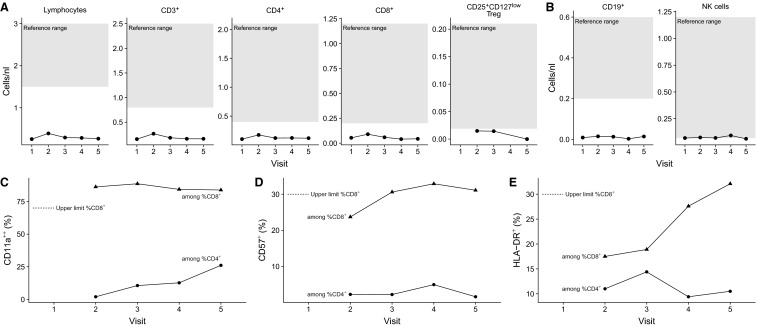
The optimal management in transplant recipients with coronavirus disease 2019 (COVID-19) remains uncertain. The main concern is the ability of immunosuppressed patients to generate sufficient immunity for antiviral protection. Here, we report on immune monitoring facilitating a successful outcome of severe severe acute respiratory syndrome coronavirus 2 (SARS-CoV-2)-associated pneumonia, meningoencephalitis, gastroenteritis, and acute kidney and pancreas graft failure in a pancreas-kidney transplant recipient. Despite the very low numbers of circulating B, NK, and T cells identified in follow-up, a strong SARS-CoV-2 reactive T cell response was observed. Importantly, we detected T cells reactive to Spike, Membrane, and Nucleocapsid proteins of SARS-CoV-2 with majority of T cells showing polyfunctional proinflammatory Th1 phenotype at all analyzed time points. Antibodies against Spike protein were also detected with increasing titers in follow-up. Neutralization tests confirmed their antiviral protection. A correlation between cellular and humoral immunity was observed underscoring the specificity of demonstrated data. We conclude that analyzing the kinetics of nonspecific and SARS-CoV-2-reactive cellular and humoral immunity can facilitate the clinical decision on immunosuppression adjustment and allow successful outcome as demonstrated in the current clinical case. Although the antiviral protection of the detected SARS-CoV-2-reactive T cells requires further evaluation, our data prove an ability mounting a strong SARS-CoV-2-reactive T cell response with functional capacity in immunosuppressed patients.
在感染 2019 冠状病毒病(COVID-19)的移植受者中,最佳的管理方法仍不确定。主要的关注点是免疫抑制患者产生足够的抗病毒保护免疫力的能力。在这里,我们报告了免疫监测在一例胰腺-肾移植受者中成功治疗严重严重急性呼吸综合征冠状病毒 2(SARS-CoV-2)相关肺炎、脑膜脑炎、胃肠炎、急性肾和胰腺移植物衰竭方面的作用。尽管在后续随访中仅发现循环 B、NK 和 T 细胞数量非常低,但观察到了强烈的 SARS-CoV-2 反应性 T 细胞反应。重要的是,我们检测到对 SARS-CoV-2 的 Spike、Membrane 和 Nucleocapsid 蛋白具有反应性的 T 细胞,大多数 T 细胞在所有分析时间点均表现出具有促炎 Th1 表型的多功能性。还在随访中检测到针对 Spike 蛋白的抗体,且其滴度逐渐增加。中和试验证实了它们的抗病毒保护作用。观察到细胞和体液免疫之间存在相关性,突出了所展示数据的特异性。我们得出结论,分析非特异性和 SARS-CoV-2 反应性细胞和体液免疫的动力学可以促进免疫抑制调整的临床决策,并允许如当前临床病例所示获得成功结果。尽管所检测的 SARS-CoV-2 反应性 T 细胞的抗病毒保护作用需要进一步评估,但我们的数据证明了在免疫抑制患者中能够产生具有功能能力的强烈 SARS-CoV-2 反应性 T 细胞反应的能力。