Department of Pharmaceutical Chemistry, University of California San Francisco, San Francisco, CA 94158, USA.
Division of Glycobiologics, Intractable Disease Research Center, Juntendo University Graduate School of Medicine, Tokyo, Japan; Glycometabolic Biochemistry Laboratory, RIKEN Cluster for Pioneering Research, Saitama, Japan.
Biochem Biophys Res Commun. 2020 Oct 1;530(4):719-724. doi: 10.1016/j.bbrc.2020.06.127. Epub 2020 Aug 8.
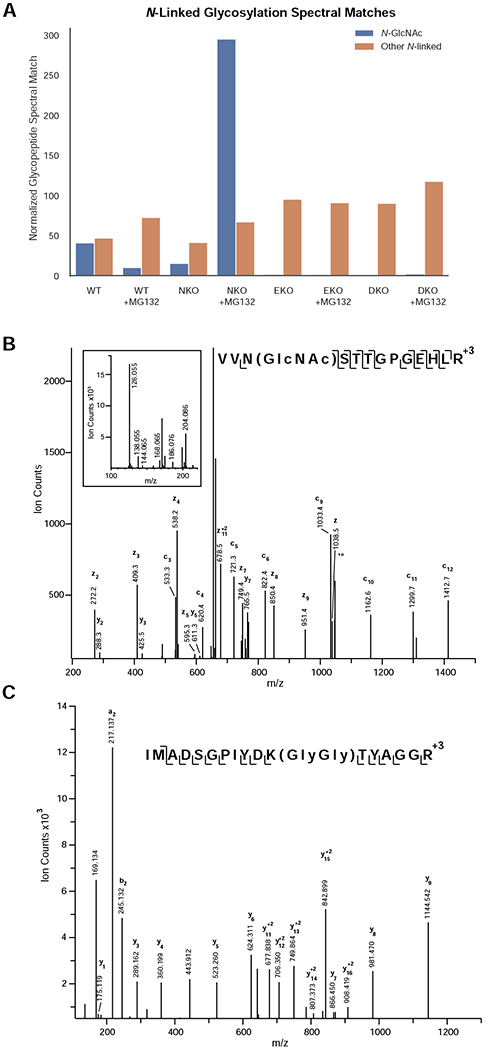
NGLY1 is a widely conserved eukaryotic cytosolic deglycosylating enzyme involved in the endoplasmic reticulum-associated degradation (ERAD) process, which eliminates misfolded proteins through retrograde translocation and proteasomal degradation. A human genetic disorder called NGLY1-deficiency has been reported, indicating the functional importance of NGLY1 in humans. Evidence suggests that Ngly1-KO is embryonic lethal in mice, while additional deletion of the Engase gene, encoding another cytosolic deglycosylating enzyme (endo-β-N-acetylglucosaminidase; ENGase), partially rescued lethality. Upon compromised Ngly1 activity, ENGase-mediated deglycosylation of misfolded glycoproteins may cause excess formation of N-GlcNAc proteins in the cytosol, leading to detrimental effects in the mice. Whether endogenous N-GlcNAc proteins are really formed in Ngly1-KO cells/animals or not remains unclarified. Here, comprehensive identification of O- and N-GlcNAc proteins was carried out using purified cytosol from wild type, Ngly1-KO, Engase-KO, and Ngly1/Engase double KO mouse embryonic fibroblasts. It was revealed that while there is no dramatic change in the level of O-GlcNAc proteins among cells examined, there was a vast increase of N-GlcNAc proteins in Ngly1-KO cells upon proteasome inhibition. Importantly, few N-GlcNAc proteins were observed in Engase-KO or Ngly1/Engase double-KO cells, clearly indicating that the cytosolic ENGase is responsible for the formation of N-GlcNAc proteins. The excess formation of N-GlcNAc proteins may at least in part account for the pathogenesis of NGLY1-deficiency.
NGLY1 是一种广泛保守的真核细胞质脱糖基化酶,参与内质网相关降解(ERAD)过程,通过逆行易位和蛋白酶体降解消除错误折叠的蛋白质。已经报道了一种称为 NGLY1 缺乏的人类遗传疾病,表明 NGLY1 在人类中的功能重要性。有证据表明,Ngly1-KO 小鼠胚胎致死,而另一种细胞质脱糖基化酶(内-β-N-乙酰氨基葡萄糖苷酶;ENGase)编码基因 Engase 的缺失部分挽救了致死性。在 Ngly1 活性受损的情况下,ENGase 介导的错误折叠糖蛋白的脱糖基化可能导致细胞质中 N-GlcNAc 蛋白的过度形成,从而对小鼠产生有害影响。在 Ngly1-KO 细胞/动物中是否真的形成了内源性 N-GlcNAc 蛋白仍不清楚。在这里,使用来自野生型、Ngly1-KO、Engase-KO 和 Ngly1/Engase 双 KO 小鼠胚胎成纤维细胞的纯化细胞质进行了全面的 O-和 N-GlcNAc 蛋白鉴定。结果表明,虽然在所检查的细胞中 O-GlcNAc 蛋白的水平没有明显变化,但在蛋白酶体抑制时,Ngly1-KO 细胞中 N-GlcNAc 蛋白的含量大大增加。重要的是,在 Engase-KO 或 Ngly1/Engase 双 KO 细胞中几乎观察不到 N-GlcNAc 蛋白,这清楚地表明细胞质 ENGase 负责 N-GlcNAc 蛋白的形成。N-GlcNAc 蛋白的过度形成至少部分解释了 NGLY1 缺乏的发病机制。