Moro Tatiana, Paoli Antonio
Department of Biomedical Sciences, University of Padova, Italy.
CIR-Myo, University of Padova, Italy.
Eur J Transl Myol. 2020 Jun 17;30(2):9069. doi: 10.4081/ejtm.2019.9069. eCollection 2020 Jul 13.
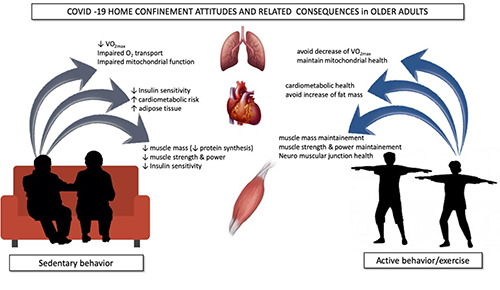
At the beginning of 2020 a respiratory diseased named COVID-19 rapidly spread worldwide. Due to the presence of comorbidities and a greater susceptibility to infections, older adults are the population most affected by this pandemic. An efficient pharmacological treatment for COVID-19 is not ready yet; in the meanwhile, a general quarantine has been initiated as a preventive action against the spread of the disease. If on one side this countermeasure is slowing the spread of the virus, on the other side is also reducing the amount of physical activity. Sedentariness is associated with numerous negative health outcomes and increase risk of fall, fractures and disabilities in older adults. Models of physical inactivity have been widely studied in the past decades, and most studies agreed that is necessary to implement physical exercise (such as walking, low load resistance or in bed exercise) during periods of disuse to protect muscle mass and function from catabolic crisis. Moreover, older adults have a blunted response to physical rehabilitation, and a combination of intense resistance training and nutrition are necessary to overcome the loss of in skeletal muscle due to disuse.
2020年初,一种名为COVID-19的呼吸道疾病在全球迅速传播。由于存在合并症以及对感染的易感性更高,老年人是受此次大流行影响最严重的人群。针对COVID-19的有效药物治疗尚未准备就绪;与此同时,已启动全面隔离作为预防疾病传播的行动。一方面,这种对策正在减缓病毒的传播,另一方面,它也在减少身体活动量。久坐不动与许多负面健康结果相关,并增加老年人跌倒、骨折和残疾的风险。在过去几十年中,缺乏身体活动的模式已得到广泛研究,大多数研究一致认为,在不使用期间进行体育锻炼(如散步、低负荷阻力或床上运动)对于保护肌肉质量和功能免受分解代谢危机的影响是必要的。此外,老年人对身体康复的反应较为迟钝,需要结合高强度阻力训练和营养来克服因不使用而导致的骨骼肌损失。