Karolinska Institutet, Institute of Environmental Medicine, 171 77 Stockholm, Sweden.
Int J Mol Sci. 2020 Aug 8;21(16):5681. doi: 10.3390/ijms21165681.
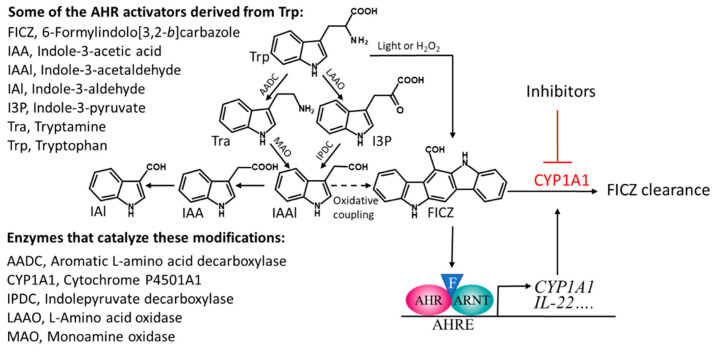
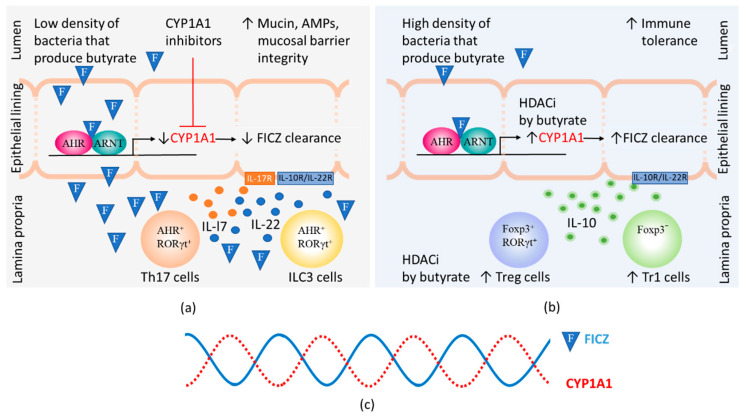
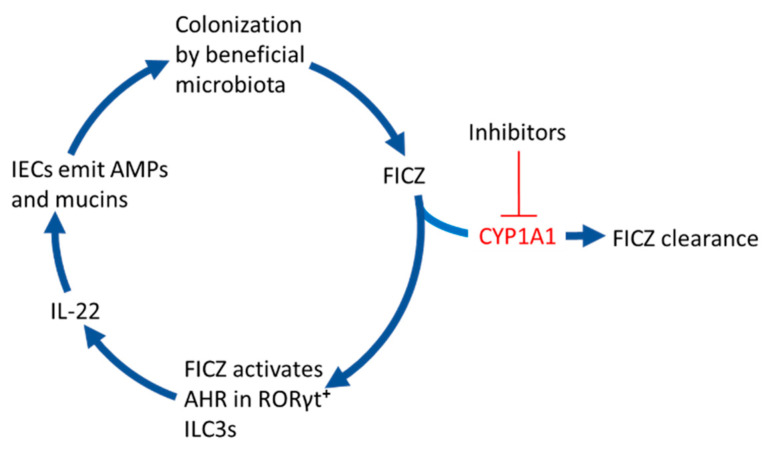
Ever since the 1970s, when profound immunosuppression caused by exogenous dioxin-like compounds was first observed, the involvement of the aryl hydrocarbon receptor (AHR) in immunomodulation has been the focus of considerable research interest. Today it is established that activation of this receptor by its high-affinity endogenous ligand, 6-formylindolo[3,2-]carbazole (FICZ), plays important physiological roles in maintaining epithelial barriers. In the gut lumen, the small amounts of FICZ that are produced from L-tryptophan by microbes are normally degraded rapidly by the inducible cytochrome P4501A1 (CYP1A1) enzyme. This review describes how when the metabolic clearance of FICZ is attenuated by inhibition of CYP1A1, this compound passes through the intestinal epithelium to immune cells in the lamina propria. FICZ, the level of which is thus modulated by this autoregulatory loop involving FICZ itself, the AHR and CYP1A1, plays a central role in maintaining gut homeostasis by potently up-regulating the expression of interleukin 22 (IL-22) by group 3 innate lymphoid cells (ILC3s). IL-22 stimulates various epithelial cells to produce antimicrobial peptides and mucus, thereby both strengthening the epithelial barrier against pathogenic microbes and promoting colonization by beneficial bacteria. Dietary phytochemicals stimulate this process by inhibiting CYP1A1 and causing changes in the composition of the intestinal microbiota. The activity of CYP1A1 can be increased by other microbial products, including the short-chain fatty acids, thereby accelerating clearance of FICZ. In particular, butyrate enhances both the level of the AHR and CYP1A1 activity by stimulating histone acetylation, a process involved in the daily cycle of the FICZ/AHR/CYP1A1 feedback loop. It is now of key interest to examine the potential involvement of FICZ, a major physiological activator of the AHR, in inflammatory disorders and autoimmunity.
自 20 世纪 70 年代首次观察到外源性二噁英样化合物引起的深刻免疫抑制以来,芳烃受体(AHR)在免疫调节中的作用一直是相当多研究的重点。如今,该受体被其高亲和力内源性配体 6- 甲酰基吲哚并[3,2-b]咔唑(FICZ)激活,在维持上皮屏障方面发挥着重要的生理作用。在肠道腔中,微生物从 L-色氨酸产生的少量 FICZ 通常很快被诱导型细胞色素 P4501A1(CYP1A1)酶降解。本综述描述了当 FICZ 的代谢清除率因 CYP1A1 的抑制而减弱时,该化合物如何穿过肠上皮细胞到达固有层中的免疫细胞。FICZ 的水平受该自动调节环路调节,该环路涉及 FICZ 本身、AHR 和 CYP1A1,通过强烈上调 3 组固有淋巴细胞(ILC3)的白细胞介素 22(IL-22)的表达,在维持肠道内稳态方面发挥核心作用。IL-22 刺激各种上皮细胞产生抗菌肽和粘液,从而增强上皮屏障对病原微生物的抵抗力,并促进有益细菌的定植。膳食植物化学物质通过抑制 CYP1A1 并改变肠道微生物群落的组成来刺激这一过程。CYP1A1 的活性可被其他微生物产物增加,包括短链脂肪酸,从而加速 FICZ 的清除。特别是,丁酸盐通过刺激组蛋白乙酰化来增强 AHR 和 CYP1A1 活性,这是 FICZ/AHR/CYP1A1 反馈环的日常循环过程的一部分。目前,研究 FICZ(AHR 的主要生理激活剂)在炎症性疾病和自身免疫中的潜在作用是非常重要的。