Department of Plant and Microbial Biology, University of Minnesota-Twin Cities, 1445 Gortner Avenue, St. Paul, MN 55108, USA.
Institut für Molekulare Physiologie, Johannes Gutenberg-Universität Mainz, D-55099 Mainz, Germany.
Syst Biol. 2021 Feb 10;70(2):219-235. doi: 10.1093/sysbio/syaa066.
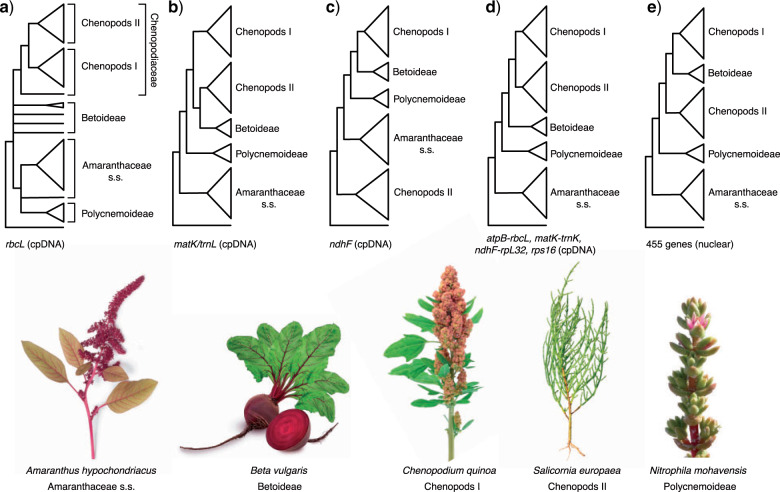
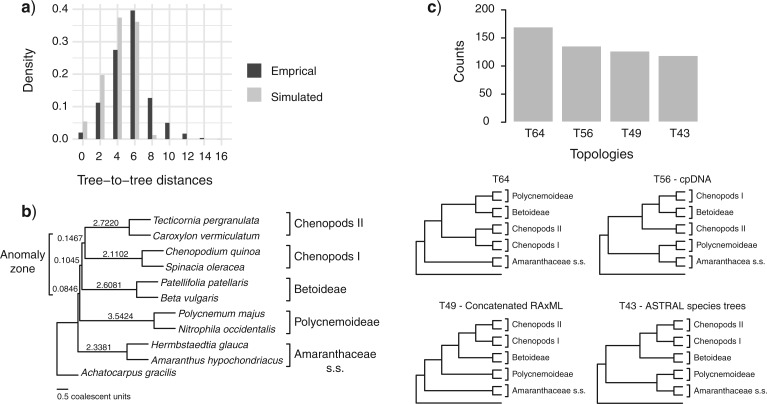
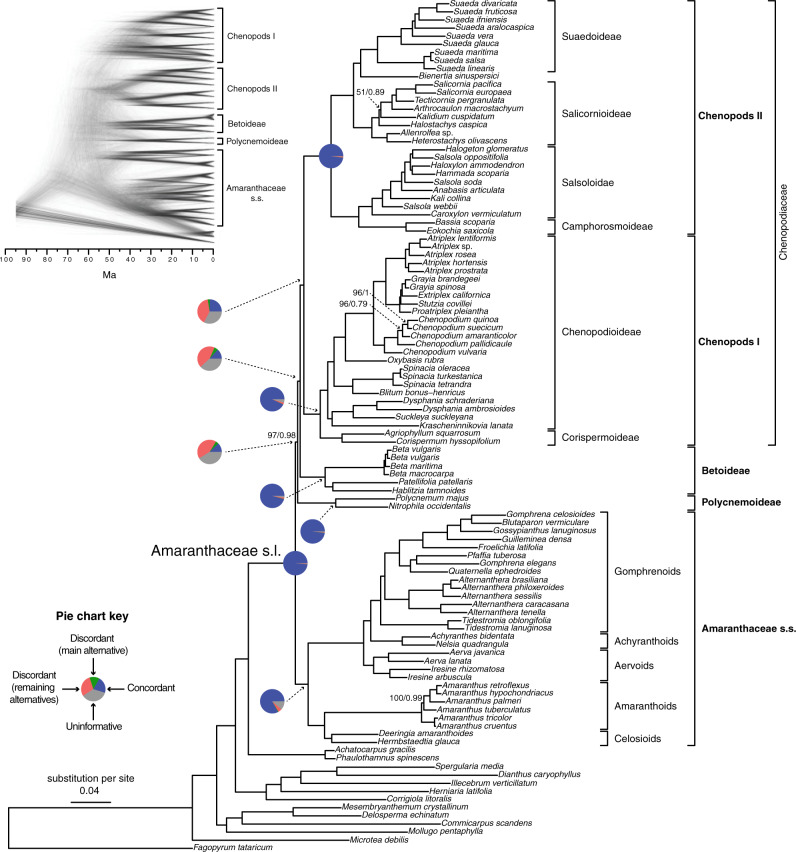
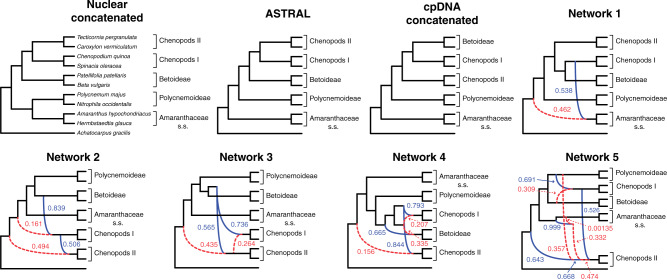
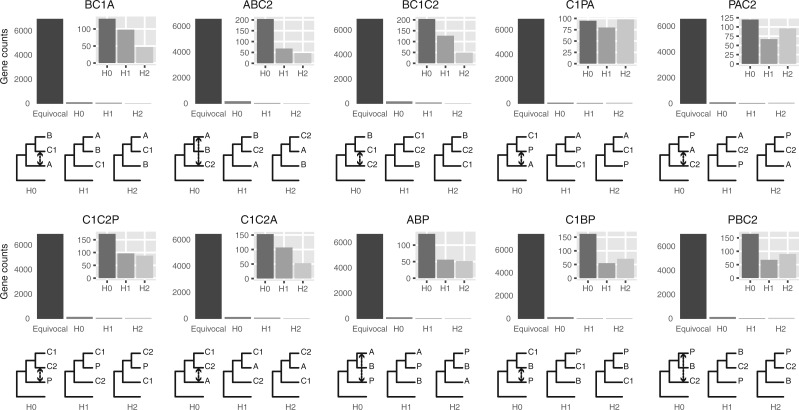
Gene tree discordance in large genomic data sets can be caused by evolutionary processes such as incomplete lineage sorting and hybridization, as well as model violation, and errors in data processing, orthology inference, and gene tree estimation. Species tree methods that identify and accommodate all sources of conflict are not available, but a combination of multiple approaches can help tease apart alternative sources of conflict. Here, using a phylotranscriptomic analysis in combination with reference genomes, we test a hypothesis of ancient hybridization events within the plant family Amaranthaceae s.l. that was previously supported by morphological, ecological, and Sanger-based molecular data. The data set included seven genomes and 88 transcriptomes, 17 generated for this study. We examined gene-tree discordance using coalescent-based species trees and network inference, gene tree discordance analyses, site pattern tests of introgression, topology tests, synteny analyses, and simulations. We found that a combination of processes might have generated the high levels of gene tree discordance in the backbone of Amaranthaceae s.l. Furthermore, we found evidence that three consecutive short internal branches produce anomalous trees contributing to the discordance. Overall, our results suggest that Amaranthaceae s.l. might be a product of an ancient and rapid lineage diversification, and remains, and probably will remain, unresolved. This work highlights the potential problems of identifiability associated with the sources of gene tree discordance including, in particular, phylogenetic network methods. Our results also demonstrate the importance of thoroughly testing for multiple sources of conflict in phylogenomic analyses, especially in the context of ancient, rapid radiations. We provide several recommendations for exploring conflicting signals in such situations. [Amaranthaceae; gene tree discordance; hybridization; incomplete lineage sorting; phylogenomics; species network; species tree; transcriptomics.].
在大型基因组数据集,基因树分歧可能是由进化过程引起的,如不完全谱系分选和杂交,以及模型违反,和数据处理错误,同源推断,和基因树估计。没有可识别和适应所有冲突源的物种树方法,但多种方法的组合可以帮助理清替代冲突源。在这里,我们使用系统发生转录组学分析结合参考基因组,检验了一个关于苋科植物家族内远古杂交事件的假说,该假说以前得到了形态学、生态学和基于 Sanger 的分子数据的支持。该数据集包括七个基因组和 88 个转录组,其中 17 个是为本研究生成的。我们使用基于合并的物种树和网络推断、基因树分歧分析、基因渗入的位点模式测试、拓扑测试、同线性分析和模拟来检查基因树分歧。我们发现,多种过程可能产生了苋科植物家族基因树分歧的高水平。此外,我们发现有证据表明,连续的三个短内部分支产生了异常的树,导致了分歧。总的来说,我们的结果表明,苋科植物家族可能是一个古老而快速的谱系多样化和分支的产物,并且仍然存在,并且可能仍然无法解决。这项工作突出了与基因树分歧源相关的可识别性的潜在问题,包括特别是系统发生网络方法。我们的结果还表明,在系统发生基因组分析中,特别是在远古快速辐射的背景下,彻底测试多种冲突源的重要性。我们提供了一些建议,用于在这种情况下探索冲突信号。[苋科;基因树分歧;杂交;不完全谱系分选;系统发生基因组学;物种网络;物种树;转录组学。]