Earthquake Research Institute, The University of Tokyo.
Proc Jpn Acad Ser B Phys Biol Sci. 2020;96(7):297-315. doi: 10.2183/pjab.96.022.
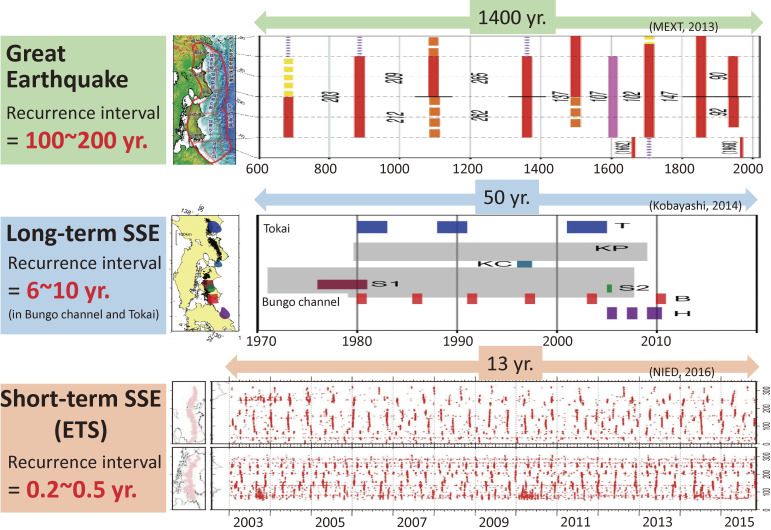
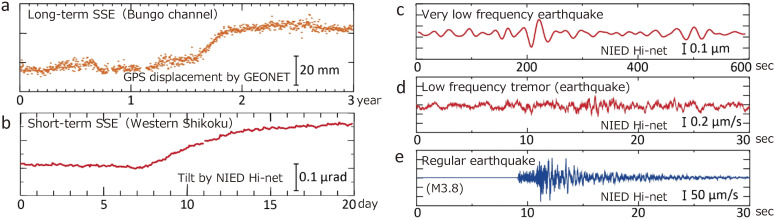
Slow earthquakes are a recently discovered phenomenon that mainly occur updip and downdip of the seismogenic zones of great earthquakes along the subducting plate interface. The spatiotemporal activity of various slow earthquakes occurring in the Nankai subduction zone is characterized by along-strike heterogeneity and along-dip systematic changes. Various slow earthquakes are horizontally distributed at their own depths and along-strike segments can be observed with respect to this distribution downdip of the locked zone; however, slow and great earthquakes occur in the same depth range near the Nankai Trough and Japan Trench axes. The frequently observed spatiotemporal interactions between different slow earthquakes can be attributed to their sensitivity and the stress transfer of the surrounding areas. This stress transfer is expected to extend to the adjacent sections in the seismogenic zone. Therefore, precise monitoring of slow earthquakes is important for future evaluations of great earthquakes, which requires the long-term maintenance and continuous improvement of the high-quality observation networks.
慢地震是最近发现的一种现象,主要发生在沿俯冲板块界面的大地震发震带的上倾和下倾方向。在南海俯冲带发生的各种慢地震的时空活动具有沿走向的非均一性和沿倾向的系统变化。各种慢地震在其自身深度上呈水平分布,并且可以在被锁定区域下倾方向观察到沿走向段相对于该分布的情况;然而,慢地震和大地震在南海槽和日本海沟轴附近的同一深度范围内发生。不同慢地震之间经常观察到的时空相互作用归因于它们的敏感性和周围地区的应力传递。这种应力传递预计将扩展到发震带的相邻部分。因此,对慢地震的精确监测对于未来对大地震的评估很重要,这需要长期维护和不断改进高质量的观测网络。