Wang Jingjun, Li Jinghui, Wang Fengxia, Xiao Jianxin, Wang Yajing, Yang Hongjian, Li Shengli, Cao Zhijun
State Key Laboratory of Animal Nutrition, Beijing Engineering Technology Research Center of Raw Milk Quality and Safety Control, College of Animal Science and Technology, China Agricultural University, Beijing, 100193 PR China.
Department of Animal Science, University of California, Davis, California 95616 USA.
J Anim Sci Biotechnol. 2020 Aug 10;11:79. doi: 10.1186/s40104-020-00485-8. eCollection 2020.
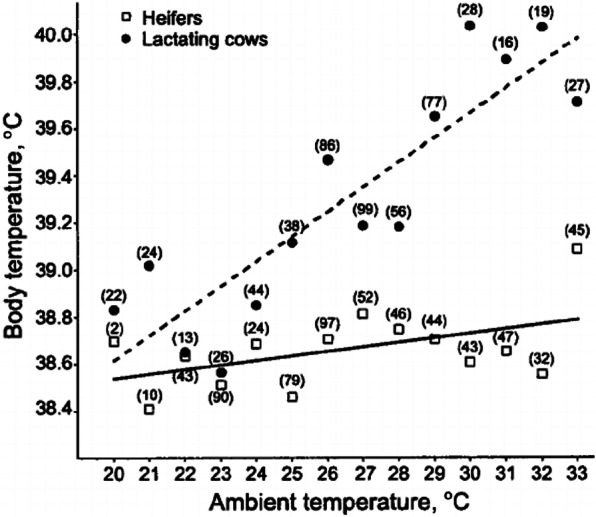
The current review is designed with aims to highlight the impact of heat stress (HS) on calves and heifers and to suggest methods for HS alleviation. HS occurs in animals when heat gain from environment and metabolism surpasses heat loss by radiation, convection, evaporation and conduction. Although calves and heifers are comparatively heat resistant due to less production of metabolic heat and more heat dissipation efficiency, they still suffer from HS to some degree. Dry matter intake and growth performance of calves and heifers are reduced during HS because of redistributing energy to heat regulation through a series of physiological and metabolic responses, such as elevated blood insulin and protein catabolism. Enhanced respiration rate and panting during HS accelerate the loss of CO, resulting in altered blood acid-base chemistry and respiratory alkalosis. HS-induced alteration in rumen motility and microbiota affects the feed digestibility and rumen fermentation. Decreased luteinizing hormone, estradiol and gonadotrophins due to HS disturb the normal estrus cyclicity, depress follicular development, hence the drop in conception rate. Prenatal HS not only suppresses the embryonic development by the impaired placenta, which results in hypoxia and malnutrition, but also retards the growth, immunity and future milk production of newborn calves. Based on the above challenges, we attempted to describe the possible impacts of HS on growth, health, digestibility and reproduction of calves and heifers. Likewise, we also proposed three primary strategies for ameliorating HS consequences. Genetic development and reproductive measures, such as gene selection and embryo transfers, are more likely long-term approaches to enhance heat tolerance. While physical modification of the environment, such as shades and sprinkle systems, is the most common and easily implemented measure to alleviate HS. Additionally, nutritional management is another key approach which could help calves and heifers maintain homeostasis and prevent nutrient deficiencies because of HS.
本综述旨在强调热应激(HS)对犊牛和小母牛的影响,并提出缓解热应激的方法。当动物从环境和新陈代谢中获得的热量超过通过辐射、对流、蒸发和传导散失的热量时,就会发生热应激。尽管犊牛和小母牛由于代谢产热较少和散热效率较高而具有相对较强的耐热性,但它们仍会在一定程度上遭受热应激。在热应激期间,犊牛和小母牛的干物质摄入量和生长性能会降低,因为它们会通过一系列生理和代谢反应,如血液胰岛素升高和蛋白质分解代谢,将能量重新分配用于体温调节。热应激期间呼吸频率加快和喘气会加速二氧化碳的流失,导致血液酸碱化学变化和呼吸性碱中毒。热应激引起的瘤胃蠕动和微生物群变化会影响饲料消化率和瘤胃发酵。热应激导致促黄体生成素(LH)、雌二醇和促性腺激素减少,扰乱正常的发情周期,抑制卵泡发育,从而导致受孕率下降。产前热应激不仅会通过受损的胎盘抑制胚胎发育,导致缺氧和营养不良,还会阻碍新生犊牛的生长、免疫和未来产奶量。基于上述挑战,我们试图描述热应激对犊牛和小母牛生长、健康、消化率和繁殖的可能影响。同样,我们还提出了三种减轻热应激后果的主要策略。遗传发育和繁殖措施,如基因选择和胚胎移植,更有可能是提高耐热性的长期方法。而对环境进行物理改造,如遮阳和喷淋系统,是缓解热应激最常见且易于实施的措施。此外,营养管理是另一个关键方法,它可以帮助犊牛和小母牛维持体内平衡,预防因热应激导致的营养缺乏。