Sección de Parasitología, Instituto de Salud Pública de Chile, Santiago, Región Metropolitana, Chile.
Malaria Branch, Division of Parasitic Diseases and Malaria, Center for Global Health, Centers for Disease Control and Prevention, Atlanta, GA, USA.
Malar J. 2020 Aug 13;19(1):289. doi: 10.1186/s12936-020-03353-y.
Chile is one of the South American countries certified as malaria-free since 1945. However, the recent increase of imported malaria cases and the presence of the vector Anopheles pseudopunctipennis in previously endemic areas in Chile require an active malaria surveillance programme.
Specimens from 268 suspected malaria cases-all imported-collected between 2015 and 2018 at the Public Health Institute of Chile (ISP), were diagnosed by microscopy and positive cases were included for epidemiological analysis. A photo-induced electron transfer fluorogenic primer real-time PCR (PET-PCR) was used to confirm the presence of malaria parasites in available blood samples. Sanger sequencing of drug resistance molecular markers (pfk13, pfcrt and pfmdr1) and microsatellite (MS) analysis were performed in confirmed Plasmodium falciparum samples and results were related to origin of infection.
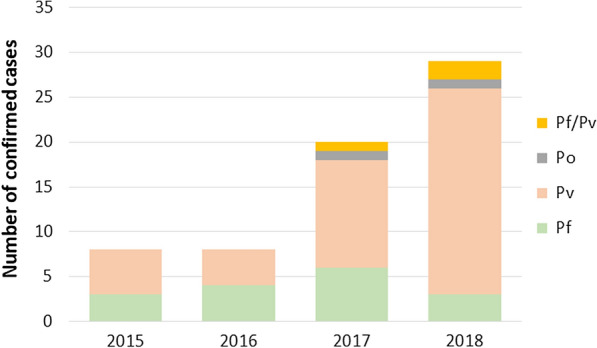
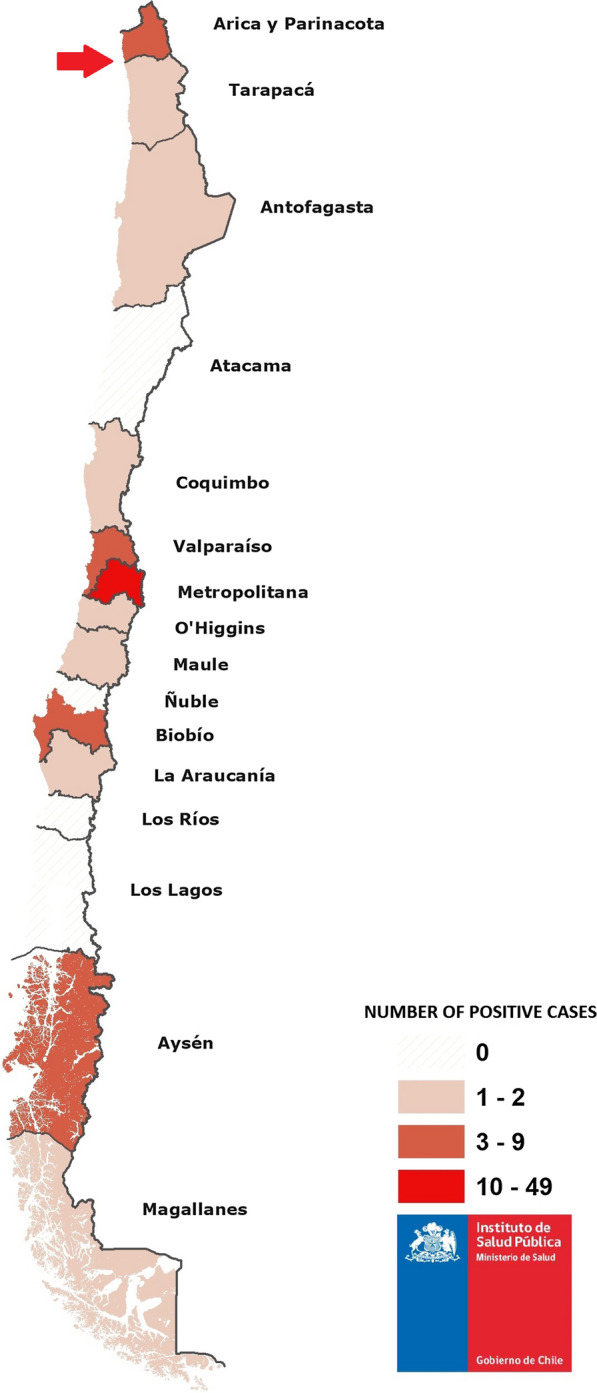
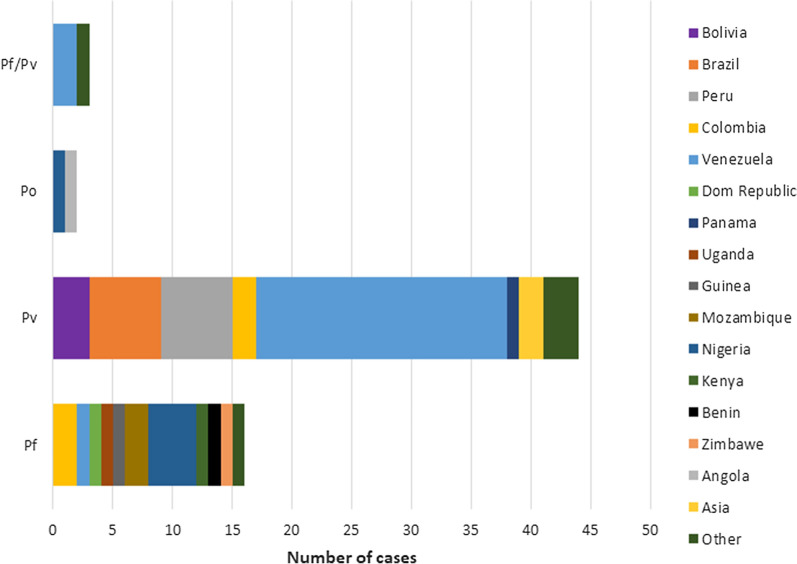
Out of the 268 suspected cases, 65 were Plasmodium spp. positive by microscopy. A total of 63% of the malaria patients were male and 37% were female; 43/65 of the patients acquired infections in South American endemic countries. Species confirmation of available blood samples by PET-PCR revealed that 15 samples were positive for P. falciparum, 27 for Plasmodium vivax and 4 were mixed infections. The P. falciparum samples sequenced contained four mutant pfcrt genotypes (CVMNT, CVMET, CVIET and SVMNT) and three mutant pfmdr1 genotypes (Y184F/S1034C/N1042D/D1246Y, Y184F/N1042D/D1246Y and Y184F). MS analysis confirmed that all P. falciparum samples presented different haplotypes according to the suspected country of origin. Four patients with P. vivax infection returned to the health facilities due to relapses.
The timely detection of polymorphisms associated with drug resistance will contribute to understanding if current drug policies in the country are appropriate for treatment of imported malaria cases and provide information about the most frequent resistant genotypes entering Chile.
智利是自 1945 年以来被认证无疟疾的南美国家之一。然而,最近输入性疟疾病例的增加以及在智利以前流行地区出现媒介按蚊 Anopheles pseudopunctipennis,这都需要一个积极的疟疾监测计划。
2015 年至 2018 年期间,在智利公共卫生研究所(ISP)收集了 268 例疑似疟疾病例(均为输入性病例)的标本,通过显微镜检查进行诊断,并对阳性病例进行了流行病学分析。采用光诱导电子转移荧光引物实时 PCR(PET-PCR)法对现有血样中疟原虫的存在进行了确认。对确认的恶性疟原虫样本进行了耐药分子标记(pfk13、pfcrt 和 pfmdr1)和微卫星(MS)分析,并对其与感染来源进行了相关性分析。
在 268 例疑似病例中,有 65 例经显微镜检查证实为疟原虫阳性。65 例疟疾病例中,男性占 63%,女性占 37%;43/65 例疟疾病例是在南美流行国家感染的。利用 PET-PCR 对现有血样进行物种确认,结果显示 15 份样本为恶性疟原虫阳性,27 份为间日疟原虫阳性,4 份为混合感染。对恶性疟原虫样本进行测序,结果发现有 4 种突变型 pfcrt 基因型(CVMNT、CVMET、CVIET 和 SVMNT)和 3 种突变型 pfmdr1 基因型(Y184F/S1034C/N1042D/D1246Y、Y184F/N1042D/D1246Y 和 Y184F)。MS 分析证实,所有恶性疟原虫样本均根据疑似感染来源国呈现出不同的单倍型。4 例间日疟原虫感染患者因复发而再次返回医疗机构。
及时检测与耐药性相关的多态性,有助于了解该国目前的药物治疗政策是否适合治疗输入性疟疾病例,并为了解进入智利的最常见耐药基因型提供信息。