Iannucci Jaclyn, Renehan William, Grammas Paula
The George and Anne Ryan Institute for Neuroscience, The University of Rhode Island, Kingston, RI, United States.
Department of Biomedical and Pharmaceutical Sciences, College of Pharmacy, The University of Rhode Island, Kingston, RI, United States.
Front Neurosci. 2020 Jul 24;14:762. doi: 10.3389/fnins.2020.00762. eCollection 2020.
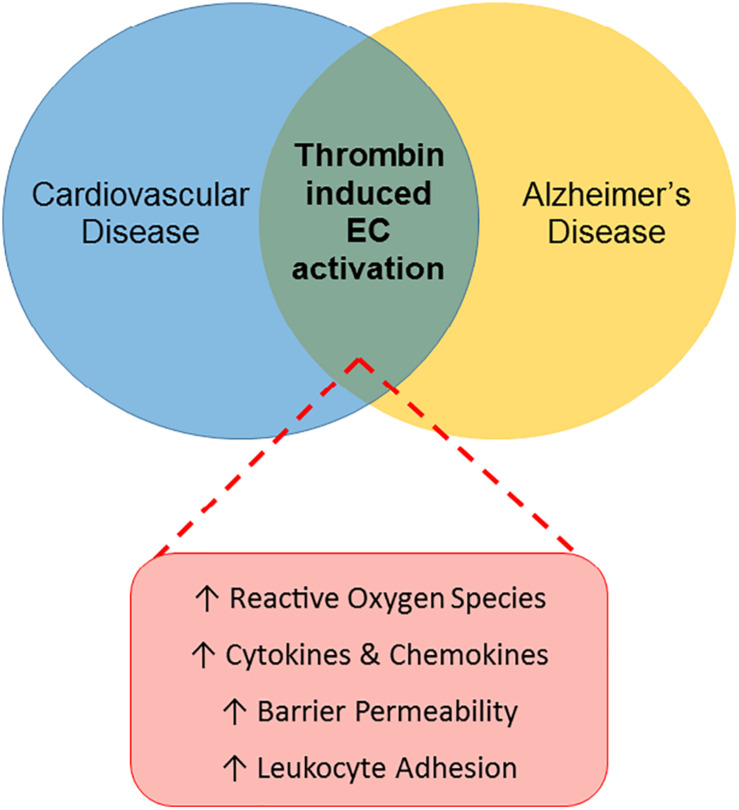
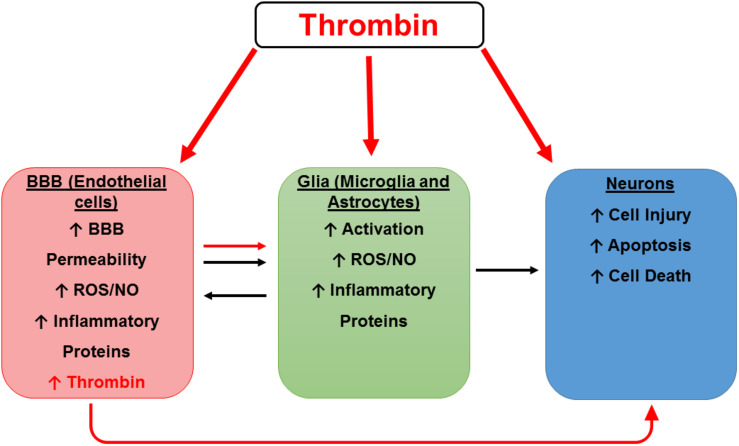
The societal burden of Alzheimer's disease (AD) is staggering, with current estimates suggesting that 50 million people world-wide have AD. Identification of new therapeutic targets is a critical barrier to the development of disease-modifying therapies. A large body of data implicates vascular pathology and cardiovascular risk factors in the development of AD, indicating that there are likely shared pathological mediators. Inflammation plays a role in both cardiovascular disease and AD, and recent evidence has implicated elements of the coagulation system in the regulation of inflammation. In particular, the multifunctional serine protease thrombin has been found to act as a mediator of vascular dysfunction and inflammation in both the periphery and the central nervous system. In the periphery, thrombin contributes to the development of cardiovascular disease, including atherosclerosis and diabetes, by inducing endothelial dysfunction and related inflammation. In the brain, thrombin has been found to act on endothelial cells of the blood brain barrier, microglia, astrocytes, and neurons in a manner that promotes vascular dysfunction, inflammation, and neurodegeneration. Thrombin is elevated in the AD brain, and thrombin signaling has been linked to both tau and amyloid beta, pathological hallmarks of the disease. In AD mouse models, inhibiting thrombin preserves cognition and endothelial function and reduces neuroinflammation. Evidence linking atrial fibrillation with AD and dementia indicates that anticoagulant therapy may reduce the risk of dementia, with targeting thrombin shown to be particularly effective. It is time for "outside-the-box" thinking about how vascular risk factors, such as atherosclerosis and diabetes, as well as the coagulation and inflammatory pathways interact to promote increased AD risk. In this review, we present evidence that thrombin is a convergence point for AD risk factors and as such that thrombin-based therapeutics could target multiple points of AD pathology, including neurodegeneration, vascular activation, and neuroinflammation. The urgent need for disease-modifying drugs in AD demands new thinking about disease pathogenesis and an exploration of novel drug targets, we propose that thrombin inhibition is an innovative tactic in the therapeutic battle against this devastating disease.
阿尔茨海默病(AD)的社会负担惊人,目前估计全球有5000万人患有AD。确定新的治疗靶点是开发疾病修饰疗法的关键障碍。大量数据表明血管病理和心血管危险因素与AD的发生有关,这表明可能存在共同的病理介质。炎症在心血管疾病和AD中均起作用,最近的证据表明凝血系统的成分参与炎症调节。特别是,多功能丝氨酸蛋白酶凝血酶已被发现是外周和中枢神经系统中血管功能障碍和炎症的介质。在外周,凝血酶通过诱导内皮功能障碍和相关炎症,促进包括动脉粥样硬化和糖尿病在内的心血管疾病的发展。在大脑中,已发现凝血酶作用于血脑屏障的内皮细胞、小胶质细胞、星形胶质细胞和神经元,其方式可促进血管功能障碍、炎症和神经退行性变。AD大脑中的凝血酶水平升高,凝血酶信号传导与疾病的病理标志tau和β淀粉样蛋白均有关联。在AD小鼠模型中,抑制凝血酶可保留认知和内皮功能,并减少神经炎症。将心房颤动与AD和痴呆联系起来的证据表明,抗凝治疗可能降低痴呆风险,针对凝血酶的治疗显示出特别有效。现在是时候跳出框框思考动脉粥样硬化和糖尿病等血管危险因素以及凝血和炎症途径如何相互作用以增加AD风险了。在本综述中,我们提供证据表明凝血酶是AD危险因素的汇聚点,因此基于凝血酶的治疗方法可以针对AD病理的多个点,包括神经退行性变、血管激活和神经炎症。AD中对疾病修饰药物的迫切需求要求对疾病发病机制进行新的思考并探索新的药物靶点,我们提出抑制凝血酶是对抗这种毁灭性疾病的治疗斗争中的一种创新策略。