Cullen Danielle, Abel Dori, Attridge Megan, Fein Joel A
Pediatric Emergency Medicine, The Children's Hospital of Philadelphia (D Cullen and JA Fein), Philadelphia, Pa.
New York-Presbyterian Morgan Stanley Children's Hospital (D Abel), New York, NY.
Acad Pediatr. 2021 Apr;21(3):440-445. doi: 10.1016/j.acap.2020.08.005. Epub 2020 Aug 12.
Pediatric health care institutions are increasingly implementing food insecurity (FI) screens, but there is limited information about participant interest in referral and engagement with resources provided.
In this descriptive cross-sectional study, we recruited participants from a consecutive sample of adult caregivers arriving with pediatric patients in the emergency department at an urban, freestanding children's hospital. Caregivers completed a validated, 2-question screen for FI. All participants received a list of food access resources. Direct referral to a partnered community food resource agency was offered to those who screened positive for FI; that agency completed a phone call to the participant for resource provision within 2 weeks.
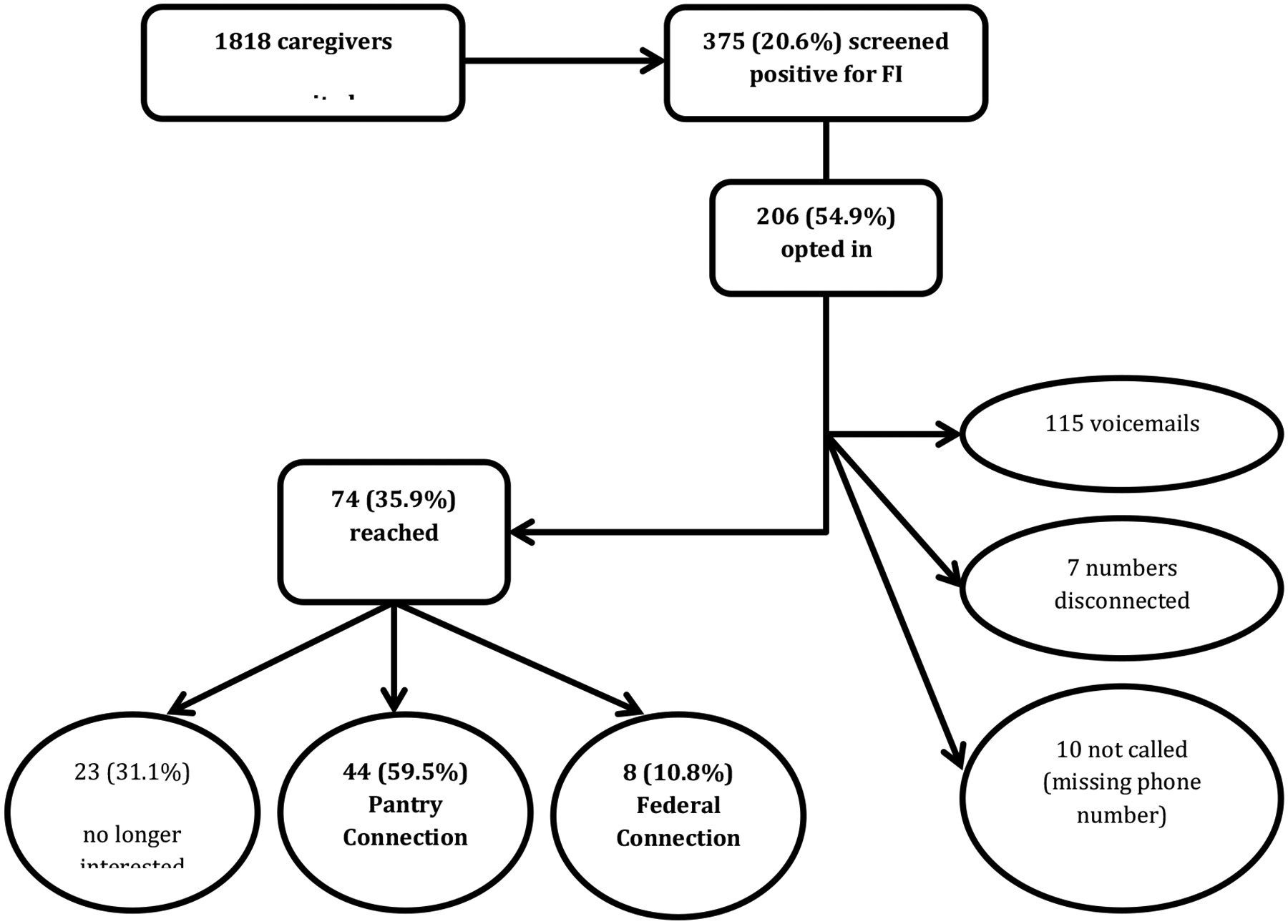
Among the 1818 participants recruited, 20.6% (375) screened positive for FI, consistent with the area's reported child FI rate. Of those who screened positive, 54.9% (206) opted to receive a direct-referral via phone call to a food resource agency, and 35.9% (74) of these were reached by phone. About 31.1% (23) of those contacted were no longer interested in food resource referrals, 10.8% (8) were signed up for the Supplemental Nutrition Assistance Program, and 59.5% (44) were referred to local food pantries.
Through hospital-community partnership in an initial attempt to screen and offer direct-referral for FI, we elicited considerable interest among families for connection to resource agencies. However, there was a substantial gap between referral acceptance and ultimate connection with the resource agency stemming from 2 major sources: inability to re-contact and loss of interest after contact.
儿科医疗机构越来越多地开展粮食不安全(FI)筛查,但关于参与者对转诊的兴趣以及对所提供资源的参与情况的信息有限。
在这项描述性横断面研究中,我们从一家城市独立儿童医院急诊科的儿科患者成年看护者连续样本中招募参与者。看护者完成了一项经过验证的、包含两个问题的FI筛查。所有参与者都收到了一份粮食获取资源清单。对FI筛查呈阳性的参与者提供直接转介至合作社区粮食资源机构的服务;该机构在两周内给参与者打电话提供资源。
在招募的1818名参与者中,20.6%(375名)FI筛查呈阳性,与该地区报告的儿童FI率一致。在筛查呈阳性的参与者中,54.9%(206名)选择通过电话直接转介至粮食资源机构,其中35.9%(74名)接到了电话。在接到电话的人中,约31.1%(23名)不再对粮食资源转介感兴趣,10.8%(8名)已注册参加补充营养援助计划,59.5%(44名)被转介至当地食品救济站。
通过医院与社区的合作,初步尝试对FI进行筛查并提供直接转介服务,我们引发了家庭对与资源机构建立联系的浓厚兴趣。然而,转诊接受与最终与资源机构建立联系之间存在很大差距,主要源于两个主要原因:无法再次联系以及联系后失去兴趣。