Division of Pediatric Nephrology, Department of Pediatrics, Indiana University School of Medicine and Riley Children's Health, Indianapolis, IN, USA.
Department of Pediatrics, University of Washington, Seattle, WA, USA.
BMC Pediatr. 2022 Jul 15;22(1):420. doi: 10.1186/s12887-022-03472-2.
Food insecurity, an important social determinant of health among children, has become more common during the COVID-19 pandemic. Children with chronic diseases including end-stage kidney disease (ESKD) are at higher risk of food insecurity due to their complex care needs, medication burden, and dietary restrictions. No data exists describing food insecurity prevalence in pediatric ESKD patients during the COVID-19 pandemic.
Food insecurity was assessed among families of children (age 0-18 years) with ESKD on chronic dialysis at two pediatric academic medical centers. Families were screened in April 2020 using the Hunger Vital Sign, a validated 2-question screening tool. We assessed impact of COVID-19 on food insecurity. We compared serum phosphorus "pre-COVID" (January/February 2020) to "during COVID" (April/May 2020).
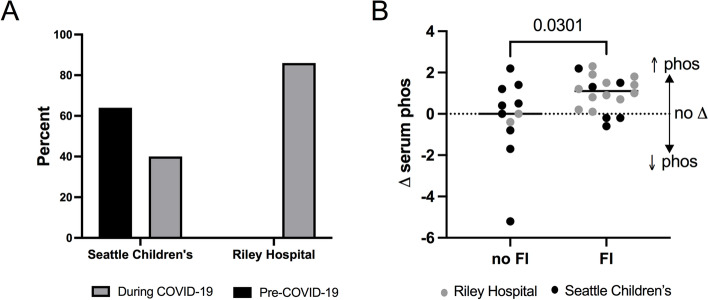
A total of 29 families enrolled in this study. 62% (18/29) of children with ESKD lived in food insecure households, and of those, 72% (13/18) reported that COVID-19 had worsened their food insecurity status. During the COVID-19 pandemic, food insecure patients experienced greater rise in their serum phosphorus levels (1.1 mg/dL vs. 0 mg/dL, p = 0.03) and decreased likelihood of having adequate phosphorus control (50% vs. 11%, p = 0.03).
Food insecurity was common among children with ESKD on chronic dialysis during the COVID-19 pandemic. Children with food insecurity had a greater increase in their phosphorus levels during the pandemic than did food secure children. Further exploration into how food resources such as an onsite food pantry impacts food insecurity and phosphorus control in children with ESKD is essential.
食品不安全是儿童健康的一个重要社会决定因素,在 COVID-19 大流行期间变得更加普遍。患有包括终末期肾病(ESKD)在内的慢性病的儿童由于其复杂的护理需求、药物负担和饮食限制,面临更高的食品不安全风险。目前尚无数据描述 COVID-19 大流行期间儿科 ESKD 患者的食品不安全流行率。
在两家儿科学术医疗中心对接受慢性透析的儿童(0-18 岁)的家庭进行了食品不安全评估。在 2020 年 4 月,使用经过验证的 2 个问题的饥饿生命体征筛查工具对家庭进行了筛查。我们评估了 COVID-19 对食品不安全的影响。我们比较了 COVID 之前(2020 年 1 月/2 月)和 COVID 期间(2020 年 4 月/5 月)的血清磷。
共有 29 个家庭参与了这项研究。62%(18/29)的 ESKD 儿童生活在食品不安全的家庭中,其中 72%(13/18)报告 COVID-19 使他们的食品不安全状况恶化。在 COVID-19 大流行期间,食品不安全患者的血清磷水平升高幅度更大(1.1mg/dL 与 0mg/dL,p=0.03),磷控制达标率降低(50%与 11%,p=0.03)。
在 COVID-19 大流行期间,接受慢性透析的 ESKD 儿童中食品不安全很常见。与食品安全的儿童相比,食品不安全的儿童在大流行期间磷水平升高幅度更大。进一步探索现场食品储藏室等食品资源如何影响 ESKD 儿童的食品不安全和磷控制至关重要。