González-Jiménez María Del Carmen, García-Martínez Teresa, Puig-Pujol Anna, Capdevila Fina, Moreno-García Jaime, Moreno Juan, Mauricio Juan Carlos
Department of Microbiology, University of Cordoba, 14014 Cordoba, Spain.
Department of Enological Research, Institute of Agrifood Research and Technology-Catalan Institute of Vine and Wine (IRTA-INCAVI), Vilafranca del Penedès, 08720 Barcelona, Spain.
Microorganisms. 2020 Aug 11;8(8):1216. doi: 10.3390/microorganisms8081216.
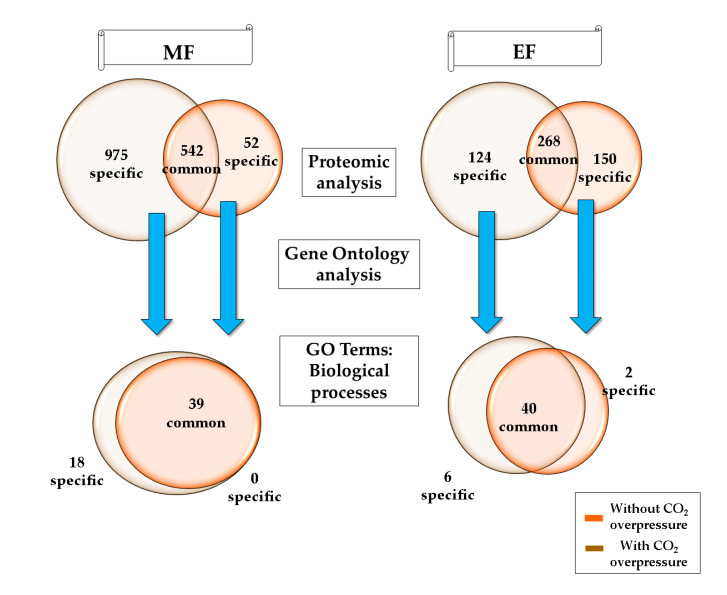
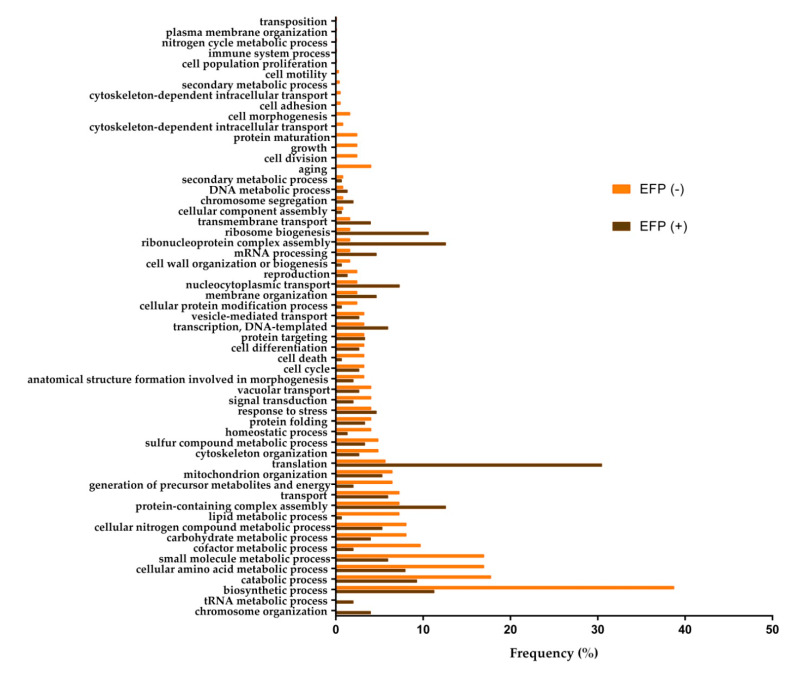
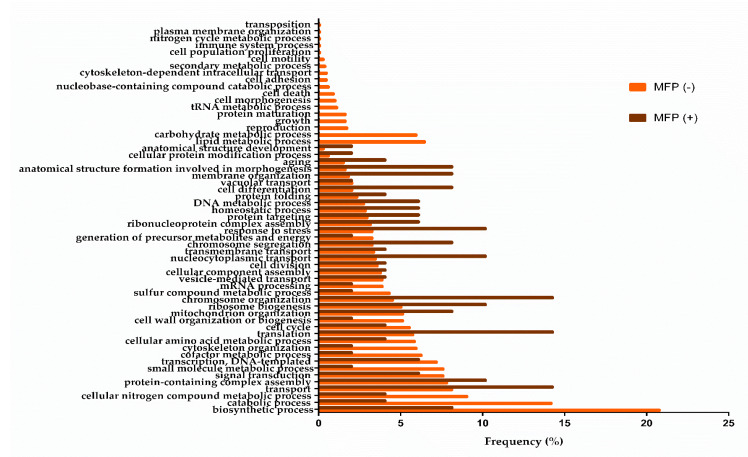
Sparkling wines elaboration has been studied by several research groups, but this is the first report on analysis of biological processes according to the Gene Ontology terms (GO terms) and related to proteins expressed by yeast cells during the second fermentation of sparkling wines. This work provides a comprehensive study of the most relevant biological processes in P29, a sparkling wine strain, during the second fermentation under two conditions (without and with endogenous CO overpressure) in the middle and the end of second fermentation. Consequently, a proteomic analysis with the OFFGEL fractionator and protein identification with LTQ Orbitrap XL coupled to HPLC were performed. The classification of biological processes was carried out using the tools provided by the Genome Database. Results indicate that a greater number of biological processes were identified under condition without CO overpressure and in the middle of the fermentation versus the end of the second fermentation. The biological processes highlighted under condition without CO overpressure in the middle of the fermentation were involved in the carbohydrate and lipid metabolic processes and catabolic and biosynthetic processes. However, under CO overpressure, specific protein expression in response to stress, transport, translation, and chromosome organization and specific processes were not found. At the end of fermentation, there were higher specific processes under condition without CO overpressure; most were related to cell division, growth, biosynthetic process, and gene transcription resulting in increased cell viability in this condition. Under CO overpressure condition, the most representative processes were related to translation as tRNA metabolic process, chromosome organization, mRNA processing, ribosome biogenesis, and ribonucleoprotein complex assembly, probably in response to the stress caused by the hard fermentation conditions. Therefore, a broader knowledge of the adaptation of the yeast, and its behavior under typical conditions to produce sparkling wine, might improve and favor the wine industry and the selection of yeast for obtaining a high-quality wine.
几个研究小组都对起泡酒的酿造过程进行了研究,但这是第一份根据基因本体术语(GO术语)对生物过程进行分析的报告,该分析与起泡酒二次发酵过程中酵母细胞表达的蛋白质有关。这项工作全面研究了起泡酒菌株P29在二次发酵的中期和末期,在两种条件下(无内源性CO超压和有内源性CO超压)二次发酵过程中最相关的生物过程。因此,使用OFFGEL分级仪进行了蛋白质组分析,并使用与HPLC联用的LTQ Orbitrap XL进行了蛋白质鉴定。利用基因组数据库提供的工具对生物过程进行了分类。结果表明,与二次发酵末期相比,在无CO超压条件下且在发酵中期鉴定出的生物过程更多。在发酵中期无CO超压条件下突出的生物过程涉及碳水化合物和脂质代谢过程以及分解代谢和生物合成过程。然而,在CO超压条件下,未发现响应应激、运输、翻译以及染色体组织和特定过程的特异性蛋白质表达。在发酵末期,无CO超压条件下有更多的特定过程;大多数与细胞分裂、生长、生物合成过程和基因转录有关,从而在这种条件下提高了细胞活力。在CO超压条件下,最具代表性的过程与翻译有关,如tRNA代谢过程、染色体组织、mRNA加工、核糖体生物发生和核糖核蛋白复合体组装,这可能是对艰难发酵条件引起的应激的反应。因此,更广泛地了解酵母的适应性及其在生产起泡酒的典型条件下的行为,可能会改善并有利于葡萄酒行业以及用于获得高质量葡萄酒的酵母的选择。