Karna Ranju R, Luxton Todd, Bronstein Katherine E, Redmon Jennifer Hoponick, Scheckel Kirk G
Oak Ridge Institute for Science and Education, Oak Ridge, Tennessee, USA.
United States Environmental Protection Agency, National Risk Management Research Laboratory, Cincinnati, Ohio, USA.
Crit Rev Environ Sci Technol. 2017 Feb 6;47(2):65-129. doi: 10.1080/10643389.2016.1275417.
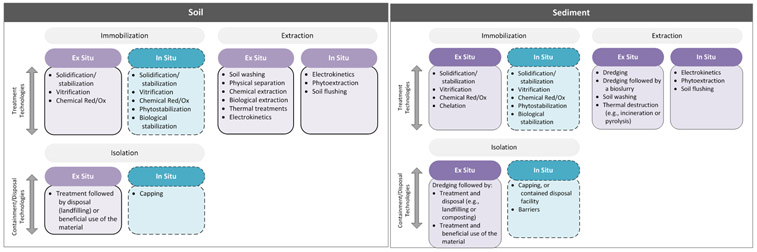
Metal and metalloid contamination of soil and sediment is a widespread problem both in urban and rural areas throughout the United States (U.S. EPA, 2014). Beneficial use of waste by-products as amendments to remediate metal-contaminated soils and sediments can provide major economic and environmental advantages on both a site-specific and national scale. These waste by-products can also reduce our need to mine virgin materials or produce synthetic materials for amendments. Waste by-products must not be hazardous or pose unacceptable risk to human health and the environment, and should be a suitable replacement for virgin and synthetic materials. This review serves to present the state of science on in situ remediation of metal-contaminated soil and sediment and the potential for beneficial usage of waste by-product materials. Not all unintended consequences can be fully understood or predicted prior to implementing a treatment option, however some realized, and potentially unrealized, benefits and unintended consequences are explored.
在美国城乡地区,土壤和沉积物的金属及类金属污染是一个普遍存在的问题(美国环境保护局,2014年)。将废弃副产品用作修复金属污染土壤和沉积物的改良剂,在特定场地和全国范围内都能带来重大的经济和环境效益。这些废弃副产品还能减少我们开采原生材料或生产合成材料用于改良的需求。废弃副产品不得具有危险性,也不得对人类健康和环境构成不可接受的风险,并且应是原生材料和合成材料的合适替代品。本综述旨在介绍金属污染土壤和沉积物原位修复的科学现状以及废弃副产品材料的有益利用潜力。并非所有意外后果在实施处理方案之前都能被完全理解或预测,不过本文探讨了一些已实现的以及潜在未实现的益处和意外后果。