Mo Kangnan, Shang Jinbiao, Wang Kejing, Gu Jialei, Wang Peng, Nie Xilin, Wang Wendong
Department of Head and Neck Surgery, Cancer Hospital of University of Chinese Academy of Sciences (Zhejiang Cancer Hospital), No. 1 Banshan Road (East), Gongshu, Hangzhou 310022, China.
Department of Head and Neck Surgery, Institute of Cancer and Basic Medicine (IBMC), Chinese Academy of Sciences, No. 1 Banshan Road (East), Gongshu, Hangzhou 310022, China.
Int J Endocrinol. 2020 Aug 1;2020:7189857. doi: 10.1155/2020/7189857. eCollection 2020.
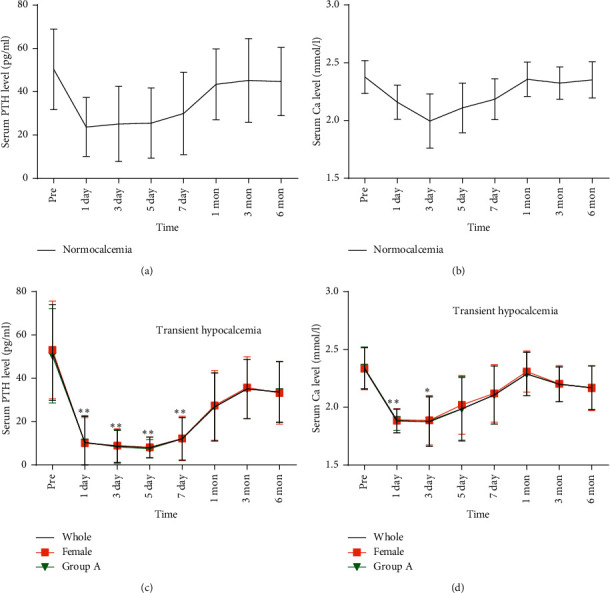
We performed this study to investigate the risk factors for postoperative hypocalcemia after total thyroidectomy with central lymph node dissection (CLND). . This was a single-center prospective study based on 176 consecutive patients who underwent total thyroidectomy for papillary thyroid carcinoma. . Patients were recruited between January 2016 and June 2018. . Patients who underwent bilateral ( = 155, bilateral group) and ipsilateral CLND ( = 21) after total thyroidectomy were included. The preoperative and postoperative parathyroid hormone (PTH) and calcium levels were detected. The risk factors for transient hypocalcemia were identified using logistic regression analysis and receiver operating characteristic (ROC) curve analysis.
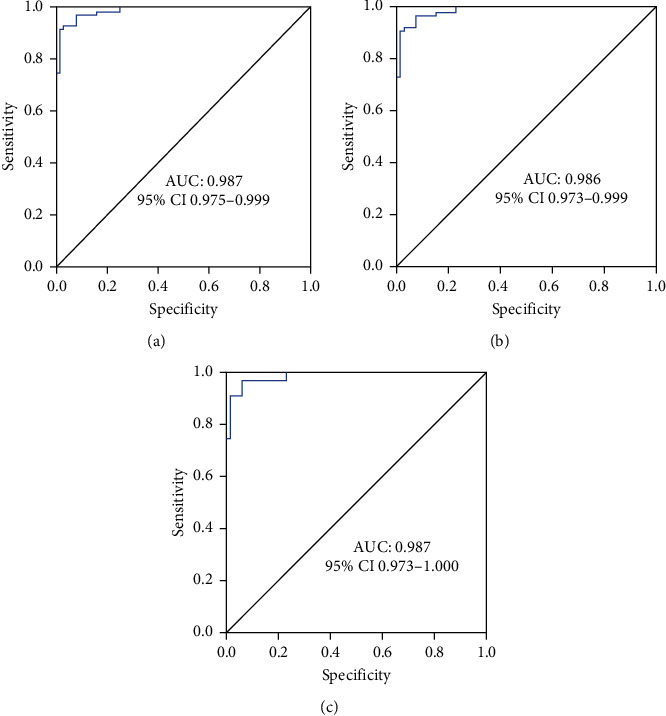
Fifty-one (28.98%) patients developed transient hypocalcemia, and 2 patients (1.14%) developed permanent hypoparathyroidism. There was no difference in the gender ratio or the morbidity of hypocalcemia between the patients who underwent bilateral and ipsilateral CLND. On postoperative day 1, PTH decrease was a risk factor for transient hypocalcemia in the whole cohort ( = 0.043, OR = 1.044, 95% CI 1.023-1.065, < 0.001), bilateral group ( = 0.042, OR = 1.043, 95% CI 1.022-1.064, < 0.001), and female patients ( = 0.049, OR = 1.050, 95% CI 1.026-1.075, < 0.001). Tumor diameter was a risk factor for transient hypocalcemia in female patients ( = 0.499, OR = 1.647, 95% CI 1.003-2.704, =0.049). The ROC curve analysis illustrated that 65.58%, 71.00%, and 71.00% PTH level reduction had high accuracy in predicting transient hypocalcemia in the whole cohort, bilateral group, and female patients, respectively (AUC = 0.986, 0.987, and 0.987).
Asymptomatic female patients with bilateral CLND and a 71.00% PTH level reduction were at a high risk of transient hypocalcemia.
我们开展本研究以调查甲状腺全切除术联合中央区淋巴结清扫术(CLND)后发生术后低钙血症的危险因素。 这是一项单中心前瞻性研究,基于176例连续接受甲状腺全切除术治疗甲状腺乳头状癌的患者。 患者于2016年1月至2018年6月期间入组。 纳入甲状腺全切除术后接受双侧(n = 155,双侧组)和同侧CLND(n = 21)的患者。检测术前和术后甲状旁腺激素(PTH)及血钙水平。采用逻辑回归分析和受试者工作特征(ROC)曲线分析确定短暂性低钙血症的危险因素。
51例(28.98%)患者发生短暂性低钙血症,2例(1.14%)患者发生永久性甲状旁腺功能减退。接受双侧和同侧CLND的患者在性别比例或低钙血症发病率方面无差异。术后第1天,PTH降低是整个队列(P = 0.043,OR = 1.044,95%CI 1.023 - 1.065,P < 0.001)、双侧组(P = 0.042,OR = 1.043,95%CI 1.022 - 1.064,P < 0.001)及女性患者(P = 0.049,OR = 1.050,95%CI 1.026 - 1.075,P < 0.001)发生短暂性低钙血症的危险因素。肿瘤直径是女性患者发生短暂性低钙血症的危险因素(P = 0.499,OR = 1.647,95%CI 1.003 - 2.704,P = 0.049)。ROC曲线分析表明,PTH水平降低65.58%、71.00%和71.00%分别在预测整个队列、双侧组及女性患者短暂性低钙血症方面具有较高准确性(AUC = 0.986、0.987和0.987)。
无症状的接受双侧CLND且PTH水平降低71.00%的女性患者发生短暂性低钙血症的风险较高。