Department of Gynecology, The Third Affiliated Hospital of Sun Yat-sen University, Guangzhou 510630, China.
Dis Markers. 2020 Jul 27;2020:7415056. doi: 10.1155/2020/7415056. eCollection 2020.
This study was to compare the efficacy and safety between neoadjuvant chemotherapy followed by radical surgery (NACT+RS) and radiotherapy only (RT) or concurrent chemoradiotherapy (CCRT) for treatment of patients with stage IB2, IIA, or IIB cervical cancer.
The electronic databases of PubMed, Embase, and the Cochrane Library were searched to screen relevant studies from their inception to October 2018. Clinical data including overall survival (OS), disease-free survival (DFS), and adverse events were extracted. Egger's test was used to evaluate the publication bias, and sensitivity analysis was conducted to estimate the robustness of results.
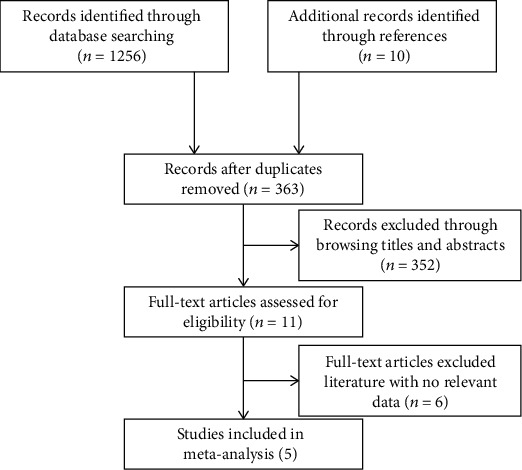
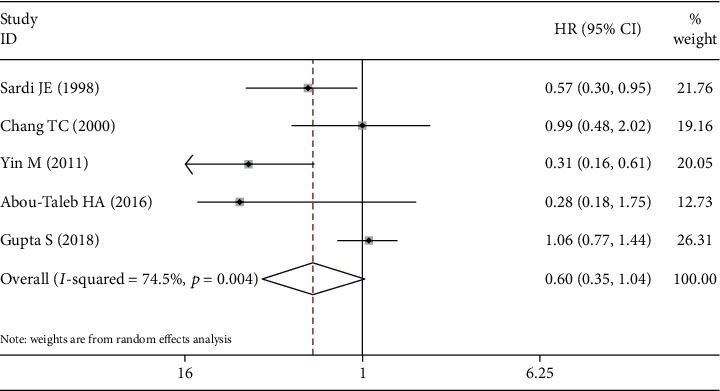
Finally, three randomized controlled trials (RCTs) and two case-control studies consisting of 1,275 patients with stage IB2, IIA, or IIB cervical cancer were included in the current study. Overall, pooled results showed no significant differences in OS ((hazard ratio (HR) = 0.603, 95%CI = 0.350 - 1.038) and DFS (HR = 0.678, 95%CI = 0.242 - 1.904) for patients treated with NACT+RS compared with RT only or CCRT, but the subgroup analysis showed that the OS and DFS were significantly longer in the NACT+RS groups than the RT or CCRT group (OS: HR = 0.431, 95%CI = 0.238 - 0.781, = 0.006; DFS: HR = 0.300, 95%CI = 0.187 - 0.482, < 0.001) for the population with median follow-up time of more than 60 months. For adverse events, the incidence of thrombocytopenia in the NACT+RS group was significantly higher than that in the RT only or CCRT group (relative risk (RR) = 3.240, 95% CI 1.575-6.662), while the incidence of diarrhea was significantly lower than that in the RT only or CCRT group (RR = 0.452, 95% CI =0.230-0.890).
These findings suggest that the short-term therapeutic effects of the two treatments may be possibly equal for patients with stage IB2-IIB cervical cancer, but the long-term effects for improving OS and DFS may be better using NACT+RS compared with the RT only or CCRT.
本研究旨在比较新辅助化疗后根治性手术(NACT+RS)与单纯放疗(RT)或同期放化疗(CCRT)治疗 IB2 期、IIA 期或 IIB 期宫颈癌患者的疗效和安全性。
检索 PubMed、Embase 和 Cochrane 图书馆的电子数据库,从建库至 2018 年 10 月筛选相关研究。提取总生存(OS)、无病生存(DFS)和不良事件等临床数据。采用 Egger 检验评估发表偏倚,并进行敏感性分析以估计结果的稳健性。
最终纳入 3 项随机对照试验(RCT)和 2 项病例对照研究,共纳入 1275 例 IB2 期、IIA 期或 IIB 期宫颈癌患者。总体而言,汇总结果显示,与 RT 或 CCRT 相比,NACT+RS 治疗患者的 OS(风险比[HR] = 0.603,95%CI = 0.350-1.038)和 DFS(HR = 0.678,95%CI = 0.242-1.904)无显著差异,但亚组分析显示,NACT+RS 组的 OS 和 DFS 明显长于 RT 或 CCRT 组(OS:HR = 0.431,95%CI = 0.238-0.781, = 0.006;DFS:HR = 0.300,95%CI = 0.187-0.482, < 0.001),随访时间中位数超过 60 个月。对于不良反应,NACT+RS 组血小板减少症的发生率明显高于 RT 或 CCRT 组(相对风险[RR] = 3.240,95%CI 1.575-6.662),而腹泻的发生率明显低于 RT 或 CCRT 组(RR = 0.452,95%CI = 0.230-0.890)。
这些发现提示,对于 IB2 期- IIB 期宫颈癌患者,两种治疗方法的短期疗效可能相当,但 NACT+RS 长期提高 OS 和 DFS 的效果可能优于 RT 或 CCRT。