
非侵入性外周神经刺激可选择性增强成年人的言语类别学习能力。
Non-invasive peripheral nerve stimulation selectively enhances speech category learning in adults.
作者信息
Llanos Fernando, McHaney Jacie R, Schuerman William L, Yi Han G, Leonard Matthew K, Chandrasekaran Bharath
机构信息
Department of Communication Science and Disorders, University of Pittsburgh, Pittsburgh, PA 15260 USA.
Neurological Surgery, University of California, San Francisco, San Francisco, CA 94143 USA.
出版信息
NPJ Sci Learn. 2020 Aug 6;5:12. doi: 10.1038/s41539-020-0070-0. eCollection 2020.
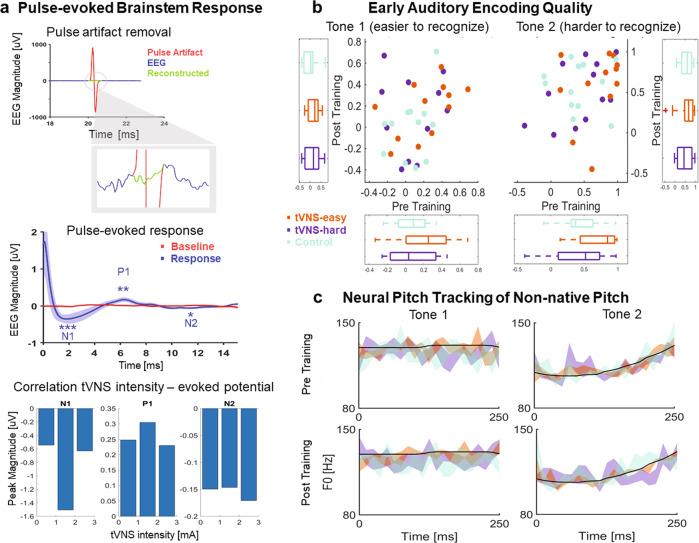
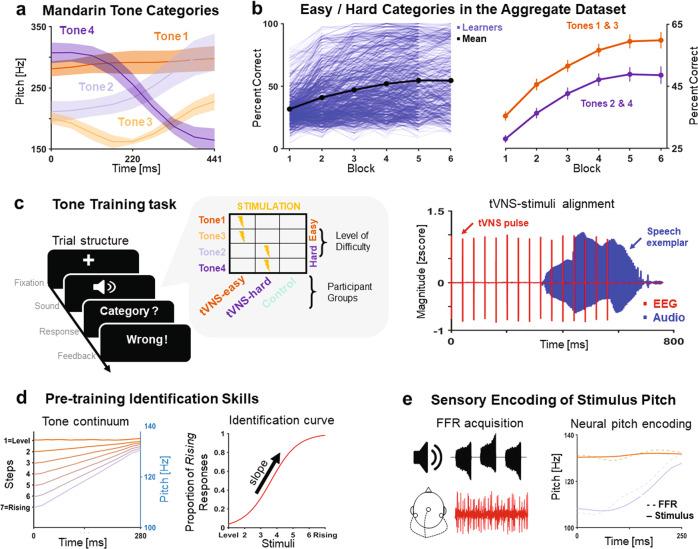
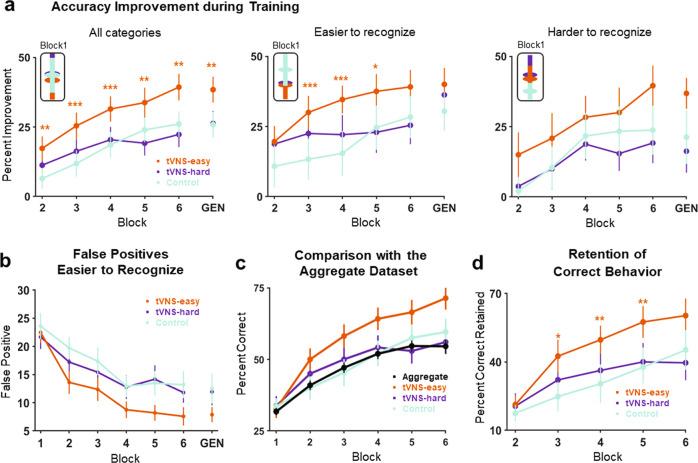
Adults struggle to learn non-native speech contrasts even after years of exposure. While laboratory-based training approaches yield learning, the optimal training conditions for maximizing speech learning in adulthood are currently unknown. Vagus nerve stimulation has been shown to prime adult sensory-perceptual systems towards plasticity in animal models. Precise temporal pairing with auditory stimuli can enhance auditory cortical representations with a high degree of specificity. Here, we examined whether sub-perceptual threshold transcutaneous vagus nerve stimulation (tVNS), paired with non-native speech sounds, enhances speech category learning in adults. Twenty-four native English-speakers were trained to identify non-native Mandarin tone categories. Across two groups, tVNS was paired with the tone categories that were easier- or harder-to-learn. A control group received no stimulation but followed an identical thresholding procedure as the intervention groups. We found that tVNS robustly enhanced speech category learning and retention of correct stimulus-response associations, but only when stimulation was paired with the easier-to-learn categories. This effect emerged rapidly, generalized to new exemplars, and was qualitatively different from the normal individual variability observed in hundreds of learners who have performed in the same task without stimulation. Electroencephalography recorded before and after training indicated no evidence of tVNS-induced changes in the sensory representation of auditory stimuli. These results suggest that paired-tVNS induces a temporally precise neuromodulatory signal that selectively enhances the perception and memory consolidation of perceptually salient categories.
即使经过多年接触,成年人学习非母语语音对比仍很困难。虽然基于实验室的训练方法能带来学习效果,但目前尚不清楚成年期实现语音学习最大化的最佳训练条件。在动物模型中,迷走神经刺激已被证明能使成年动物的感觉-知觉系统向可塑性转变。与听觉刺激进行精确的时间配对可以高度特异性地增强听觉皮层表征。在此,我们研究了与非母语语音配对的阈下经皮迷走神经刺激(tVNS)是否能增强成年人的语音类别学习。24名以英语为母语的人接受了识别非母语普通话声调类别的训练。在两组中,tVNS与较易或较难学习的声调类别配对。一个对照组未接受刺激,但遵循与干预组相同的阈值设定程序。我们发现,tVNS有力地增强了语音类别学习以及对正确刺激-反应关联的记忆,但仅当刺激与较易学习的类别配对时才会如此。这种效应迅速出现,能推广到新的示例,并且在性质上不同于在数百名未接受刺激而执行相同任务的学习者中观察到的正常个体差异。训练前后记录的脑电图表明,没有证据显示tVNS会引起听觉刺激感觉表征方面的变化。这些结果表明,配对tVNS会诱发一种时间精确的神经调节信号,该信号能选择性地增强对感知突出类别的感知和记忆巩固。
 Zotero 插件