Li Yang, Gao Erji, Yang Yi, Gao Zongli, He Weiwei, Zhao Yonghong, Wu Weiming, Zhao Tiancheng, Guo Xiang
Department of Thoracic surgery, Shanghai Jiaotong University Affiliated Sixth People's Hospital, Shanghai, China.
J Thorac Dis. 2020 Jul;12(7):3706-3714. doi: 10.21037/jtd-19-2586.
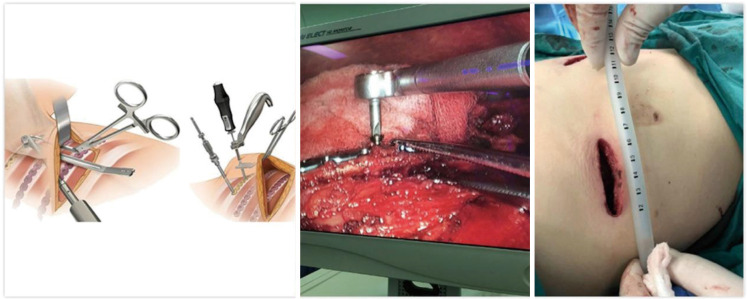
To evaluate therapeutic efficacy of minimally invasive and small incision surgery [minimally invasive surgery (MIS)] in patients with non-flail chest rib fractures through a prospective cohort study.
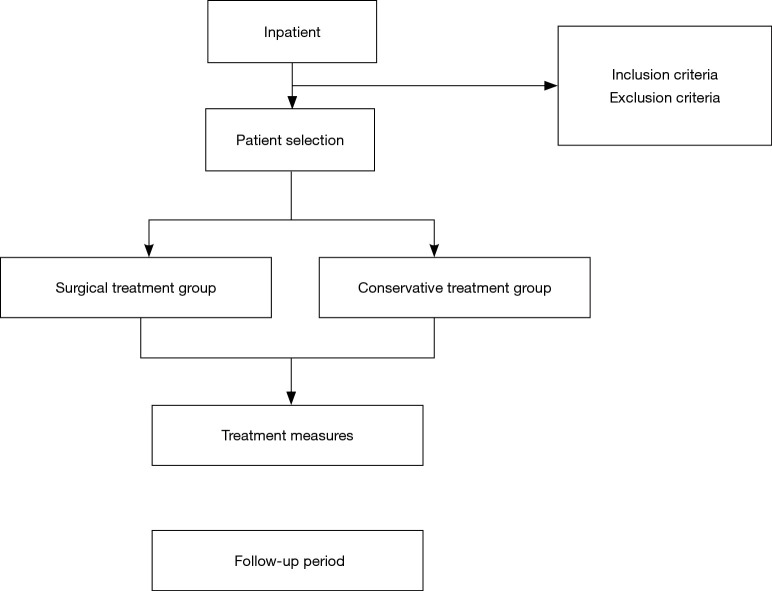
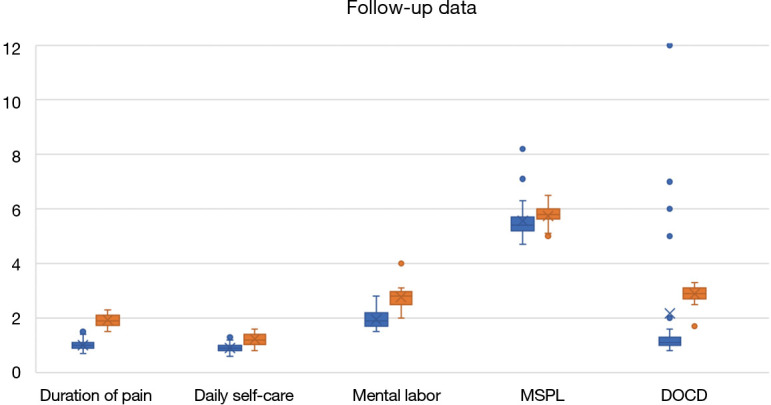
This study included 98 patients with non-flail chest rib fractures (≥3 displaced fractures) and 66 patients undergoing MIS served as the experimental group and 32 patients receiving conservative treatment served as the matched control group. Pain index and indicators of pulmonary function [vital capacity (VC); forced expiratory volume in one second (FEV1); peak expiratory flow (PEF)] for the two groups were assessed and compared at the time of admission and before discharge. In addition, duration of pain, time required for the patient to regain the ability to perform daily self-care, mental labor, and moderate-to-severe physical labor, and duration of chest discomfort were measured during long-term follow-up and compared between the two groups.
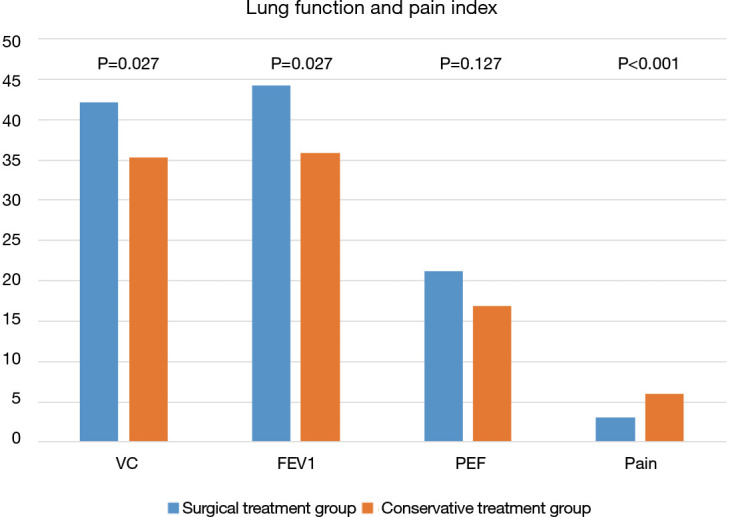
There were also no significant differences (P>0.05) in pain index (8 . 8) or indicators of pulmonary function (VC: 31.0% . 26.5%; FEV1: 29.9% . 26.7%; PEF: 15.2% . 12.0%) were found between the MIS and conservative treatment groups at the time of admission; while pain index (3 . 6), VC (42.1% . 35.3%), and FEV1 (44.2% 35.9%) were significantly different between the two groups (P<0.05) but not in PEF (21.2% . 19.6%) before discharge. Long-term follow-up showed that duration of pain, time required for the patient to regain the ability to engage in daily self-care, mental labor, and moderate-to-severe physical labor, and duration of chest discomfort in the MIS group were significantly more improved than in the conservative treatment group (P<0.05).
MIS was a simple and safe treatment that significantly relieved chest pain and rapidly restored pulmonary function and improved the long-term quality of life of patients with non-flail chest rib fractures of ≥3 ribs with displacement.
通过一项前瞻性队列研究评估微创和小切口手术[微创手术(MIS)]治疗非连枷胸肋骨骨折患者的疗效。
本研究纳入98例非连枷胸肋骨骨折(≥3处移位骨折)患者,其中66例行MIS手术的患者作为实验组,32例接受保守治疗的患者作为匹配对照组。在入院时和出院前对两组患者的疼痛指数和肺功能指标[肺活量(VC)、一秒用力呼气容积(FEV1)、呼气峰值流速(PEF)]进行评估和比较。此外,在长期随访期间测量两组患者的疼痛持续时间、患者恢复日常自理能力、脑力劳动以及中度至重度体力劳动能力所需的时间,以及胸部不适的持续时间,并进行比较。
入院时,MIS组与保守治疗组在疼痛指数(8.8)或肺功能指标(VC:31.0%.26.5%;FEV1:29.9%.26.7%;PEF:15.2%.12.0%)方面也无显著差异(P>0.05);而出院时,两组间疼痛指数(3.6)、VC(42.1%.35.3%)和FEV1(44.2%.35.9%)存在显著差异(P<0.05),但PEF(21.2%.19.6%)无显著差异。长期随访显示,MIS组的疼痛持续时间、患者恢复日常自理能力、脑力劳动以及中度至重度体力劳动能力所需的时间,以及胸部不适的持续时间均比保守治疗组有显著改善(P<0.05)。
MIS是一种简单安全的治疗方法,能显著缓解胸痛,快速恢复肺功能,改善≥3根肋骨移位的非连枷胸肋骨骨折患者的长期生活质量。