Department of Surgery, University Medical Center Utrecht, PO Box 85500, 3508 GA, Utrecht, The Netherlands.
Utrecht Traumacenter, Utrecht, The Netherlands.
Eur J Trauma Emerg Surg. 2019 Aug;45(4):645-654. doi: 10.1007/s00068-018-1009-5. Epub 2018 Sep 18.
Rib fixation for flail chest has been shown to improve in-hospital outcome, but little is known about treatment for multiple rib fractures and long-term outcome is scarce. The aim of this study was to describe the safety, long-term quality of life, and implant-related irritation after rib fixation for flail chest and multiple rib fractures.
All adult patients with blunt thoracic trauma who underwent rib fixation for flail chest or multiple rib fractures between January 2010 and December 2016 in our level 1 trauma facility were retrospectively included. In-hospital characteristics and implant removal were obtained via medical records and long-term quality of life was assessed over the telephone.
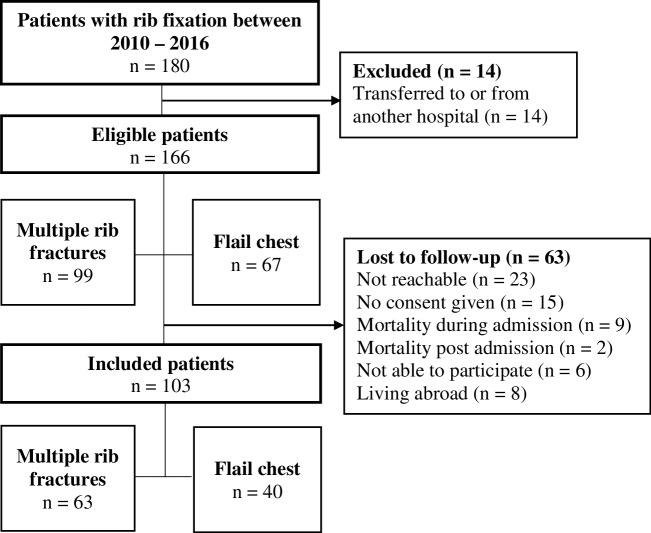
Of the 864 patients admitted with ≥ 3 rib fractures, 166 (19%) underwent rib fixation; 66 flail chest patients and 99 multiple rib fracture patients with an ISS of 24 (IQR 18-34) and 21 (IQR 16-29), respectively. Overall, the most common complication was pneumonia (n = 58, 35%). Six (9%) patients with a flail chest and three (3%) with multiple rib fractures died, only one because of injuries related to the thorax. On average at 3.9 years, follow-up was obtained from 103 patients (62%); 40 with flail chest and 63 with multiple rib fractures reported an EQ-5D index of 0.85 (IQR 0.62-1) and 0.79 (0.62-0.91), respectively. Forty-eight (48%) patients had implant-related irritation and nine (9%) had implant removal.
We show that rib fixation is a safe procedure and that patients reported a relative good quality of life. Patients should be counseled that after rib fixation approximately half of the patients will experience implant-related irritation and about one in ten patients requires implant material removal.
研究表明,肋骨固定术可改善连枷胸患者的院内转归,但对于多发性肋骨骨折的治疗方法及其长期转归知之甚少。本研究旨在描述连枷胸和多发性肋骨骨折患者行肋骨固定术的安全性、长期生活质量和与植入物相关的刺激情况。
回顾性纳入 2010 年 1 月至 2016 年 12 月期间在我院 1 级创伤中心因连枷胸或多发性肋骨骨折接受肋骨固定术的所有成年患者。通过病历获取患者的院内特征和植入物取出情况,通过电话评估长期生活质量。
在 864 例至少有 3 处肋骨骨折的入院患者中,有 166 例(19%)接受了肋骨固定术;66 例连枷胸患者和 99 例多发性肋骨骨折患者的 ISS 分别为 24(IQR 18-34)和 21(IQR 16-29)。总体而言,最常见的并发症是肺炎(n=58,35%)。6 例连枷胸患者和 3 例多发性肋骨骨折患者死亡,只有 1 例是与胸部损伤相关的死亡。平均随访 3.9 年,共获得 103 例(62%)患者的随访资料;40 例连枷胸患者和 63 例多发性肋骨骨折患者的 EQ-5D 指数分别为 0.85(IQR 0.62-1)和 0.79(0.62-0.91)。48 例(48%)患者存在与植入物相关的刺激,9 例(9%)患者进行了植入物取出。
我们表明,肋骨固定术是一种安全的治疗方法,患者报告的生活质量相对较好。应告知患者,肋骨固定术后约有一半的患者会出现与植入物相关的刺激,约十分之一的患者需要取出植入物材料。