Fortaleza General Hospital (HGF), Rua Ávila Goularte, 900, Fortaleza, Ceará, 60150-160, Brazil.
Grupo Américas, São Paulo, SP, Brazil.
Breast Cancer Res Treat. 2020 Nov;184(2):637-647. doi: 10.1007/s10549-020-05877-y. Epub 2020 Aug 16.
The COVID-19 pandemic has impacted early breast cancer (EBC) treatment worldwide. This study analyzed how Brazilian breast specialists are managing EBC.
An electronic survey was conducted with members of the Brazilian Society of Breast Cancer Specialists (SBM) between April 30 and May 11, 2020. Bivariate analysis was used to describe changes in how specialists managed EBC at the beginning and during the pandemic, according to breast cancer subtype and oncoplastic surgery.
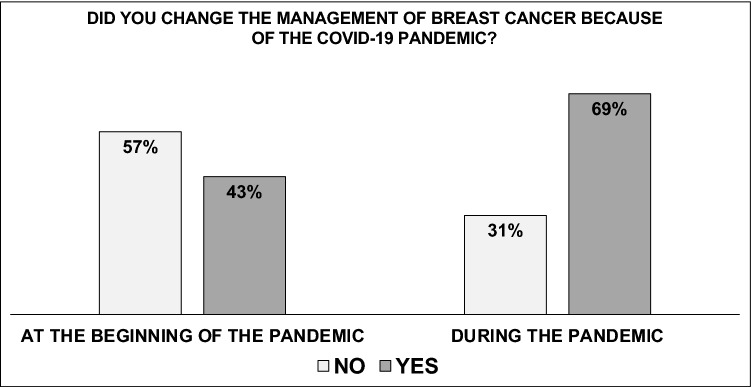
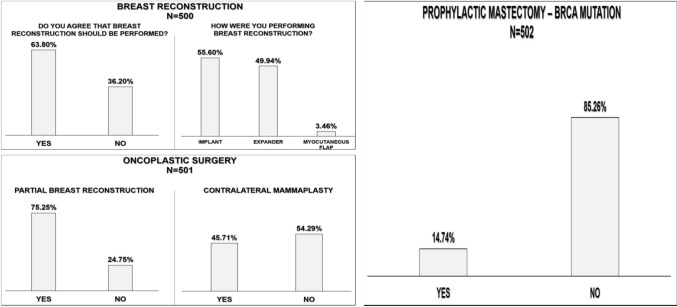
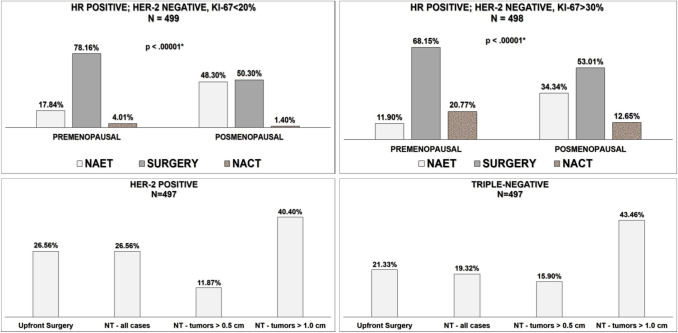
The response rate was 34.4% (503/1462 specialists). Most of the respondents (324; 64.4%) lived in a state capital city, were board-certified as breast specialists (395; 78.5%) and either worked in an academic institute or one associated with breast cancer treatment (390; 77.5%). The best response rate was from the southeast of the country (240; 47.7%) followed by the northeast (128; 25.4%). At the beginning of the pandemic, 43% changed their management approach. As the outbreak progressed, this proportion increased to 69.8% (p < 0.001). The southeast of the country (p = 0.005) and the state capital cities (p < 0.001) were associated with changes at the beginning of the pandemic, while being female (p = 0.001) was associated with changes during the pandemic. For hormone receptor-positive tumors with the best prognosis (Ki-67 < 20%), 47.9% and 17.7% of specialists would recommend neoadjuvant endocrine therapy for postmenopausal and premenopausal women, respectively. For tumors with poorer prognosis (Ki-67 > 30%), 34% and 10.9% would recommend it for postmenopausal and premenopausal women, respectively. Menopausal status significantly affected whether the specialists changed their approach (p < 0.00001). For tumors ≥ 1.0 cm, 42.9% of respondents would recommend neoadjuvant systemic therapy for triple-negative tumors and 39.6% for HER2 + tumors. Overall, 63.4% would recommend immediate total breast reconstruction, while only 3.4% would recommend autologous reconstruction. In breast-conserving surgery, 75% would recommend partial breast reconstruction; however, 54.1% would contraindicate mammoplasty. Furthermore, 84.9% of respondents would not recommend prophylactic mastectomy in cases of BRCA mutation.
Important changes occurred in EBC treatment, particularly for hormone receptor-positive tumors, as the outbreak progressed in each region. Systematic monitoring could assure appropriate breast cancer treatment, mitigating the impact of the pandemic.
COVID-19 大流行对全球早期乳腺癌(EBC)的治疗产生了影响。本研究分析了巴西乳腺专家如何管理 EBC。
2020 年 4 月 30 日至 5 月 11 日,对巴西乳腺肿瘤专家协会(SBM)的成员进行了电子调查。根据乳腺癌亚型和肿瘤整形手术,采用双变量分析来描述专家在大流行开始时和大流行期间管理 EBC 的方式的变化。
应答率为 34.4%(503/1462 名专家)。大多数受访者(324;64.4%)居住在州首府,具有乳腺专家认证(395;78.5%),并且在学术机构或与乳腺癌治疗相关的机构工作(390;77.5%)。该国东南部(240;47.7%)的回复率最高,其次是东北部(128;25.4%)。在大流行开始时,43%的人改变了治疗方法。随着疫情的发展,这一比例增加到 69.8%(p<0.001)。东南部(p=0.005)和州首府城市(p<0.001)与大流行开始时的变化相关,而女性(p=0.001)与大流行期间的变化相关。对于激素受体阳性且预后最佳(Ki-67<20%)的肿瘤,分别有 47.9%和 17.7%的专家建议绝经后和绝经前女性进行新辅助内分泌治疗。对于预后较差(Ki-67>30%)的肿瘤,分别有 34%和 10.9%的专家建议绝经后和绝经前女性进行新辅助内分泌治疗。绝经期状态显著影响专家改变其治疗方法(p<0.00001)。对于≥1.0cm 的肿瘤,42.9%的受访者建议对三阴性肿瘤和 39.6%的 HER2+肿瘤进行新辅助全身治疗。总体而言,63.4%的人会建议立即进行全乳房重建,而只有 3.4%的人会建议进行自体重建。在保乳手术中,75%的人会建议部分乳房重建;但是,54.1%的人会禁忌乳房成形术。此外,84.9%的受访者不会建议在 BRCA 突变的情况下进行预防性乳房切除术。
随着每个地区疫情的发展,EBC 的治疗方法发生了重要变化,尤其是激素受体阳性肿瘤。系统监测可以确保适当的乳腺癌治疗,减轻大流行的影响。