Department of Gastroenterology and Hepatology, Radboud University Medical Center, Geert Grooteplein Zuid 10, 6500 HB, Nijmegen, The Netherlands.
Surg Endosc. 2021 Jul;35(7):3564-3571. doi: 10.1007/s00464-020-07819-7. Epub 2020 Aug 17.
A novel self-assembling peptide (SAP) can be applied to the post-endoscopic mucosal resection (EMR) defect to treat oozing bleedings. It has been suggested to stimulate early healing of damaged vessels. We hypothesized that SAP application could prevent delayed bleeding (DB) after EMR and performed a prospective cohort study to determine feasibility and safety.
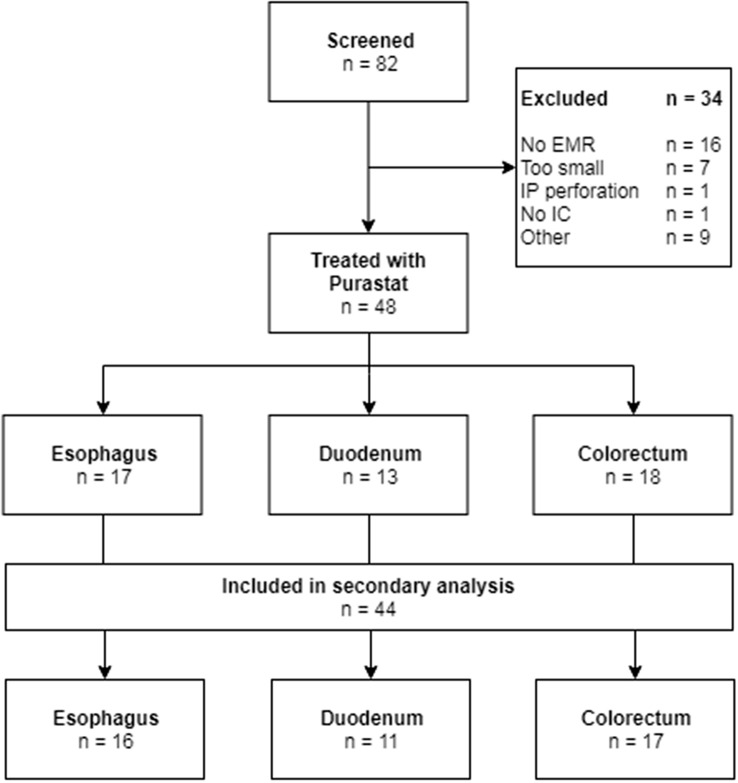
A total of 48 consecutive patients who underwent EMR between June 2018 and August 2019 for large lesions in the esophagus, duodenum (> 1 cm) or colorectum (> 2 cm) were treated with adjuvant SAP application. Duration and ease of SAP application were measured, as well as DB outcome.
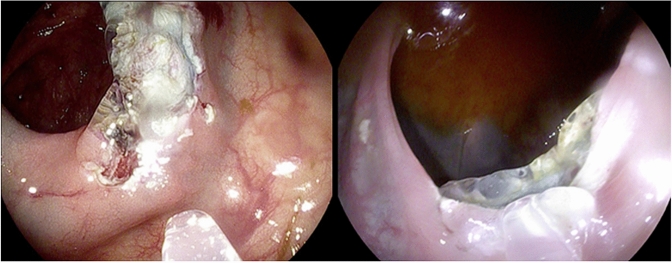
The EMR defects of 48 patients were treated with SAP; 17 in the esophagus, 13 in the duodenum and 18 in the colorectum. SAP was easy to apply on the EMR defect with a median duration of 2.0 min. A dose of 3 cc was generally enough to cover a defect between 10 and 50 mm. An exploratory analysis of the prophylactic ability of SAP showed that 15.9% of patients (7/44) treated with SAP still had a DB, mostly in the duodenum (4/11). No adverse events related to gel exposure were reported.
SAP application after EMR was found to be feasible and safe, and did not delay the procedure; however, DB was still relatively common. Future comparative studies are needed to evaluate whether SAP is able to reduce DB after EMR, particularly for lesions with an increased bleeding risk, such as in the duodenum.
一种新型自组装肽(SAP)可应用于内镜黏膜切除(EMR)术后的缺损处,以治疗渗血。它被认为可以刺激受损血管的早期愈合。我们假设 SAP 的应用可以预防 EMR 后迟发性出血(DB),并进行了一项前瞻性队列研究以确定其可行性和安全性。
2018 年 6 月至 2019 年 8 月,我们对 48 例因食管、十二指肠(> 1cm)或结直肠(> 2cm)大病变而接受 EMR 的连续患者采用 SAP 辅助治疗。测量 SAP 应用的持续时间和容易程度,以及 DB 的结果。
48 例患者的 EMR 缺损均采用 SAP 治疗;食管 17 例,十二指肠 13 例,结直肠 18 例。SAP 很容易应用于 EMR 缺损,平均持续时间为 2.0 分钟。一般来说,3cc 的剂量足以覆盖 10 至 50mm 的缺损。对 SAP 预防能力的探索性分析表明,SAP 治疗组 15.9%(7/44)的患者仍有 DB,主要发生在十二指肠(4/11)。未报告与凝胶暴露相关的不良事件。
EMR 后 SAP 的应用被发现是可行和安全的,且不会延迟手术;然而,DB 仍然相对常见。未来需要进行比较研究,以评估 SAP 是否能够减少 EMR 后的 DB,特别是对于十二指肠等出血风险增加的病变。