Zou Min, Barmaz Yves, Preovolos Melissa, Popko Leszek, Ménard Timothé
F. Hoffmann-La Roche AG, 4070, Basel, Switzerland.
Ther Innov Regul Sci. 2021 Jan;55(1):190-196. doi: 10.1007/s43441-020-00205-4. Epub 2020 Aug 17.
The European Medicines Agency Good Pharmacovigilance Practices (GVP) guidelines provide a framework for pharmacovigilance (PV) audits, including limited guidance on risk assessment methods. Quality assurance (QA) teams of large and medium sized pharmaceutical companies generally conduct annual risk assessments of the PV system, based on retrospective review of data and pre-defined impact factors to plan for PV audits which require a high volume of manual work and resources. In addition, for companies of this size, auditing the entire "universe" of individual entities on an annual basis is generally prohibitive due to sheer volume. A risk assessment approach that enables efficient, temporal, and targeted PV audits is not currently available.
In this project, we developed a statistical model to enable holistic and efficient risk assessment of certain aspects of the PV system. We used findings from a curated data set from Roche operational and quality assurance PV data, covering a span of over 8 years (2011-2019) and we modeled the risk with a logistic regression on quality PV risk indicators defined as data stream statistics over sliding windows.
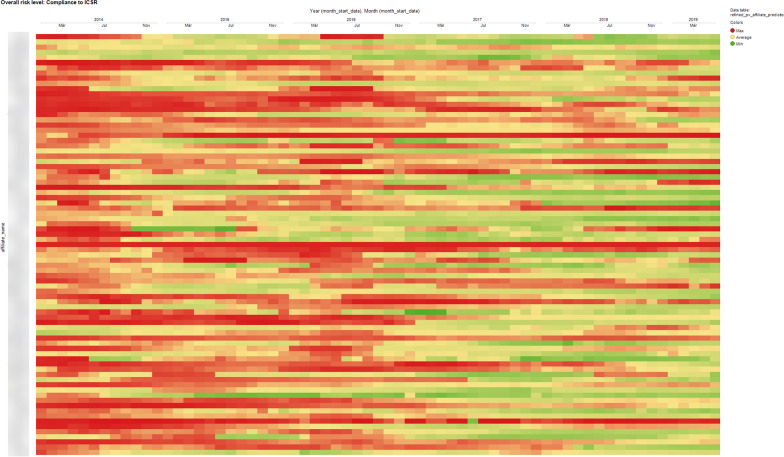
We produced a model for each PV impact factor (e.g. 'Compliance to Individual Case Safety Report') for which we had enough features. For PV impact factors where modeling was not feasible, we used descriptive statistics. All the outputs were consolidated and displayed in a QA dashboard built on Spotfire.
The model has been deployed as a quality decisioning tool available to Roche Quality professionals. It is used, for example, to inform the decision on which affiliates (i.e. pharmaceutical company commercial entities) undergo audit for PV activities. The model will be continuously monitored and fine-tuned to ensure its reliability.
欧洲药品管理局药品不良反应监测规范(GVP)指南为药品不良反应监测(PV)审计提供了一个框架,其中包括对风险评估方法的有限指导。大中型制药公司的质量保证(QA)团队通常基于对数据的回顾性审查和预先定义的影响因素,对PV系统进行年度风险评估,以规划需要大量人工和资源的PV审计。此外,对于这种规模的公司来说,由于数量庞大,每年对所有个体实体进行审计通常是不切实际的。目前尚无一种能够实现高效、及时且有针对性的PV审计的风险评估方法。
在本项目中,我们开发了一种统计模型,以对PV系统某些方面进行全面且高效的风险评估。我们使用了罗氏运营和质量保证PV数据的精选数据集的结果,该数据集涵盖了8年多的时间(2011 - 2019年),并使用逻辑回归对定义为滑动窗口上数据流统计量的质量PV风险指标进行风险建模。
我们为每个有足够特征的PV影响因素(例如“对个体病例安全报告的合规性”)生成了一个模型。对于无法进行建模的PV影响因素,我们使用描述性统计。所有输出结果都进行了整合,并显示在基于Spotfire构建的QA仪表板中。
该模型已作为一种质量决策工具供罗氏质量专业人员使用。例如,它用于为决定哪些子公司(即制药公司商业实体)接受PV活动审计提供信息。该模型将持续受到监测并进行微调,以确保其可靠性。